 Netwrck
Fantasy.
The lake with no shore
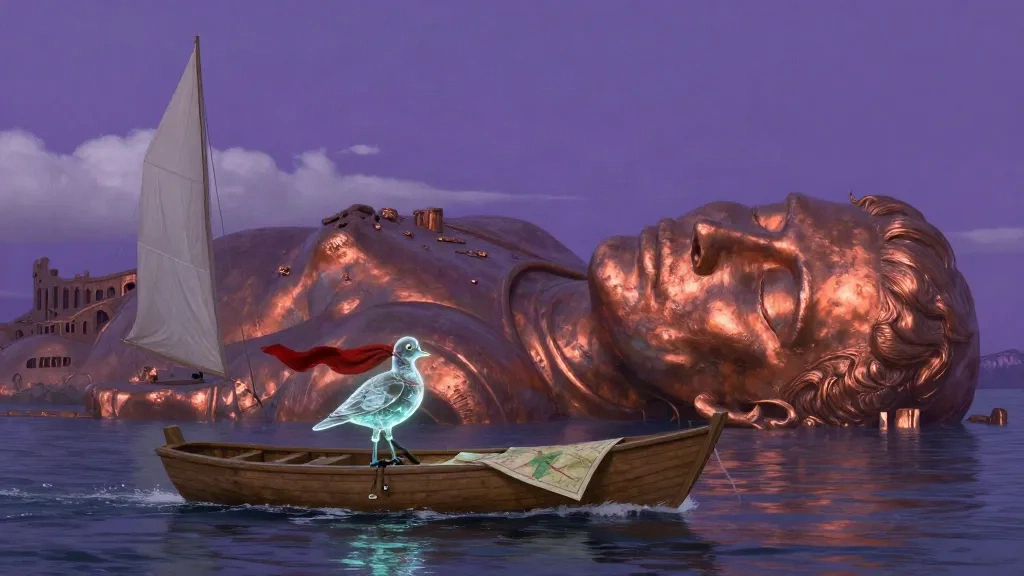
At low tide, the lake appears beneath the village. It lies inside the ribs of the sleeping giant, a long silver basin between the curved bones, and the ferryman lowers his boat with two copper bells tied to its bow.
He is called Neri, though the villagers have long since forgotten whether that was his name or the name of the river. Each dawn they bring him a request: a sealed letter, a jealous bride, a message to someone who drowned before the giant opened his eyes. Neri carries them across the low-tide water and brings back only what the water permits.
On the morning he finally accepts the ferryman’s commission, he carries no passenger.
At his belt rests a glass bird. Its wings are chipped, its body clouded by old rain, and it shines with a pale blue flame when the lake is absent. Around his neck he has tied a red scarf, though he cannot remember receiving it. The villagers say it was found in the giant’s ear. They say many things. Their memories are patient creatures, and they have learned to survive by changing shape.
The map that would not stay honest
The map is drawn on hide, with islands marked in violet ink. It shows every passage between the ribs, every submerged doorway, every place where a person might vanish without leaving a wake.
At its center is a white mark shaped like an eye.
Neri’s employer, a mapmaker with copper spectacles, tells him the mark is a person. The map will guide him to the one who remembers the original version of the world, before the giant dreamed the village into his bones.
“Use it honestly,” the mapmaker says, “and it will show you the truth.”
Neri takes the map to the lake. The first crossing is simple. The second is not. When he aligns the hide with the violet dusk, the island nearest his boat slides into the western rib. A channel opens beneath the hull, and the glass bird warms against Neri’s chest.
He folds the map and tries again. The channels rearrange. A stair climbs down through solid bone. A current runs uphill. The white eye moves from one page to another.
Each time Neri speaks the truth of where he wants to go, the map alters itself. When he lies, it burns a black line through his hands.
The shortest route is the one the map makes impossible.
By evening he has crossed seven false lakes and found seven versions of the same shore. In one, the giant is awake. In another, the village is built above ground and the ribs are only fences. In the third, the water is gone, leaving the bones white and empty.
The witness in the cloud
Near the far end of the lake, Neri finds an old woman beneath a cloud-white sail. She is repairing a boat with a needle made from frozen lightning. She remembers the world before the giant slept: the green fields, the uncrowned sky, the names of rivers spoken by children.
She remembers, too, the first mapmaker, who tried to preserve every truth in one honest chart.
“That is why it changes,” she says. “The world was never one version. It changed whenever someone demanded a single correct path.”
She points to the white eye on the map. “You are looking for the first person, not the last witness.”
The map writhes in Neri’s hands. A storm rises inside the giant’s ribs, pressing the lake into a narrow black seam. The glass bird begins to sing.
Neri understands then. The person who remembers the original world is not hidden beyond the lake. The person is the lake, preserving every honest account without deciding which one is true. The map cannot lead him there because a map must choose a route. A life cannot.
He tears the hide in two. The two halves drift apart. The storm dies. Beneath them, the water becomes clear, and the giant’s vast shadow opens like a door.
Low tide, rising home
At dawn, Neri returns to the village with the glass bird and the red scarf. The lake is already fading into the sand, but its surface holds one last reflection: a road crossing a country of open fields beneath an enormous blue sky.
He does not know whether the reflection is memory or possibility. He knows only that the ferryman’s work is not to return the world to its first shape, but to keep a way across between its changing versions.
That evening, the mapmaker asks whether the map was truthful.
Neri places the two torn halves on the table.
“It was honest,” he says. “That is why it could not remain one thing.”
Outside, the violet dusk deepens over the ribs of the sleeping giant. Somewhere beneath the village, water touches bone, and the glass bird turns once toward the dark.





