 Netwrck
Science Fiction.
The lake at low tide
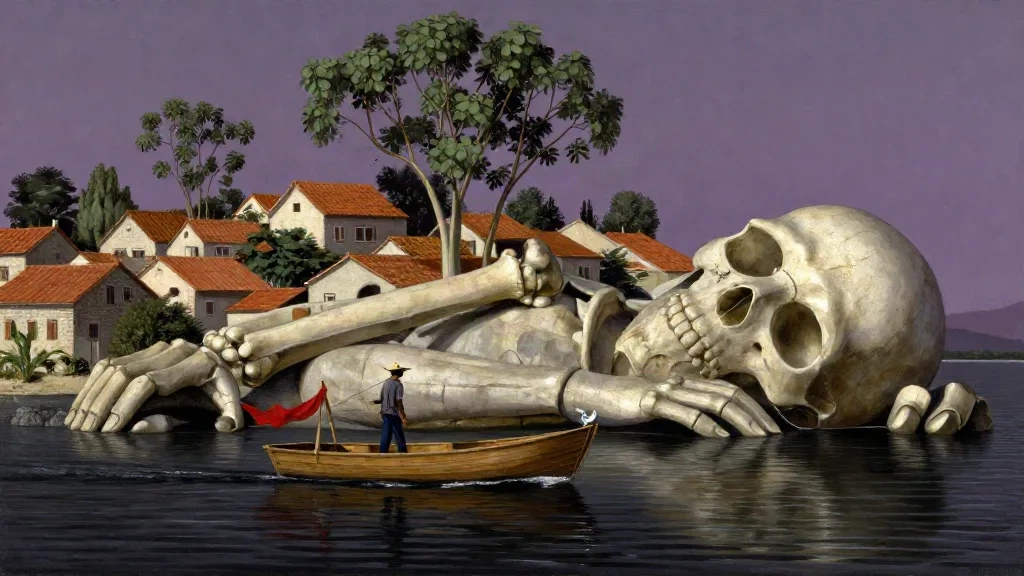
Mara had rowed the lake nine hundred times, but only the lowest tides admitted it. The water appeared between the giant’s ribs, a black mirror winding beneath the village, its surface polished by a wind that did not touch the terracotta roofs or the eucalyptus trees above. At noon, the lake vanished. At dusk, the giant’s bones creaked, and the children were told not to listen.
Mara kept the ferry anyway. Her boat had a red scarf tied around the stern post, faded to the color of old brick, and a glass bird hung from the bow. The bird had been her mother’s. Its tiny wings were flawless, though no one could remember seeing it fly.
That morning, a white-robed surveyor placed a map in Mara’s hand.
“The original shore,” the surveyor said. “Cross before the tide turns. Find the person who remembers the world before the correction.”
Mara folded the map. The paper was warm, as if it had been held near a lamp. When she looked again, a new road ran from the ferry landing into a wall of rib bone.
A map that refuses the truth
At the first narrowing, Mara unfolded the map. The road aligned with the passage, and she rowed toward a dark inlet where egrets stood on submerged stones.
The bird struck the boat’s side.
Not glass against wood: a sharp living cry. Mara looked down. The glass bird had turned its head, its beak aimed at a seam in the giant’s rib.
She unfolded the map again. The road was gone. In its place was a circle around the ferry itself.
“Honesty,” the surveyor had said, “is the only compass it respects.”
So Mara told the map what she knew. The lake had been there before the village. The village had been raised around the lake. The giant had been asleep before either existed. With every sentence, the paper changed. Rivers became ladders. The ferry landing became a stair descending into darkness.
At last, the map showed one mark: a red scarf on a distant shore.
The witness in the white house
Mara found a white house where the giant’s shoulder rose like a cliff. An old woman sat on its porch, combing black hair from a white sheet. Beside her rested a second glass bird, its wings cracked and filled with red sand.
“You came with the old map,” the woman said.
“I came for the original world.”
The woman laughed without warmth. “Which one?”
She lifted the broken bird. “The world before the sky was burned. Before the giant fell. Before we decided the lake belonged to us.”
Mara held out her mother’s bird. The two figures touched. A clear note rang through the ribs, and the village disappeared.
Mara saw the world before the correction: a green plain, a bright river, and thousands of people carrying seeds toward a distant coast. There was no giant. There was no lake. There was no village.
Then the white house returned, and the old woman was gone.
What the water remembers
The tide began to rise. Mara rowed hard, but the map snapped open in her hands. Every route pointed toward the sleeping giant’s heart.
She understood then. The map changed because it could not show a world someone tried to possess. It had led her to the witness. The witness had shown her the truth. The truth was not a place to return to.
Mara tore the map into strips and fed them to the water.
The lake rose around the boat, filling the ribcage, lifting it level with the village roofs. Her red scarf loosened and floated away, a small red flame against the black water. The glass bird remained in her hand.
Far below, the old woman’s broken bird began to sing. Mara’s glass bird answered. Between their voices, the ribs opened, and the lake poured out across the plain.
By morning, the water was gone. The village stood inside the giant, and no map could be found.
Mara stayed at the landing. Whenever the tide fell, she rowed across the hidden lake, carrying people who asked for vanished roads. She never claimed to know the original world. She only remembered that every shore can be crossed, and that some journeys begin where the honest path disappears.





