 Netwrck
Fantasy.
The Tide’s Door
Neral earned his living at low tide.
Every morning, when the lake withdrew from the village, he pushed his flat boat across the exposed basin and carried salt, seed, letters, and gossip between the stone piers. When the water returned, the lake vanished beneath the moss, and Neral returned home by the old road through the giant’s ribs.
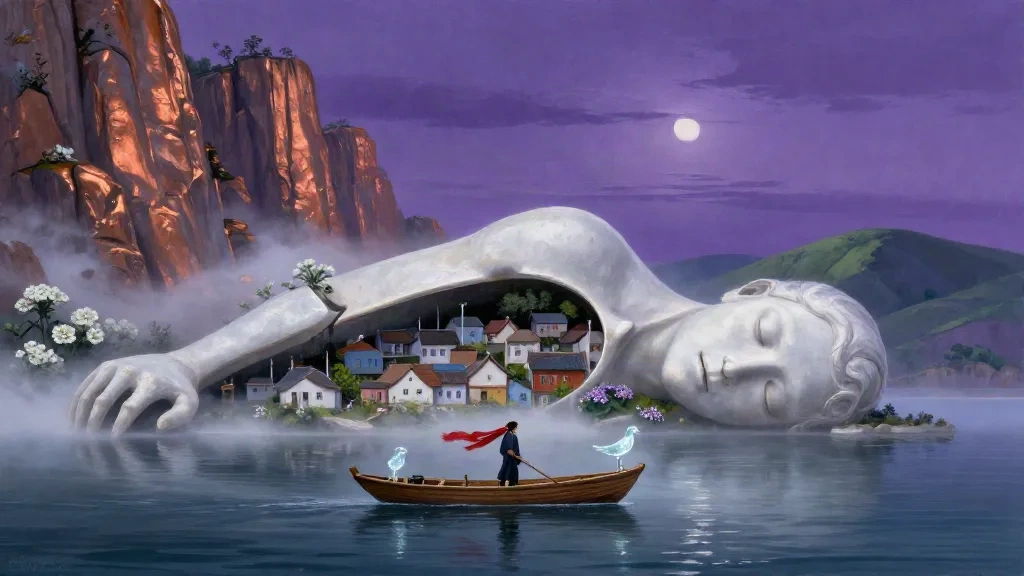
The village had grown inside those ribs so carefully that no one called the giant a giant anymore. Their houses nested between the white arches. Smoke threaded through gaps in the bone. Children played beneath ribs that rose higher than the bell tower.
Neral, however, remembered the ribs as they had been before the village: bare, shining, and enormous beyond sight.
He remembered the world before the water had learned to hide.
His mother had told him that the first world was not this one. It had blue mountains, red wolves, and a moon with a ring of fire. The sleeping giant had been a man then, or a god, or a sailor who carried the shore beneath his chest. When he slept, the old world sank into him.
Only one person remembered its exact shape.
Neral had searched for years. The ferrymen’s ledgers, the bone-scribes’ songs, and the oldest houses all spoke of the first world in riddles. One said its rivers ran uphill. Another claimed its trees bore memories instead of fruit. A child in the eastern rib swore that the sky had once been green.
Now Neral carried a map that might lead him to the truth.
He found it in the hollow of a dead crab, beneath the lake’s western stones. Its parchment was warm despite the cold. At its center, a violet lake spread between two copper-colored cliffs. A path crossed the water to a tower marked with a white bird.
Every time Neral tried to use it honestly, the map changed.
The Honest Map
He tried to follow the path by lantern. The ink bent away from the light and drew itself toward a narrow crack in the cliff.
He tried to follow the path by stars. The stars shifted, and the map replaced them with windows, then roots, then a thousand tiny open doors.
He tried to follow it by memory. The lake on the map dried into salt, and the tower sank beneath a field of cloud-white flowers.
At last he stopped trying to make the map tell the truth.
Instead, he lied to it.
He said aloud that the western cliff was east, that the tower was a tree, and that the glass bird in his pocket was made of water. The map did not move.
Then he said the one thing he knew was true: the map was afraid of being believed.
The lake on the parchment shivered.
A new line appeared, not toward the tower but toward a place where two shadows crossed.
Neral followed it.
At the far edge of the basin, where the giant’s smallest rib curved into the earth, he found a woman waiting beside a dead campfire. She wore a red scarf, though the air was warm.
“You came through the wrong map,” she said.
“I brought the right one.”
“No map is right when the world is listening.”
She held out her hand. In it was a glass bird, its wing chipped and its heart filled with violet dusk.
Neral took it. The glass was cold, then warm, then cold again.
“You remember the first world,” he said.
Her eyes filled with cloud-white light. “I remember one hour of it.”
She told him the giant had not slept by accident. Before the flood, he had stood at the edge of the world and tried to hold it still. He had pressed one hand into the earth. The land rose around him. His ribs became mountains, and his breath became weather.
“What was the first thing he saw?” Neral asked.
“A woman with a red scarf,” she said. “She was waiting for someone who could row without looking down.”
The Giant’s Breath
The map opened between them.
For the first time, it did not change. It showed a small boat crossing a black lake beneath a violet sky. At the far end stood the original world: green hills, a ringed moon, and a red wolf waiting on the shore.
“To reach it,” the woman said, “you must cross the lake while the giant dreams.”
“And if he wakes?”
“The ribs close.”
Neral looked back toward the village. Lights moved between the bone arches. Someone was calling his name.
He placed the glass bird at the bow. The woman tied her red scarf around its neck.
Then she stepped into the lake.
The water rose around her without wetting her clothes. Neral pushed off.
Behind him, the giant inhaled.
The lake widened. The cliffs bent. Above them, the ribs drew closer, pale and terrible in the violet dusk.
Neral rowed toward the green hills on the impossible map. The red scarf streamed behind him like a signal fire. The glass bird sang once, a clear note that passed through stone and water.
He did not look down.
When he reached the far shore, the map was blank.
But the red wolf was there. It lowered its head, and on the ground between its paws lay the first world’s first footprint.
Behind Neral, the lake began to close.
He had found the person who remembered, and learned that remembering was not the same as bringing a world back. It was enough to know where to row next.
He carried the red scarf home.
And beneath the sleeping giant’s ribs, the ferrymen finally learned to row toward what the map could not show them.





