 Netwrck
Gothic Fantasy.
The Tide Below the Roots
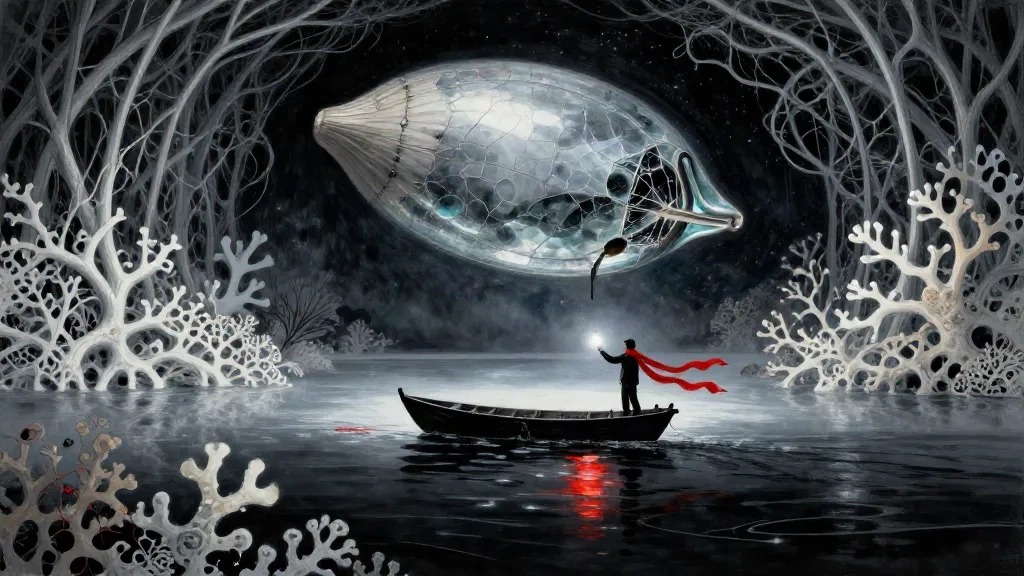
Beneath the orbital greenhouse, where white coral climbed the ribs of the station and ink-black leaves drank from mirrored tanks, a seed hung in a cage of frozen light. It remembered forests that had never orbited a world. Their roots had drunk rain. Their shadows had crossed soil.
Below it, a lake appeared twice each day, though no sea touched the station.
Its ferryman was Elian Vey, who waited at the low-tide stair with a black boat and a red scarf wound twice around his wrist. He did not remember wearing it. Each morning it was there, damp with mist, carrying a smell of cedar and ash. A glass bird stood in his boat, wings sealed shut, full of clear water.
At last tide, Elian crossed toward the drowned orchard. Someone had seen the old world there: not its legends, not its ruins, but the actual morning when the forests were green and the birds knew no cages. That person, the archivist Maelin, had once whispered, “Find the witness who remembers before remembering began.”
Elian carried a map folded inside his coat. Its paper was white as coral bone, its roads drawn in red thread. The route changed whenever he tried to follow it honestly.
The Map That Refused Him
He unfolded it beneath the greenhouse’s weakest lamp. The first line promised a bridge of pale roots. When he stepped onto it, the ink blurred and became a whirlpool. The red thread unwound itself, crossed the page, and knotted around the image of a woman holding a glass bird.
Elian tried again. This time the map showed dry land. He crossed the lake at low tide, wading ankle-deep through water that reflected a sky he had never seen. Beneath his feet lay white coral, split open to reveal ink-colored insects.
At the island, a red scarf hung from a branch, though no wind stirred.
Elian reached for it. The map snapped shut.
He opened it by telling the truth: “I am afraid.”
Every road vanished.
When he lied—claiming he wanted only shelter, only passage, only a dry place to sleep—the map produced a beautiful route. It always ended at a locked door.
The glass bird in his boat warmed against his palm. A drop of water inside it struck its beak, and the drowned orchard answered with a thousand tiny bells.
From the reeds came a voice, thin as a needle. “You cannot ask a map to carry you and still tell it where you go.”
Elian looked toward the speaker: a girl no older than the seed’s reflection, wrapped in red thread. She had his ferryman’s hands, but no ferryman’s scars.
The Woman in the Glass
“Maelin?” he called.
The girl shook her head. “Maelin is what the map calls the place you are looking for.”
She waded beside him without making ripples. Where her feet touched the lake, the water remembered trees.
“The world was remade,” she said. “The seed kept one memory, but memories leak. The red thread is all that remains between one version and the next.”
She pointed below the greenhouse. A vast root descended through the station’s central shaft, pale coral veined with ink. Along it hung small glass birds, each holding a different weather.
“The witness is inside the seed,” the girl said. “But the seed shows whoever carries the map a world where they are alone.”
Elian understood then why the paper had changed. Honesty made the route unstable; lies made it smooth. The map could not bear the truth of another person’s presence.
He tore the map in half. The red thread snapped taut, piercing his thumb. Across the lake, every drowned tree turned its branches toward him.
The glass bird cracked.
Inside it, instead of water, an entire sky appeared: blue above, gold at its edges, and a line of dark birds crossing a sun that had never belonged to the station.
“Now it will remember you,” the girl said.
The First Memory
They returned to the falling seed. Its cage shone like a lantern, and the root beneath it pulsed with red.
Elian placed the glass bird against the seed. The original sky entered the light.
For one breath, the greenhouse vanished. Elian stood beneath a forest canopy, hearing insects, wind, and the small alarm of a bird startled from a branch. The red scarf around his wrist was not ash-stained; it was new.
He understood the cost. If he kept that memory, he would preserve the old world inside the seed and leave the station’s living forest with only the artificial version. If he released it, the witness would disappear forever.
He opened his hand.
The sky poured through the glass bird and into every root. White coral turned green. Ink leaves trembled. Somewhere above, the seed opened like a dark flower.
When the last red thread fell, the lake vanished.
Elian found a new scarf beside the empty cage, woven from the station’s first living leaves. The glass bird remained in his palm, cracked but whole, holding a single bright drop.
Every tide thereafter, it whispered of rain.





