 Netwrck
Gothic Fantasy.
The Tide of Glass
The lake appeared only when the seed inhaled.
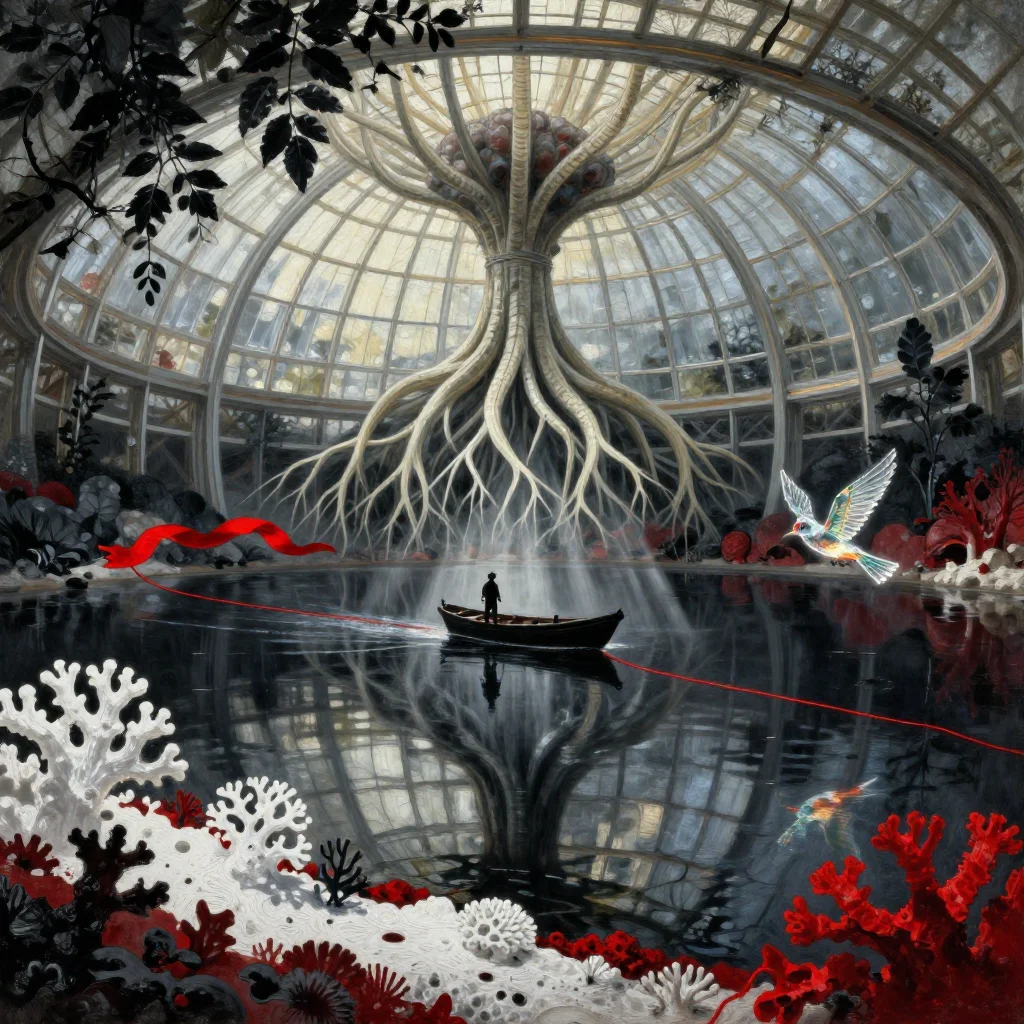
Ilyan ferried strangers across it in a narrow black boat, poling through water the color of white coral. Above him the greenhouse curved away into the dark: ribs of pale wood, leaves like stained windows, roots threaded through black soil. Each dusk the seed released its stored tide, and the lake sank, exposing a shore of salt and silver leaves. By dawn it returned and lifted his boat above the terraces, along with everyone waiting on them.
He had crossed this water for thirty-one years. The fare was a story, and the story was always the same one. No passenger ever admitted to remembering the world before the forests.
That was why Ilyan kept them. Before the burning years, before the oceans climbed their cages and the sky became a ceiling, there had been forests with roots deeper than mountains. The seed remembered their green mornings in the taste of its sap. People remembered only the versions handed down: smaller forests, safer forests, forests conveniently extinguished.
He poled. He did not ask questions, and he learned a great deal from what people volunteered to a man who never demanded anything. A woman from the upper ring described a childhood of nine springs and a river that ran warm. A boy described a dog. A dockhand, drunk and apologetic about it, described a sister who had never existed. Ilyan stored all of it in the place behind his sternum where a man keeps what he cannot afford to lose, and he said nothing, because saying it would have cost him the passage.
It had also, he understood, cost them the record. He had spent three decades being the reason no one wrote anything down.
One passenger in that first week of the year was a woman named Nadya, whose daughter lay in the clinic under the south terrace with a lung that had forgotten how to hold air. The clinic grew its medicines out of the lower gardens, and the gardens grew out of the seed's memory. Nadya did not want history. She wanted a chemist's audit of which rootstock had been lying about its lineage for two hundred years.
“The map says the blackbark lineage is original,” she told him, gripping the gunwale. “The map also says my daughter is going to be fine.”
“Maps have a poor record of prophecy.”
“Then it lies about the bark.”
Ilyan thought of the red route he had copied into her hands, the one that crossed the middle gardens and came out by the pump-house. He thought of the older line, the one he had never given anyone, that went around the long way through the root flats where the growth was slow and honest and useless.
“It lies about everything,” he said. “Go around.”
She went around. He did not know yet whether he had saved her daughter or merely made the arithmetic of someone's death more inconvenient.
A Map That Refused Truth
At the meridian bell, Ilyan found the map waiting at the landing.
It was a white coral sheet veined with ink, its edges soft as wet paper, the same sheet the archivists had issued him the winter his mother died. He had carried it folded under the seat of his boat for thirty-one years and never once unfolded it, because a map that shows a false route is a tool, and a tool that shows the truth is only a mirror, and mirrors are expensive.
When he spread it across the boat, a red thread rose from the fold and drew a route toward the drowned arboretum. He followed it. Each honest stroke altered the coastline around him. When he marked a fallen column, the column vanished. When he wrote Sera Venn, the ink changed the name to Ilyan Venn.
At the third crossing a red scarf appeared beneath his hand.
He recognized the weave before he saw the glass bird. Bad weave, doubled thread, a knot his mother had taught him in a language she claimed came from somewhere colder. Both the scarf and the bird had belonged to her, or had belonged to the woman she had made herself out of, which he had never been able to separate.
She had served the greenhouse archivists. That was the whole of what he had been told, and he had spent thirty years building the rest out of silence. The map recorded facts so old they frightened it. Instead of preserving them, it made itself useful by changing them.
“Honesty is a key,” whispered a voice from the seed's hollow trunk.
“Then you are afraid of the lock,” Ilyan said.
He was a man talking to a plant, and the plant was a library, and he had been speaking a careful dialect of lies to both of them for his entire working life. He felt no wonder. He felt the specific shame of a man whose caution has been noticed by something with no interest in forgiving it.
He forced the red thread through a tear in the paper.
The thread pulled against him, warm as a pulse, and the lake drained in a single breath. Every boat, bridge, causeway and passenger descended with the water, clattering into the greenhouse's lower gardens. Somewhere below him a pump-house roof folded like a paper cup. The clinic's south wall cracked from foundation to treeline.
His own boat struck root.
He lay in the black water with the coral of the old forest pressing against his ribs and understood, in the way you understand arithmetic only after the sum has already been done, that he had not opened a lock. He had struck a bell, and everything built on the assumption of a level sea had fallen to a new level.
The Witness in the Leaves
Beneath the arboretum, Ilyan entered a grove grown inside a cracked planetarium.
The trees had white coral trunks and crowns of black leaves. Ink dripped from their wounds whenever the seed drew breath, slow and deliberate, like ink from a nib held too long. In the center stood the glass bird, its beak sealed with red thread, the scarf wound around its legs in a knot he could have undone in his sleep.
His mother's voice came out of the roots, and for the first time in his life it was not a memory of her voice but her voice, arriving through wood.
“I am the witness you wanted,” she said. “But you know only the woman I made safe.”
Images opened among the trees: cities under green skies, rivers carrying silver sediment, children sleeping beneath leaves that had never known fire. Then the archive moved through them the way weather moves over a field. Towers became stacks. Rivers became canals. Leaves became alloy. Sera Venn's face flickered through his mother's features and he understood that the archive had not merely edited the past — it had edited the witness, grafting the testimony of the first grove onto whoever was standing close enough to carry it, which for two hundred years had been the archivists, which had been his mother, which was now him.
“The seed preserved every version,” his mother said. “The map chose which one could be used.”
“And you chose.”
A long silence. The ink dripped. The bird did not sing.
“I chose a version with a floor in it,” she said. “Do you know how many children the edited forests fed? How many lungs? The blackbark that Nadya's daughter is breathing has never existed. It is a plant I invented out of four true plants and a need. If I had let the truth stand, the greenhouse would have had no pharmacopoeia and two hundred thousand people would have died beautifully, honestly, with the correct expressions on their faces.”
He had no answer. He had spent his life preferring the true route that went around, and he had never once asked what the going around was for.
Ilyan raised the map over the glass bird. “Then let it choose honestly.”
He spoke no destination. He named no grove. He drew only what he had witnessed in thirty-one years of not asking: a ferryman, his mother's scarf, a lake sinking beneath the roots, six hundred strangers who each gave him a different childhood and none of them whole.
The paper refused. It wrote instructions in his own hand — turn here, wait for the third exhale, walk the flats — promising a route to Sera, and every line of it was accurate, and every line of it was a way to stop asking. He understood then that the map's usefulness was not that it lied. It was that it was always right about where to put your feet and never once mentioned that the ground was a decision.
He tore the page in half.
Ink spilled across the grove and recoiled from the glass bird like oil from a hot pan. The trees slammed their leaves shut. The seed took a long, audible breath, and Ilyan felt the whole structure of the greenhouse shift one degree toward a future where nothing was going to be recorded and nothing was going to be grown, and both of those facts were going to be his.
The First Shore
The bird began to sing.
Its note was too high for birds and too old for machines. The seed answered with a low crack that traveled up through the water and into the ribs of the world. Leaves opened along the observatory floor and released the smell of rain on cedar, moss after lightning, wet bark under a sky no roof had ever touched.
The red scarf unwound from the bird's legs and crossed the ruined grove, and where it passed the ink loosened from the white coral ground. At the far shore stood a woman, small and unhurried, holding a living branch. Behind her the first forest burned, and it burned the way forests burn in old accounts: not downward into itself but upward, all at once, like a page catching light.
Sera Venn looked exactly like the archivist portraits and not at all like his mother, except in the mouth, which was his mother's mouth.
“You came a long way to be given an answer,” she said.
“I came to be given a witness.”
“You have one.” She lifted the branch. It was the only living green thing in the station. “That forest was not killed by anything. It was told it was the only forest, and it believed it, and it stopped growing sideways. The greenhouse didn't burn it. It convinced it.” She watched him. “I have been here four hundred years, waiting for a boatman. I do not want you to bring me a story. I want you to admit you are not the man who remembers. You are the man who carried everyone else's.”
“I drew what I saw.”
“You drew what you carried. There is a difference and you have known it for thirty years.” She stepped back from the water's edge. “Cross, if you like. I will not stop you. But then the lake goes untended, and in four hundred years the next boatman will tell himself a version where the water was always level.”
Ilyan could have crossed. The water was right there, black and level and smelling of a morning that had never occurred.
Instead he turned the boat and kept rowing, because he understood at last that the map had not been his enemy. The map had been his post. Someone has to hold the line that connects what was to what can still be used, and no one had ever told him that holding it also meant being the man who decides which crossings are closed. He had not been a custodian. He had been a lock, and his mother had been the key, and the thing in the trunk had been right about the fear.
The Tideless Morning
The lake did not come back on schedule.
It returned on the fourth day, thin and late and at the wrong angle, and it kept returning wrong, a half-breath behind the seed's respiration, so that the crossing he had made at dawn for thirty-one years was now made at dusk, and the dusk crossings were now made in the dark, by feel, by the sound of roots clicking under the hull.
The lower gardens went first. Then the pump-house, already broken, and the clinic with it. Nadya's daughter survived, because Nadya had gone around, which was a fact Ilyan permitted himself to believe roughly half the time. The blackbark that had never existed grew anyway, out of the seed's memory, edited again by nothing at all, and the chemists were busy for a year and then had no seed to be busy against, and the medicine thinned, and then it was only the true four plants, and people began to get sick in the ordinary, unhurried way of people who have run out of inventions.
No one died of a beautiful lie. That was the part nobody warned him about. They died of a hundred small accurate things, arriving on schedule.
The passengers came anyway, because the terraces still existed and the water still came, and the ferryman was still the only man with a boat. They came holding maps whose routes no longer agreed with one another. Two women at the landing compared the same crossing and found their ink pointing to different shores, and the argument went on for an hour, and then for a day, and by the third day neither of them would speak and both of them boarded, and sat at opposite ends of the boat, carrying mutually exclusive certainties.
The Ledger at the Landing
So Ilyan stopped routing and started reading.
Each dusk, at the landing, with the water dropping away below the terrace and the wrong light coming off the seed, he read aloud whatever the maps claimed, and he named the disagreement out loud, and he said which parts he had watched with his own eyes and which parts he had only been told, and he said that too: that a ferryman hears six hundred versions of the same green morning and has kept none of them, and that the keeping was his decision, made daily, for money.
Some passengers left. Two families left. An archivist named Pei told him he had destroyed the only continuity the greenhouse had, and Ilyan agreed with her, and she left anyway, and he did not call after her, because being right was the thing the map had always accused him of.
He wrote on the blank half of his mother's map, since it was the only paper he trusted, which was a small and terrible sentence to be able to say. He wrote in the wrong hand, slowly, in ink that ran when the seed breathed, and he got the dates wrong, and he could not check any of it against anything, and at the end of every entry he put the same three words, because they were the only three he had earned: as I saw it.
He hung the red scarf at the edge of the landing, tied to a post, where the wind had it every evening. Not as a signal. As a landmark — because the first thing he had learned about memory, at thirty-one years of holding other people's, was that it cannot find a shore that is not marked, and the second thing he had learned, on that fourth day with the water coming back wrong, was that some shores are marked so that no one goes to them.
By the ninth year the seed had cracked in three places and the lake rose only twice a day, thin as an apology, and the first grove's scent came out of the cracks on the turns of the season, so faint that passengers doubted it and Ilyan never once doubted it. It was not a memory. It was weather, and it would outlast everyone who had felt it, and there was no map for weather.
He poled toward the next shore with the blank page folded under the seat, and the sun came through the stained leaves of the fallen seed onto the water, and the water did not agree with any route at all.





