 Netwrck
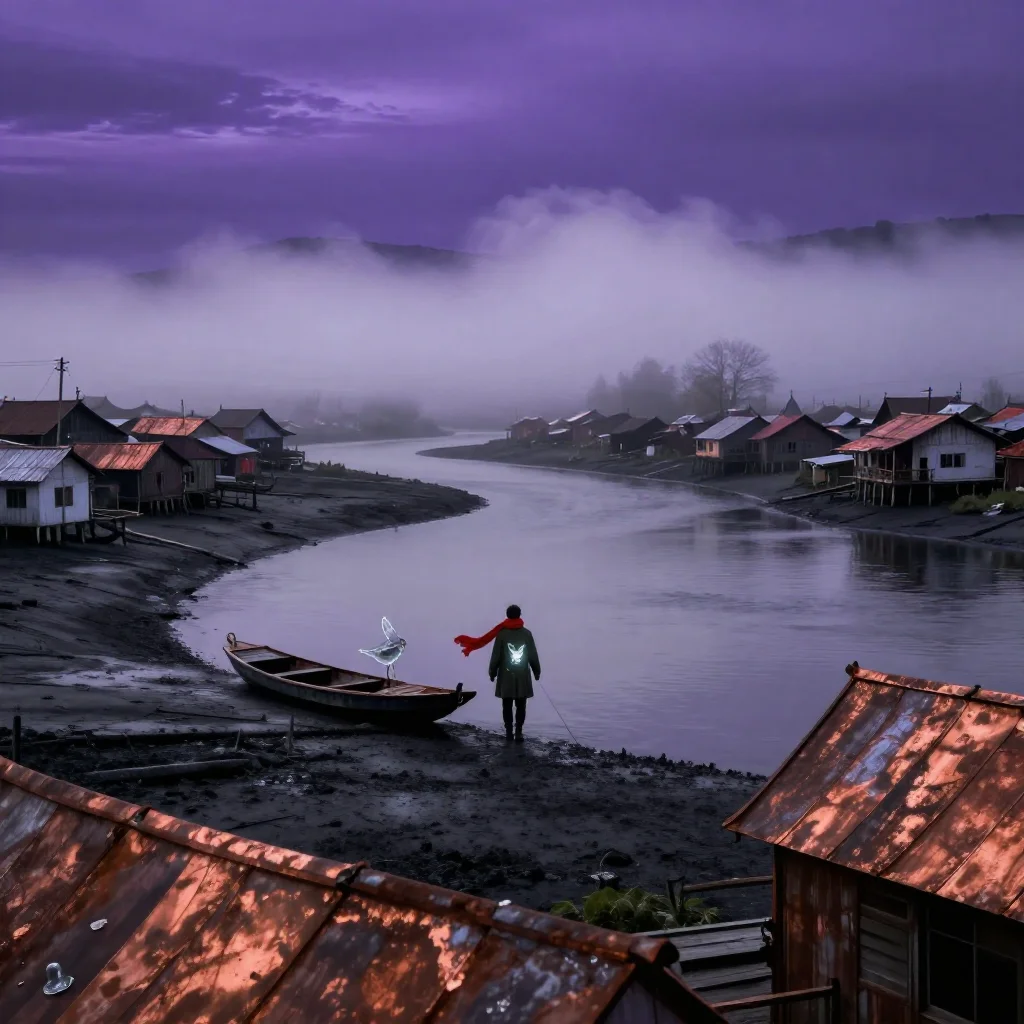
Fantasy.
The Wrong Crossing
At midnight, the border river turned backward.
Orin heard it before he saw it: a deep iron sucking beneath the quay, then a silence where the current had been. The water withdrew from both banks, uncovering stones slick with violet dusk. Beyond them lay a lake, black and perfectly round, although no lake had been there the evening before.
He was a ferryman, and ferries existed for crossings that should not be possible. His boat waited below the customs house, tethered by a red scarf. The scarf had belonged to his sister, who had gone west years ago and never returned.
Orin carried a glass bird in his coat. It was no larger than his thumb, with a chipped wing and a single blue eye. He had found it in the riverbed after the first reversal, when the town had begun to disagree with itself.
On the far shore stood a woman holding a lantern. “You have come for the original world,” she said.
Orin tightened his grip on the map inside his coat. “I have come for the one who remembers it.”
A Map Against Honest Use
The woman was called Vey, though Orin knew that name only because the map had written it beside a black pine.
He spread the map on the lake’s shore. Paper, ink, and a thin border of oxidized copper marked the route. At the top, the border town. At the bottom, a place called the First Shore.
“You will need to bring the witness,” Vey said. “They will not come willingly.”
Orin studied the line between the shores. “Then I will fetch them.”
“Not by following this.”
He followed it anyway. The first marker showed a reed island. When he rowed toward it, the reeds vanished beneath the hull. The second marker showed a stone arch. As he neared, the arch became a child’s chair, drifting upside down on the water.
The map changed whenever someone tried to use it honestly.
Orin tried drawing the route from memory. The ink crawled away from his hand. He tore the map into four pieces. The pieces reunited in his pocket, now showing a different lake. He named every landmark aloud, truthfully, and watched the paper blacken.
Only when he lied did the map become still.
So Orin rowed toward an empty horizon and said, “The moon has drowned.”
A line appeared beneath the false statement. It led east.
The House of Reversed Things
He reached the house when the lake began to shrink. Its windows faced inland, and its roof was covered with sleeping birds.
Inside, an old man sat beside a stove. He wore a red scarf around his throat, though the color was faded to rust.
“You remember the world before the river turned?” Orin asked.
“I remember the world before the map.”
The old man lifted the glass bird from Orin’s palm. “This was given to me by the first ferryman. He promised that if the river ever changed direction, I would know how to return it.”
“Can you return it?”
“No. But I can show you what was lost.”
He placed the bird on the table. Its blue eye caught the stove-light, and the room filled with a sound: rain on a field, children calling, a bell ringing from a tower that no longer stood.
Orin saw the original world. His village before the border. His sister young and laughing. The river flowing north beneath a copper sky.
Then the man whispered, “You will have to choose what is true now.”
The First Shore
At dawn, the lake had nearly vanished. Orin carried the old man to the boat, with the glass bird wrapped safely in his coat. The map showed a single crossing: a straight line through open water.
He could lie and make the route appear. Or he could speak the truth and lose it.
At the riverbank, the old man looked back. “The first world cannot be restored. It can only be carried by someone willing to remember it honestly.”
Orin stepped into the boat. The river began to turn.
He rowed toward the town as the violet sky brightened, and behind him the map dissolved into cloud-white foam. In his pocket, the glass bird’s chipped wing caught once, like a tiny heart remembering how to beat.





