 Netwrck
Magical Realism.
The Missing Hour
By the time Mara reached the monastery, every clock had disagreed with every other clock. Some showed noon beneath a pearl morning. Others displayed midnight at noon, their hands moving backward with the solemnity of insects crawling across a window.
The monastery stood on a hill above the forest of Vey, where the land had been evacuated from time. Roads vanished at dusk. Birds lifted from branches in the same instant, again and again. People who entered returned with memories missing from the middle.
Mara had come as a ranger, assigned to guard the forest from poachers, fire, and the more ambitious errors of the state. Instead, she found a locked gate bearing the monastery’s brass crest: a clock without hands.
Inside, the abbess showed her a journal written by Elian Voss, the clockmaker who had entered the forest thirty years earlier with a brass key and a small moon in his coat.
“He was making a correction,” the abbess said. “Not to the clocks. To time itself.”
Mara closed the journal. Her mother had disappeared during the same evacuation, leaving only a red scarf and instructions for a journey she had never finished. Elian’s name appeared in the margin of those instructions, followed by a map of a forest trail that existed only when the moon was low.
Her concrete desire, sharpened into a single purpose, was to complete what he had begun.
The Forest’s Curfew
At sunset, the forest closed its paths.
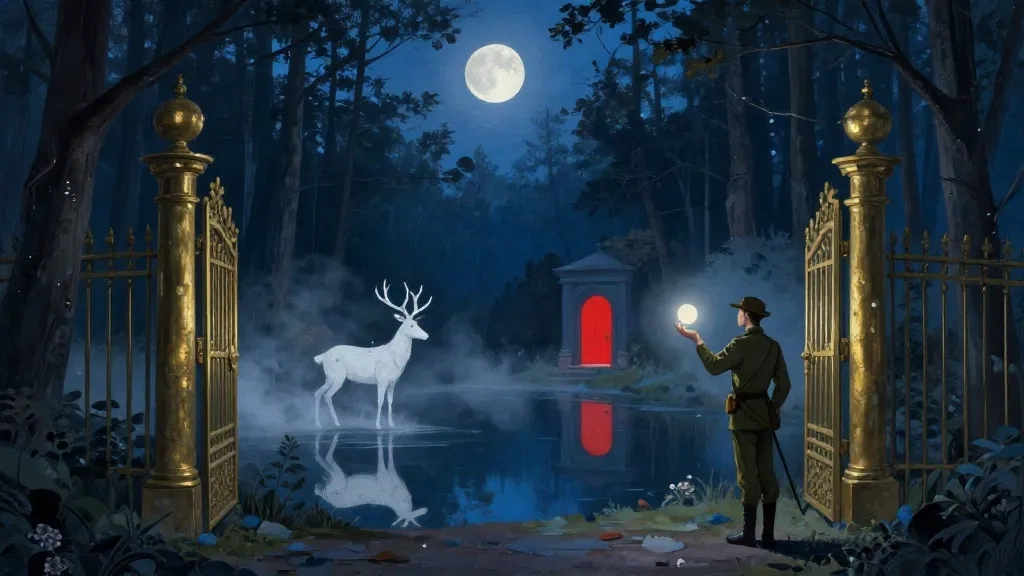
A creature came to the gate before Mara could leave: a white hart with antlers shaped like interlocking gears. It did not attack. It lowered its head and struck the earth three times, precisely when the third bell tolled.
“Curfew,” said the abbess.
“The hart enforces it,” Mara replied.
“The hart announces it. The forest enforces it.”
The rule was simple. No one could cross the boundary after the first moonbeam touched the eastern stones. No one could lie about their destination. No one could arrive before leaving.
Mara stepped onto the trail. The white hart watched her without hostility, its silver eyes fixed on the small moon in her palm—the moon Elian had left in the journal’s final drawing, though she had carried it for three years without knowing why.
She had not lied. Her destination was the place where her mother disappeared.
At the first turning, the forest produced two versions of her. One wore her ranger’s coat. The other wore a red scarf. Both asked her to follow.
Mara chose the woman in the red scarf.
The path lengthened. Trees rearranged themselves around her, and the moon in her hand became heavier, then lighter, then heavier again. The brass key she had found beneath Elian’s journal began ticking against her teeth.
The Clockmaker’s Road
Deeper in, the forest contained rooms without walls.
In one, a child learned to walk while learning to age. In another, an entire village waited for a train that had departed before the village was built. Mara passed them, keeping the red scarf in sight.
At the center stood a small lake, perfectly still beneath a sky of midnight blue. On its far shore waited a woman with Mara’s face and older hands.
“You are late,” the woman said.
“You disappeared.”
“I was meant to.”
Elian’s unfinished journey had required a person to carry time from one place to another. The forest, emptied of time, needed a witness to cross it. The witness had to arrive after the journey began, so the journey could end.
Mara understood then why the curfew existed. The forest would not tolerate a destination reached out of order. Her mother had begun the crossing. Mara must finish it.
The brass key opened nothing. It only held the lock in a shape no one else could see.
Mara placed it in the small moon. The moon opened like a flower, and inside it was a red door.
The white hart appeared on the opposite shore. It raised one hoof and pointed beyond the lake, where the forest had assembled every lost hour into a single silver tree.
“Curfew ends at first light,” it said.
Mara looked at the red door.
“Then we have until dawn.”
The Red Door
She crossed the lake. The woman in the red scarf took Elian’s brass key and opened the door.
Behind it was the final hour of the forest: a pearl-colored room with a clock at its center. The clock had no hands, only a small moon turning behind its face.
“Set it back,” the woman said.
Mara placed her mother’s moon inside the clock. The forest rushed through her: her mother’s childhood, the day of the evacuation, Elian walking away, the moment she had written the journey’s last instruction. Time did not return. It ceased to be missing.
Then the clock struck once.
The red door vanished. Dawn entered the forest in a thin white flood.
When Mara returned, the abbess was waiting outside the gate. Elian’s journal lay open on the table, its final page blank. The white hart had disappeared, leaving only a brass key in the wet grass.
Mara kept the key. She did not know what it opened yet.
Behind her, the monastery clocks began to agree, one by one, on the exact minute she had come home.





