 Netwrck
Surrealism.
Clauses Against the Sky
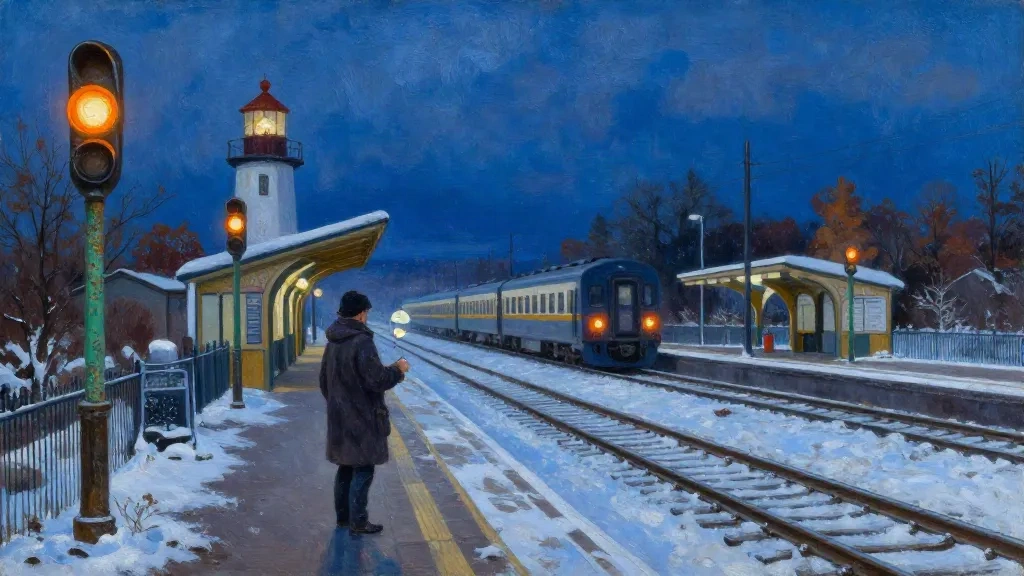
At Vesper Station, winter filled the rafters with blue storm-light, and the chimney breathed invisible swallows that argued in the flue about where summer had been put. Snow leaned its whole body against the platform timetable. Inside, every departure board told a different season: APRICOT RAIN, LATE HARVEST, THE LONG DRY, and other words passengers pretended not to see, the way one pretends not to see a man relieving himself against the outside wall of a church.
Ignatius Vale kept the weather ledger in a room above the ticket hall, beneath a window painted shut in his second winter. He had tended a lighthouse on a salt-black coast until the sea there was abolished for municipal economy. The harbour authority wrote to inform him the water had been reclassified first as an inland lake, then as a storage facility, and then they stopped writing altogether, which he understood to be the same message written twice. He had polished the brass that last morning. He still polished brass. His hands required employment at the exact hour his memory went soft, and brass never went soft.
His duty now was less dramatic: the cataloguing of weather arriving from alternate worlds. Burnt-orange dust off a thunderstorm in July, blown across a border that no longer had a name for itself. Lichen-scented gusts out of a forest composed entirely of trunk and no leaf. The delicate pressure of spring, pushing against the station’s northern wall like a palm laid flat on a child’s forehead, patient, testing the mortar.
Each observation cost a brass token, the only currency the ledger accepted. Burnt orange: one. Lichen: two. Blue storm-light: three, though nobody could name the unit, and Ignatius had stopped asking in the way a man stops asking his wife whether she means it. He had learned instead to count aloud, a small private arithmetic of breath, one token per gust, so that his hands would stay busy and his mouth would stay shut.
The stationmaster, Pell, kept her office below the timetable, where the light came up off snow and had no source worth discussing. Eleven years in post. The same grey wool coat, brushed shiny at both elbows, the way a thing is brushed that is handled but not loved. She smelled of iron and warm paper and stamp pad, of a woman who had decided to be sparing with warmth. She had a way of listening that made the speaker go back and check his own figures.
“Blue again,” she said, on the evening it began.
The Passenger Missing in Blue
She came in out of the weather without frost on her coat, though blue light trembled around her shoulders like something held in a jar. She was small and damp-haired and older than he had expected, mid-forties, the sort of tired that lives in the hands. She put a moon in his palm. It was no larger than a plum and cold as a coin in January, and it did not warm in his fist, not even near the stove, which was roaring by then, the great cast-iron thing swallowing whole birches and belching heat like an animal fed too well.
“I was on the platform,” she said, “and then every bell rang backward.”
He weighed the moon in three tokens’ worth of attention and filed it as unclassifiable, which is a thing he had learned to do only with weather and never with people.
By morning nobody remembered her. Porters moved their chairs around her as though the chair were the obstacle. An old man bought two cups of tea at the counter and looked puzzled when the second went cold in his hand, and she said, I am here, I am right here, and he looked through her at the middle distance with the awful courtesy of the very old. Ignatius copied her name into the weather ledger in his best hand. The ink remembered itself and withdrew from the page, retreating downward through the fibres as though the paper had opened a trap, and what was left was not a blank line but a shape of blankness, a wet dark absence in the shape of a name he had not been able to read a moment before. He had read it. He had read it twice.
He did not write it again. He had learned in another context that repetition is a form of panic.
Outside the municipal office someone had hung a paper lantern. Its green wash had drained to lichen; one panel still held a warmth the colour of burnt orange. Beneath it, weighted against the wind, a notice:
All impossible things are prohibited until licensed. Any person, place, weather, object, recollection, or outcome lacking municipal classification shall be removed from public memory, effective on filing, without appeal, there being no body competent to hear one.
The Clerk Who Forgot Herself
The office inside smelled of wet iron and lilac. He had come to read the notice properly, in case its small print had eaten her. Instead he stood in the doorway with his hat in his hand and looked at the inventory pinned beside the window, the working list of the current day’s removals, numbered in pencil, and at the seventh line he stopped being able to hear the radiator.
Item seven. Weather, human, low pressure, carried on the platform, associated with orange dust and one (1) small moon of uncertain provenance. Removed 16:40. Classification: unlicensed. No objection received within the statutory window of zero (0) minutes.
The hand was small, upright, hurried. She wrote the numeral seven the way other people write a letter home.
“You filed it yourself,” Ignatius said.
“I file a great many things.”
“You filed a great many things on a Tuesday. This one is a Thursday.”
Mara Venn turned from the shelves. Up close the blue light was not on her at all but in her, in the wet of her eyes, as though she had been left out in weather. She looked at the notice, and then at her own handwriting, and did the thing he had watched porters do: nothing, immediately, a full stop of the whole body.
“There is a form,” she said. “There is a form for a form. I had eleven files open and the bell going and a man from Drainage crying about a smell in Lower Fallow, and I did not read the seventh line, and I stamped it, and then at half past four I was a person with a draught in her coat.” She put her hand flat on the inventory, not touching the pencil, as though the paper might still be taken back. “I did not do it on purpose. I want that written down. Intent is in the schedule and I filed it under none.”
“You put yourself on the list.”
“I put a pressure system on the list. I did not look at it and it had my shape.”
He believed her, which frightened him, and he understood the shape of the thing: a woman who had spent a career reducing the unbearable to a line item. She had believed the columns would hold her. There was even a cruelty in his pity, and he let it stand, because cruelty is faster than kindness and winter was on the platform behind him.
“How long?” he asked.
“The schedule says nine days from filing. Fewer if somebody says her name out loud in a place with a roof.”
What the Ledger Owes
He had a notebook. He was not supposed to have a notebook. It lived inside the weather ledger, sewn into the back board, and it held one line, written in a hand that leaned the other way from his own:
Elva Vale, keeper, black water, blue light, three tokens. Not removed. Held.
Six years he had kept her against forgetting by writing down what she had looked like in bad weather. Not the truth of her — the truth of her had gone in pieces and he would not assemble them out of sentiment. The facts instead. How she held a cup with both hands and blew on it. That she hummed in the key of a door that would not close. That on the last morning she had said, if I go out, file it, don’t bury it, and he had laughed, and the laugh was the last ordinary sound in the house for a year.
He knew the mechanism now, the way you know the mechanism of a lock once you have had your hand in it. Memory is not a wall. It is a filing system with a budget. Every unclassified thing a city holds must be paid for out of the same account, and when the account is overdrawn the city takes the largest unfiled thing it can find and calls it weather. His wife had not died. She had been reduced, her name promoted to a pressure system, her face moved down into the deep ledger where the department keeps the seasons it has mislaid. The tides at his old lighthouse came in wrong now. A particular kind of light came in wrong. He had stood on the gallery at midnight, brass under his arm, and watched the sea forget itself one degree at a time.
He had written her name in the margin every day for six years. It had not faded. It had also never once returned her hands, her humming, the exact weight of her elbow against him in a dark kitchen. He wanted to be honest in his own ledger, and so he wrote this down too: holding a person is not the same as keeping one.
Which was the whole of his theory, and the whole of his cowardice, and the reason he had never once walked into that municipal office to make a claim.
One Illegal Exception
Pell would not consider the possibility, not at first. She stood behind her desk with the stamp pad squared in front of her like a plate.
“Impossible departures require an impossible ticket,” she said. “Illegal tickets require an impossible licence. Impossible licences are illegal. You can walk that triangle until your feet wear out, Vale, and I will not be the one to hand you the pin.”
He had the clauses by heart, and he laid them on her floor like a man laying a card game he has been losing for years. Clause twelve: no moon may be carried as luggage, the moon being neither freight nor nor any known quantity of the moon. Clause nineteen: no person shall remember, mourn, or covet any individual whose name has been removed from the public record. Clause forty-one: a paper lantern is a vehicle whenever it is warm enough to cast a shadow. And beneath them all, older than the schedule, in the small type where the department hides its own appetite: no filing may be made by the filer, or by the household of the filer, in respect of their own person.
Pell read the last one twice. Then she said, in a voice with the temperature of the timetable above her head, “You have not understood the shape of this. If you file against her removal, you become a claimant in a matter to which you are party. Clause nineteen will take you. And the account, Vale, the account will not take only one.”
“I know what the account takes.”
“You know its arithmetic. You do not know its appetite.”
He worked it out in front of her, because he wanted it on the record even if the record was a memory. The removal described a human pressure system, low, carried, surviving on shared memory. The law did not require the pressure system to be a woman. The law required a classified phenomenon, and the station held, in a room above the ticket hall, six years of the most thoroughly documented weather in the district. If he reclassified her — filed her as licensed, attached to his own observation, with himself named as the instrument of record — then she was no longer unlicensed weather. She was a climate he had witnessed. She would have an observer. And the city, which can only forget what nobody is holding, would have to go on holding her while he remained.
The cost was written plainly enough that he did not need to guess at it. Someone has to remember her. He was going to be the someone.
At ten seventeen, with the blue storm-light leaning in the north window and Pell standing in the doorway not saying one word, he set the small moon into the empty cradle of the paper lantern.
It cast a round blue shadow on the plaster. Round, and moving slightly as if something alive turned beneath it.
“By law,” he said, “that is a vehicle. By law the moon is its engine. By law she is cargo.”
“That is not a passenger manifest,” Pell said.
“No,” he said. “It is an illegal vehicle in an impossible station, and you have just watched me build it.”
He put the lantern in Mara’s hands. She took it by the paper handle with the caution of someone carrying a newborn flame, and something in her face gave way, and she did not thank him, which he understood to be the correct response. Instead she said, “If you do this you will not be able to write my name out loud again.”
“No.”
“Then say it now, while the bell is still forward.”
He said it. He said Mara Venn into the draught of the hall, and the swallows in the flue went quiet, and one brass token in his pocket went cold as a coin in a dead man’s pocket, and Pell turned her face to the window and permitted herself the single luxury of a woman who has decided not to stop this.
The Hearing on the Platform
He rang the autumn bell. It was a bad bell, cracked in 1911, and it gave a note like a coin dropped down a well.
No train came. The rails stayed white with winter to the fence, and the departure board clicked from THE LONG DRY to something half-formed and then to nothing at all, which passengers found encouraging.
Rain, in the Wrong Place
Then a drop of burnt-orange rain struck the lantern’s shoulder, and another, and another, and the hall filled with the smell of a summer two hundred miles south of here. It ticked against the glass, the clock, the inkwell, and it did not melt the snow; it qualified the snow, which is a different process and requires more attention. Blue storm-light gathered inside the small moon until the platform was gone from underfoot, replaced by summer-green leaves lying flat in a heat that had no sky above it.
The Conductor
A carriage surfaced beyond the rails with no more announcement than that, its windows full of late sunlight coming in low and gold. The conductor stepped down carrying a ledger larger than Ignatius’s own and set it on the platform edge, and the pages smelled of every climate the department had ever failed to place. He examined Mara without seeing her. He examined the lantern, which the law made a vehicle, and therefore his responsibility.
“Destination?”
Ignatius opened the weather record to the seventh line of the current day and read, in the flat register he had learned in the lighthouse, of nights when the fog came in and there was nothing to do but read the log aloud to a man who insisted the light was moving: every gust, every bell, every blue tremor, the orange dust of July, the two-token lichen of the leafless forest, and now the pressure of a human climate carried low, surviving on shared memory, arriving at Vesper Station, filing at sixteen forty, not reading the seventh line.
The conductor frowned. “That is not a destination.”
“It is the only place Mara Venn exists.”
He wrote the word EXISTS in the manifest and, after it, a location field he filled with the driest entry in the book: here, provided someone remains.
The Stamp
Pell came out and struck the rail with her ticket stamp. The sound was flat and official and it went through the platform like a bell going backward, and it did two things at once, which is the department’s whole genius and its whole sin: it prohibited the event in the strongest available terms, and in doing so it entered the event into the record, because nothing in that city was guaranteed to exist except what had been forbidden on paper in front of a witness.
Ignatius set his brass token on the lantern’s rim. It flared once, blue, and did not go out, and every porter in that hall remembered a woman who had taken the wrong platform on a Thursday in autumn: remembered the weight of her hand, the damp of her hair, the exact sentence she had said, which was that the light came up off snow and had no source worth discussing. The city would take that memory from him in time. For now it had it, and the having was loud, like surf.
What the Board Remembers
The train pulled away through autumn, the windows going gold, then green, then a colour with no name in the schedule. Mara leaned from the door holding the lantern by its handle, and the last thing Ignatius saw was her face turning to the light with the frank, exhausted curiosity of a woman being looked at properly for the first time in nine days. He had not saved anyone. He had entered a witness.
By morning the board had reset to something patient and new.
HERE, PROVIDED SOMEONE REMAINS
The tracks outside were white. The stove was still roaring. In the room above the ticket hall, the weather ledger lay open on the desk where he had left it, and the ink had begun, on the line beneath the seventh item, to gather itself.
He read it first before he touched it, which is the only discipline he had left. It was not Mara’s name. Mara’s name was a clean, deliberate shape, the way a held note is a shape, and it stayed. What had come up was smaller, and newer, and in the third token weight of blue storm-light, and it read, in his own hand, six years of practice steady as a man laying bricks:
Pressure, human, instrument of record, V. Vale, keeper, retained.
He put his thumb on the page. The brass token in his pocket was warm now, warm as skin, warm as a coin kept in a pocket all winter, and the draft from the hall moved across the floor and disturbed the papers in a way that felt like attention, like something turning toward him in the dark. Outside, over the white, the wind came off the roof in a gust that smelled of orange dust and burning leaves, which was wrong for the season, which the ledger would require him to enter, which he would enter, tomorrow, and the day after, for as long as the entry held.
Downstairs, in her office under the timetable, Pell had unlocked the drawer she had kept locked for eleven years, and taken out the private book in which she recorded everything she had removed and nothing she had allowed. She did not write a filing. Filings were the department. She wrote a name in a margin, in a small upright hurried hand she had not used in over a decade, and then she sat with her palms flat on the desk, in the light that comes up off snow, and did not decide whether that was a rescue or a delay.





