 Netwrck
Mythic Fiction.
The Archive Beneath the Tide
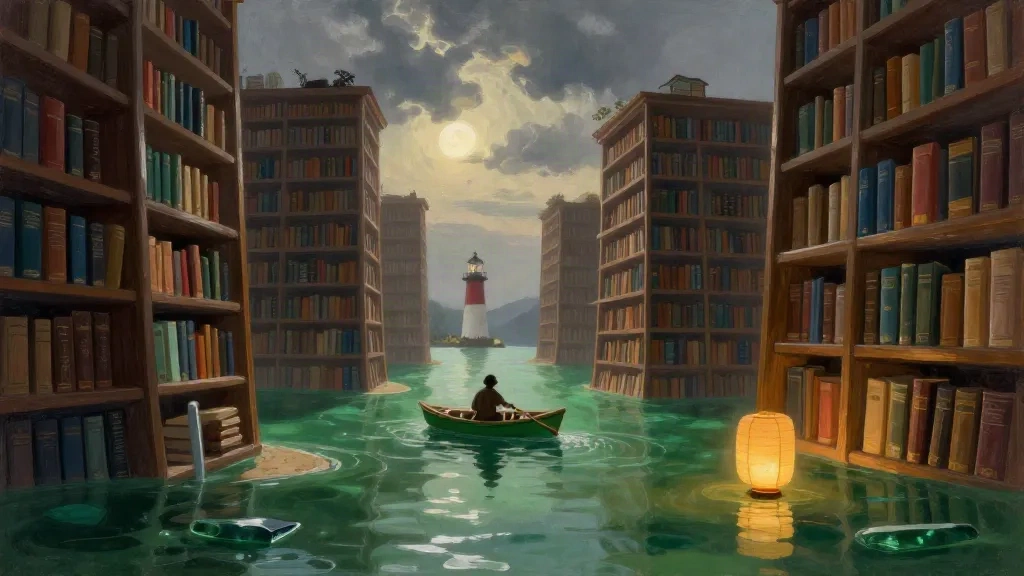
At low water, Maren rowed the green skiff between shelves that rose like drowned cathedrals. The librarians called their city Avelune, though the oldest maps showed only open sea here. Sand drifted across the catalogue desk. Seagulls nested in the upper galleries, and every evening the lamps turned the water beneath them to hammered cobalt.
Maren climbed the lighthouse ladder each dawn, carrying her brass barometer, her inkpot, and the little moon that never set. It weighed no more than a peeled apple, but when she held it over the western windows, the glass clouded with skies she did not recognize: a red sun crossing a black sea; snow falling upward from a violet tower; a storm whose lightning moved backward.
She named each weather in the margin of her ledger. Every storm belonged to a world, she wrote, and every world had lost its people to some larger forgetting. The small moon showed her the last vessel departing before the memory went dark.
That morning it showed her a single ship. Its sail carried a name stitched in blue thread.
The Rule of Necessary Things
Below the lighthouse, the municipal bell rang through the flooded stacks. A brass proclamation surfaced on the desk of every skiff.
By order of the Survey Office: all impossible phenomena are prohibited, including vanished worlds, upside-down rain, lunar fruit, self-rowing boats, and the speaking of names no living person remembers.
Maren read it twice. The ink remained dry. Someone had amended the rule overnight, adding her name to the list of offenders.
In the deepest aisle, she found the keeper she meant to save.
He hung from a chain beside a shelf of sealed storms, a young man with salt in his hair and his shadow cast behind him. When Maren lifted her lamp, the shadow failed to follow. It remained fixed to a cobalt patch of stone, folded into the shape of a kneeling body.
His name was Ilyan Venn. The archive had forgotten him so thoroughly that the walls had begun forgetting the man who remained.
“Can you hear me?” Maren asked.
Ilyan opened his eyes. “I was the last navigator of Orison. Your archive took our weather, but the city took our memories. Now the city is taking everyone who remembers us.”
His voice failed. On the shelf above him, a paper lantern swayed without wind. Inside it, a flame burned in the shape of a tiny shoreline.
Maren understood. The collective forgetting was not a spell cast by a rival. It was the ordinary process of a city built by erasing every fact that could not be entered into a ledger. The library had preserved Ilyan only because he had become a weather report.
One Name Against the Ordinance
She cut him loose. The chain snapped, and every librarian’s bell rang at once.
Boats struck the shelves. Blue shadows leapt from the walls. Across Avelune, a tide rose beneath the floorboards, carrying fragments of languages, doors, birds, and faces. The Survey Office sent six black skiffs to arrest her, their rowers wearing masks stamped with blank squares.
Maren placed the paper lantern in the bow and the small moon in her coat. The flame showed a path between the shelves. It did not lead toward shore. It led toward the oldest volume, where the city kept its first blank record.
“You cannot restore a lost world,” one mask said.
“I only need to restore one person.”
She rowed toward the blank record. Ilyan sat behind her, too weak to pull an oar, while the black skiffs closed in. The little moon grew warm in her pocket. Outside, the impossible weather began answering: thunder from beneath the sea, wings beating through drowned rooms, rain falling upward from the lighthouse.
At the final shelf, Maren opened the volume. Its pages were dry despite the flood. She wrote one line in cobalt ink.
Ilyan Venn, navigator of Orison, remembers the shore where his ship was born.
The Shore That Remembered Him
The archive gasped. Every oar stopped. On the shelves, forgotten names returned, each one small as a seed.
The municipal rule flared across the ceiling. Impossible acts are illegal. A black line struck through the word impossible, then another through illegal. The remaining sentence read: All necessary things are permitted.
Ilyan stepped onto the archive floor. His shadow rushed back to his heels, carrying a cobalt glow. The paper lantern flared once, revealing the little moon in Maren’s hand. It was no longer a stolen fragment of some other sky. It was a small, round moon belonging to this flooded city, reflected in the water where a new shore was forming.
At dawn, Avelune’s librarians rowed toward that shore. They carried seeds, names, and lanterns made from weather no one else could see. The Survey Office filed a complaint. No one knew how to classify a city becoming a country.
Maren climbed the lighthouse again. In her ledger she wrote a new entry:
Weather observed: the first morning after a person is remembered.
Below, Ilyan taught the librarians to read the stars that had no constellations. When they laughed, he smiled as if a buried bell had rung.
The small moon rose over the archive. It did not set. Nor did the paper lantern. Between them, a path of sea-glass green remained open across the flood, narrow enough for one boat, wide enough to bring everyone home.





