 Netwrck
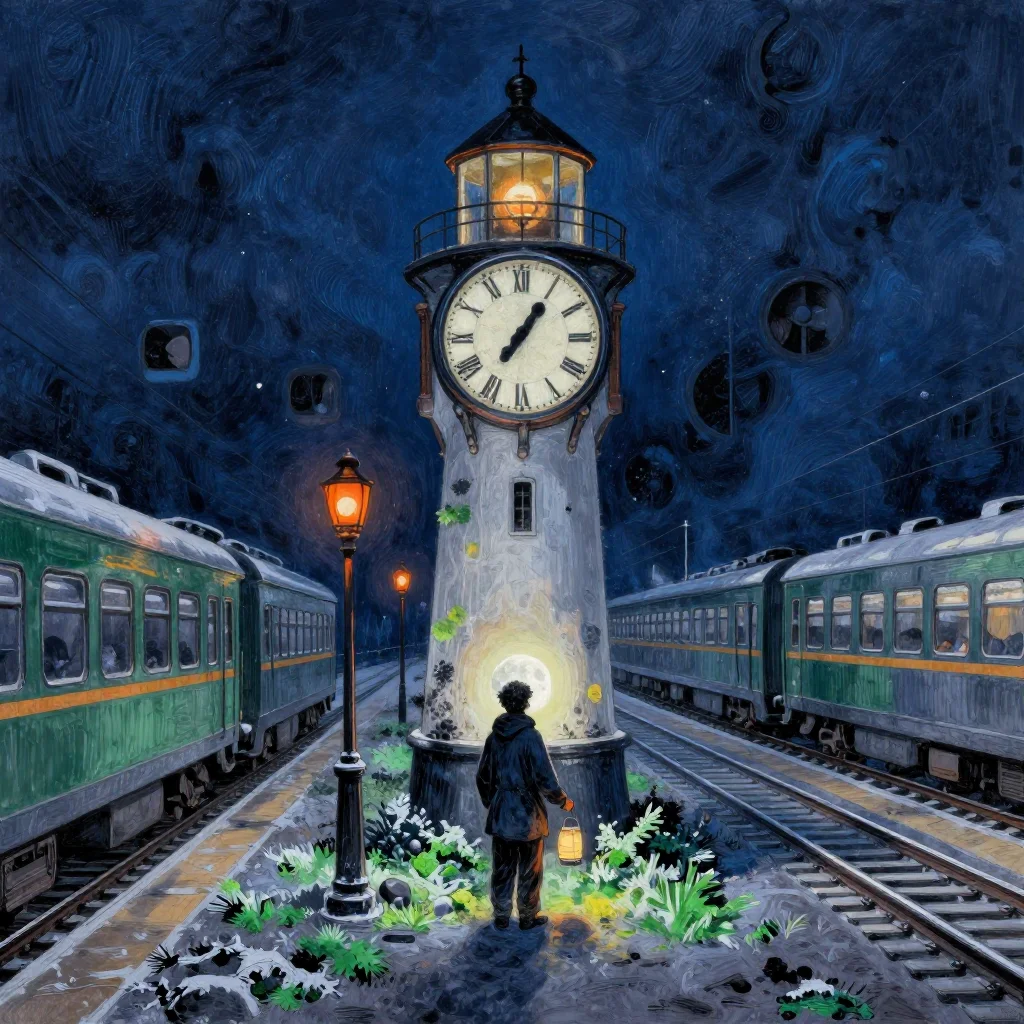
Surrealism.
The Last Warm Carriage
Mara Vale kept her lighthouse beneath the eastern clock, though the tower held no sea. Each morning she climbed its icy spiral with a brass barometer, a notebook, and a small moon in her coat pocket. The moon was not celestial. It was the size of a plum, warm as a swallowed pebble, and it recorded weather from worlds that had not happened yet.
At Vinter Station, winter had become a bureaucratic season. Four platforms opened onto alternate years: a blue thunder April, a drought autumn, a November of swallows. Passengers boarded by presenting a ticket printed in the color of the weather they sought.
Mara catalogued the arrivals in the lighthouse log. Wet wind from a country where mountains had learned to sing. Snow falling upward beneath a red sun. Rain that remembered every face it had touched.
On the evening of the first frost, a child named Ilyan came to her desk. He carried a paper lantern with a blue storm-light glowing inside, though the flame cast no shadow.
“My sister is disappearing,” he said.
Mara opened the municipal notice nailed beside the timetable. EVERY IMPOSSIBLE THING IS ILLEGAL. The sentence ran beneath itself in smaller letters: INCLUDING UNRECORDED WEATHER, UNCLAIMED MEMORIES, AND PERSONS ARRIVING BY SEASON.
“The city is forgetting her,” Ilyan said. “Everyone who knew her has begun forgetting her name. The station says she never boarded.”
Mara looked through the station glass. On Platform Three, a young woman stood beneath a moth-eaten sign, holding a ticket shaped like a snowflake. Her face was already blurred at the edges.
“What is her name?”
“I can’t say it,” Ilyan whispered. “When I try, the lantern goes out.”
A Loophole in the Weather
Mara had spent years learning the city’s rules. Impossible things were forbidden because the station could not explain them to the ledger. A blue sun, a summer in the middle of frost, a person arriving from a year that had been abandoned: all required a form, and forms required a witness.
So Mara took out her small moon.
She placed it on the platform clock. It gave a pulse like a second heart. The blue storm-light in Ilyan’s lantern leaned toward it.
“If I record her weather,” Mara said, “the city cannot forget her without forgetting what it felt like.”
“That would be illegal,” Ilyan said.
“Yes.”
She opened the log and began writing. Not the woman’s name. The weather around her: frost silvering the iron rails, a cloud breathing through the station ceiling, the faint electrical scent before a world remembered lightning.
The station replied with a warning bell. Municipal weather had been altered. Unauthorized atmosphere was present. Please report the responsible keeper.
Mara wrote faster. Ilyan held the lantern high. Its blue light spilled across the woman, and for one moment the blur in her face tightened. A mouth appeared. Then eyes. Then the crease where she had frowned.
The small moon cracked.
Mara felt the memory enter her log: a kitchen with burnt-orange curtains, a red train leaving without its passengers, a girl saying, “I will find you in another winter.”
Now the station remembered.
The Rule Against Arrival
At once, every platform became winter. The blue thunder April collapsed into sleet. The drought autumn browned to dust. Swallows struck the glass in the November wind, and the departure board filled with names no one had purchased tickets for.
Officials arrived carrying blank forms. They did not arrest Mara. They fined her. They declared the moon unverified, the lantern unlicensed, and the woman’s arrival an administrative error.
“Correct the record,” said the senior clerk, “and she will disappear again.”
Mara understood then. The rule had been written to preserve the city by making loss orderly. If nothing impossible could be admitted, no one had to mourn what vanished.
She placed the cracked moon inside the lantern.
The small moon and the paper lantern touched. Blue storm-light became a rope.
Mara threw it around the woman’s wrist.
“You are not an impossible thing,” she said. “You are a person who arrived through weather.”
The clerk reached for the rope. The station’s frost climbed his sleeves. In the windows, the city’s countless rooms appeared: kitchens, hospitals, schoolrooms, all crowded with people noticing the same absence.
The woman spoke at last. Her name filled the station like a returning train.
What the Winter Kept
By dawn, the officials had gone. Vinter Station remained winter, but the platforms were no longer sealed. Passengers boarded into summers they had been denied, carrying tickets stained with weather no clerk could classify.
Mara’s log was confiscated. The lighthouse moon was reduced to a glittering splinter. Yet the paper lantern stayed on her desk, burning with a blue light that made no shadow.
Every night, Mara climbed the tower and listened to the storm. She catalogued the new weather: grief moving like rain across a dry country, forgiveness arriving without luggage, laughter heard through walls in a city beneath the sea.
She never asked whether the rescue had been lawful. Law is a rail laid over a moving world. Sometimes the train leaves the track.
At the bottom of the log, beneath the official stamp that declared the station impossible, Mara wrote one final entry: One person remembered. The season can be disputed.
Outside, the small moon began to grow.





