 Netwrck
Adventure.
Thirteen Winters
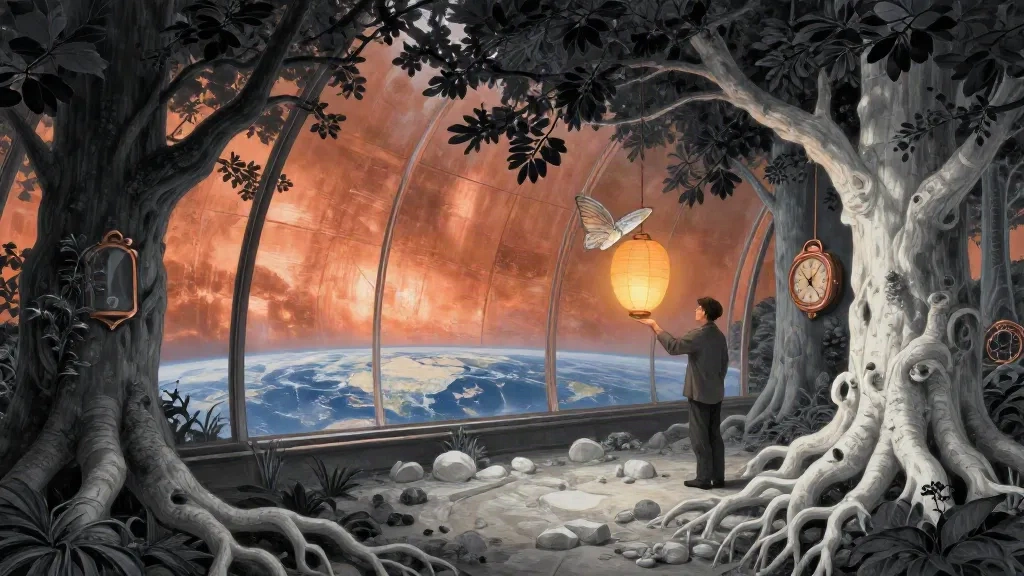
Iona Vey kept time in black cherry wood, pale stone, and the dull copper gleam of the seed’s equatorial glass. Her clocks did not count hours. Each one opened like a flower when its season arrived: spring loosened its silver petals, summer filled them with warm sap, autumn released a single fragrant knock. Winter was the dangerous part. A winter clock had no hands. It contained a small, sleeping weather.
Around the orbital greenhouse, Seed 713 remembered forests Earth had lost. Cedar groves rose through the central dome. Ghost elms brushed the observation ring with leaves that had never opened. Beneath them, roots threaded old names into the station’s soil.
That morning, the oldest winter clock stopped.
Iona found a paper lantern on its face, folded so tightly the paper had split. Inside the crease lay one moth wing, black cherry at its base and pale stone at the tip. It did not belong to any species catalogued aboard the station.
The clock was not broken. It had been opened from within.
The Choir Under the Roots
Iona descended to the seed chamber, where forgotten memories stirred in the dark. The floor trembled with the choir.
They arrived in borrowed voices: her mother naming kitchen jars, a river counting stones, a child laughing beneath an elm that no longer stood. Seed 713 had preserved them, but the forest’s oldest memory was missing. Without it, the ghost elms were losing their seasons.
“I did not steal it,” said the lantern’s voice.
“You carried it away,” replied the moth wing, thin as a hinge.
Every voice claimed a different origin. The river said the memory had been donated. The child insisted it had been inherited. Her mother commanded Iona to return it at once, then denied giving anything.
Seed 713 had no single will. It had hundreds, all preserved with equal care and none willing to surrender.
Iona opened her tool case. Beside the calipers lay the maker’s mark: a moth burned into brass, wings spread around a drop of resin. The same mark was cut into the underside of Seed 713’s central taproot.
The memory had belonged to the seed’s maker.
Now the choir wanted it erased.
What the Clock Owed
Iona climbed into the watch chamber and set the stopped clock beneath the copper horizon. Outside, the station turned slowly above Earth. Daybreak raced along the glass, making forests of light.
“I will return it,” she told the choir, “when everyone knows where it belongs.”
She offered the lantern to the river, which rejected it as drowned property. She offered the moth wing to the child, who closed her borrowed hands. The memories circled her, pulling at her sleeves, filling the room with contradictory seasons.
One insisted winter was ending. Another swore winter had never ended. Her mother said the clock was late, though no one had named the hour.
Iona understood then that they feared not forgetting. They feared being forgotten.
She opened the clock’s smallest chamber and played its sleeping weather. Cold moved through the workshop. The black cherry wood tightened. On the copper horizon, frost spread into branching stars.
The moth wing warmed beneath her palm.
“You were made by the same hands,” she said to the wing. “So was the forest.”
The Memory Returned
She carried both objects to the seed chamber. The choir fell silent as she laid the lantern beneath the maker’s mark and placed the wing inside it.
Light unfolded, thin and gold. A forest appeared in the lantern: not ghost elms, but the real grove before its extinction. A woman in a pale stone coat knelt among the roots, repairing a seedling clock. On the bench beside her rested a copper hammer and a moth-wing charm.
The memory showed the final storm. It showed the woman winding winter beneath the roots so the forest could sleep safely inside one seed. She had made Seed 713 her own refuge, knowing she would not survive to tend it.
Iona lifted the lantern toward the waiting choir.
“She did not leave this to one voice,” she said. “She left it to all of you.”
So the river accepted the woman’s silence. The child accepted her steady hands. Her mother’s voice, at last, remembered her as maker rather than judge. One by one, the other memories joined them, each contributing what the grove had been.
Seed 713 drank the lantern’s light.
Above, the ghost elms flowered from root to crown. The stopped winter clock began to turn, though it still had no hands.
Iona repaired its broken catch and returned the moth wing to the forest, where it dissolved into silver dust. By morning, pale stone blossoms had opened around the lantern. Their scent was cedar, rain, and the cold clean edge of snow.
She did not wind the clock. The maker had already set the season in motion.
On the copper horizon, the first true dawn arrived. Beneath it, every leaf of Seed 713 turned toward the light, as if remembering where home had been made.





