 Netwrck
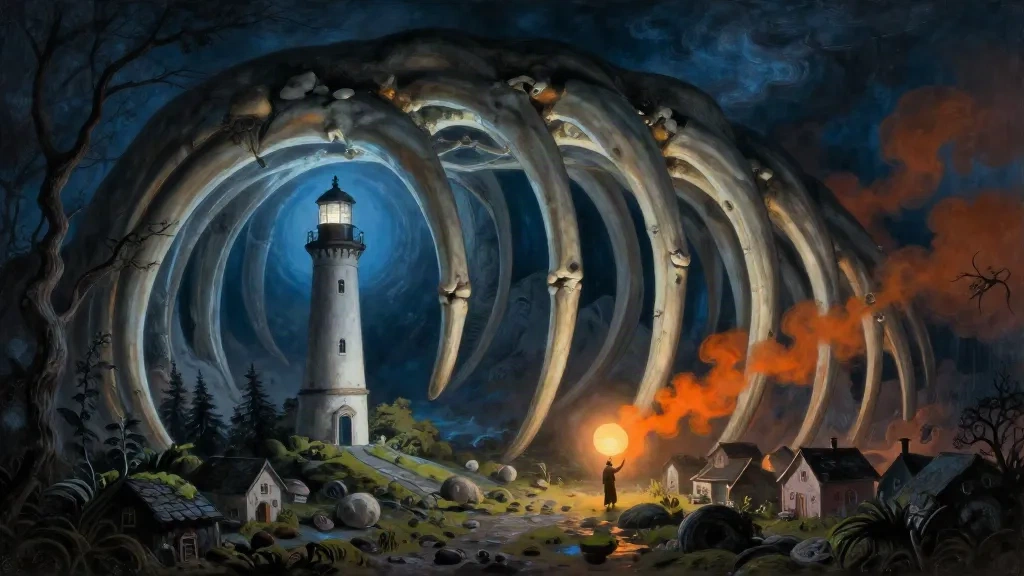
Surrealism.
The Weather Register
Elian kept the lighthouse in the fourth rib of the sleeping giant, where the bone walls sweated salt and the wind moved through narrow hollows with a voice like a woman remembering a name.
Every dawn, he climbed the spiral stair and opened the brass weather register. He recorded the storms of other worlds: rain that fell upward, thunder that arrived without clouds, snowflakes carrying handwritten minutes. The village below woke beneath a sky of blue storm-light, its roofs glazed in lichen, its chimneys breathing burnt-orange smoke.
That morning, the register contained a weather report from a world where oceans had been removed by careful administrative order. Elian copied it in blue ink and heard someone knock on the lantern room door.
The municipal inspector entered without removing his gloves. “The sky is clear,” he said.
“The sky is a report,” Elian replied. “Clear is not the same as empty.”
The inspector pointed to a notice nailed beneath the brass barometer: No impossible thing shall be made present within the village limits. The rule had been added that winter, after the mayor’s wife remembered a child who had never been born. The clerk called the amendment necessary. The inspector called it enforceable.
Elian closed the register. “I have made no impossible thing present.”
“You have imagined one.”
“Imagination is not a public utility.”
The inspector smiled with the patience of a man who had never needed to invent an exit. “No matter what you intend, the regulation begins at the thought.”
The Name Mara Gave Him
Below the lighthouse, Mara was selling paper lanterns in the rib market. She made them from old notices, folding each one until the red print disappeared inside. Her stall leaned against the giant’s seventh rib, beside a cistern filled with orange rainwater.
She had known Elian since childhood, though neither of them could say where they had met. He remembered her hands, but not the first time he saw them. She remembered his voice, but not the words it had spoken. The village called this a harmless effect of the sleeping giant’s dreams.
Elian found her beneath the blue storm-light, holding a small moon in her palm. It was the size of a plum, and it cast a white glow over the lantern paper.
“Where did you get that?” he asked.
“It was given to me.”
“By whom?”
Mara looked toward the lighthouse. Her face went blank in stages, as if a sentence were being removed from the inside out. “By someone you are forgetting.”
He reached for the moon, and the air tightened around his hand. A brass whistle sounded from the mayor’s balcony.
“Unlawful celestial object,” the inspector called. “Surrender it.”
The small moon rose above the market, pulling every paper lantern upward with it. Lanterns detached from their strings and floated toward the giant’s open mouth, where blue storm-light gathered like weather inside a lantern.
Mara climbed onto the cistern and reached for one lantern.
“The forgetting has reached the songs,” she said. “Soon it will reach the names.”
Elian understood then that Mara was not being erased by accident. The village had spent decades making sorrow administrative. Every impossible loss had been assigned a number, every disappearance a clearance fee, every grief a sealed drawer in the mayor’s office. Her absence had become a sanctioned condition.
An Illegal Memory
Elian returned to the lantern room with the small moon and the paper lantern Mara had caught. He opened the register and wrote at the bottom: Weather event: one person remembered.
The inspector struck the page with his glove. “That is not weather.”
“It is atmospheric pressure.”
“That is a lie.”
“Then it is an unauthorized report.”
Elian lifted the lantern. Inside its paper walls, a tiny blue flame revealed a procession of faces passing through the village square. He recognized no one except Mara. Each figure carried a lantern of their own. Each looked relieved to be forgotten.
He spoke a memory into the flame: Mara at the cistern, rain on her wrists, the small moon between them. He added the sound of her laugh and the exact number of paper lanterns she had sold that morning. Then he added one detail that could not belong to any report from another world: the warmth of her hand when she had placed the moon in his palm.
The memory struck the room like weather.
Outside, the market lanterns fell back into the villagers’ hands. The sleeping giant inhaled, and the ribs creaked like a ship remembering harbor.
The inspector drew a small, illegal-looking stamp from his coat. “You have made a thing present.”
Elian held the lantern tighter. “Yes.”
“You are liable.”
“For remembering her?”
“For making her remember you.”
Elian looked through the blue storm-light at Mara on the cistern below. She had caught one final paper lantern. Its surface was blank.
The Lantern That Remained
At dusk, the inspector sealed the lighthouse door. Elian descended through the giant’s ribs, carrying the small moon beneath his arm. The village waited beneath the orange sky, every face turned toward the market.
They could not remember Mara. They could remember the absence of her.
Elian set the small moon in the blank lantern. Its white glow softened into blue, then spread through the paper until every crease became visible. He struck a match.
“Mara,” he said, naming her into the rule’s hearing.
The lantern flared. The municipal notice peeled from the barometer and burned without becoming ash. The inspector shouted that the sky had been altered, that the weather had been stolen, that no one was permitted to bring back what the village had lawfully released.
But Mara stepped out of the blue storm-light carrying the orange glow of the cistern on her hands. She looked at the lantern, then at Elian.
“I remember the rain,” she said.
Elian handed her the small moon.
By morning, the village had changed the rule. No impossible thing is present, the new notice read, unless someone remains to witness it.
That evening, Elian entered Mara’s name in the register. Beside it he recorded the weather: a paper lantern, a small moon, and the first honest rain the sleeping giant had allowed in years.





