 Netwrck
Romance.
The Weather Beyond the Window
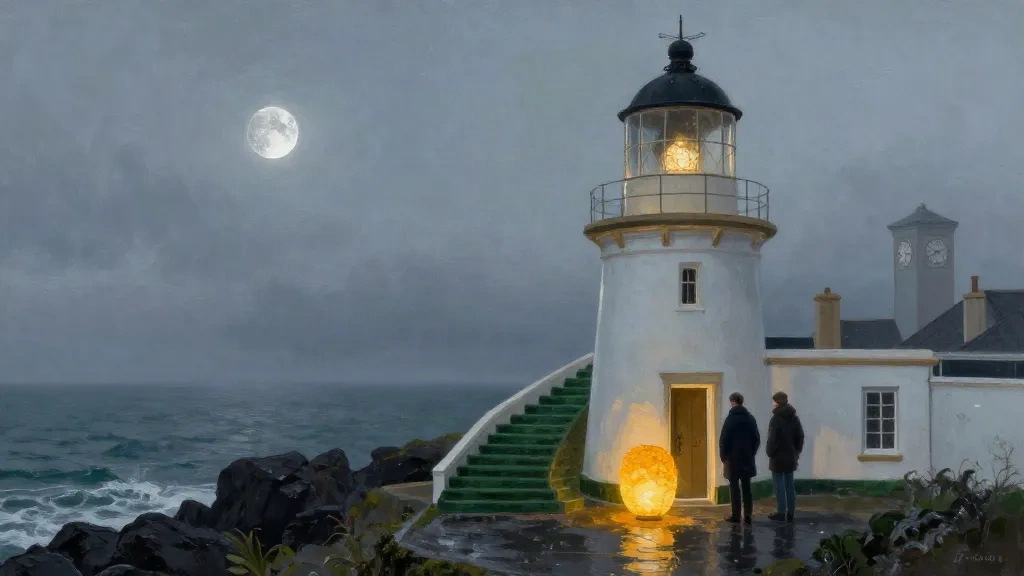
At the western edge of the country, where the cliffs wore moss green and the stone remained wet beneath a sunless sky, the Monastery of Clockmakers kept its towers.
Every tower held a clock with no hands. Every clock disagreed with every other. Bells sounded at different hours, and the monks marked the day by the color of the sea.
At the outermost lighthouse lived Elian Vey, keeper of the western light. His work was not to watch the water. It was to catalogue weather that arrived from elsewhere: rain falling upward, thunder inside glass, snow in the shape of drowned birds, sunlight moving at the speed of a walking man.
He recorded each event in a green ledger beneath a small moon of frosted silver. The moon had appeared in the tower window one winter night and never left. It was no larger than a coin, but its pale glow made the wet stone shine.
Elian had learned not to trust appearances. He trusted repetition.
A Name in the Ledger
On the seventh night of the unmonth, a woman arrived in a paper lantern.
She stood beyond the cliff path, holding the lantern before her as if it were a small sun. Marigold light shone through its folds. When Elian raised his hand, she lowered the lantern and bowed.
“I am Mara,” she said. “I have come to be remembered.”
He searched the ledger for her name. The pages held thousands of storms, migrations, vanished villages, and borrowed afternoons. Mara appeared nowhere.
“Who is forgetting you?”
“The municipality.”
She handed him a notice sealed with black wax. Elian read it by lanternlight. Any person who is absent from the public record is presumed legally impossible. Their arrival, residence, memory, and death are prohibited.
“So every impossible thing is illegal,” he said.
“Every impossible thing is a trespass.”
He looked at the small moon. Its silver rim had dimmed.
Across the courtyard, the clockmakers rang an hour that had not yet happened.
The Rule Against the Sea
The abbot found them beneath the western tower. He was young for his office, with ink-dark sleeves and a chain of brass keys.
“The rule protects us,” he said. “If a thing cannot be entered into the record, it cannot be allowed to disturb the record.”
Elian held up Mara’s notice. “She came by lantern.”
“Then the lantern is contraband.”
The abbot ordered the lantern extinguished and Mara returned to the country beyond memory. Elian stepped between them.
“Catalogued her.”
The abbot frowned. “You cannot catalogue a person.”
“I catalogue what arrives.”
That night, Elian entered Mara in the ledger. He wrote the color of her coat, the warmth of her hand, the exact hour she had said she was born. He drew a small moon beside her name and, beneath it, a paper lantern glowing marigold.
When he finished, the tower bells stopped.
For the first time in his life, Elian could not hear the sea.
The Hour That Belonged to Them
Mara woke beneath his coat, on the lighthouse floor. The lantern had vanished, but its wax had left a warm stain on the stones.
“The rule is changing you,” she whispered.
Elian understood. The public record was not only forgetting her. It was teaching the country to call her impossible, and him foolish for sheltering her.
At dawn, the monks came with the abbot and a municipal officer carrying a book of seals. The officer read the law aloud. The ink trembled.
Elian opened the ledger. “I can prove she exists.”
“You have written a wish.”
“No.” He offered his hand. “I have written a witness.”
Mara took it.
The small moon flashed above them. In the sudden marigold light, the seals on the officer’s book began to melt. The prohibition had specified that no impossible person could be remembered by two witnesses. It had not said that two witnesses could remember one another.
The lighthouse beam swept across the wet stone, across the moss-covered cliffs, across the country where clocks still disagreed.
Where the light passed, the sea returned with a sound like a held breath released.
Elian closed the ledger. Mara remained beside him, solid enough to cast a shadow.
“What will you record now?” she asked.
“This,” he said. “A storm arrived from another world. It brought one person, one lantern, and enough light to make the old laws look small.”
Then he took her hand and led her to the western door.





