 Netwrck
Adventure.
The Law of Possible Things
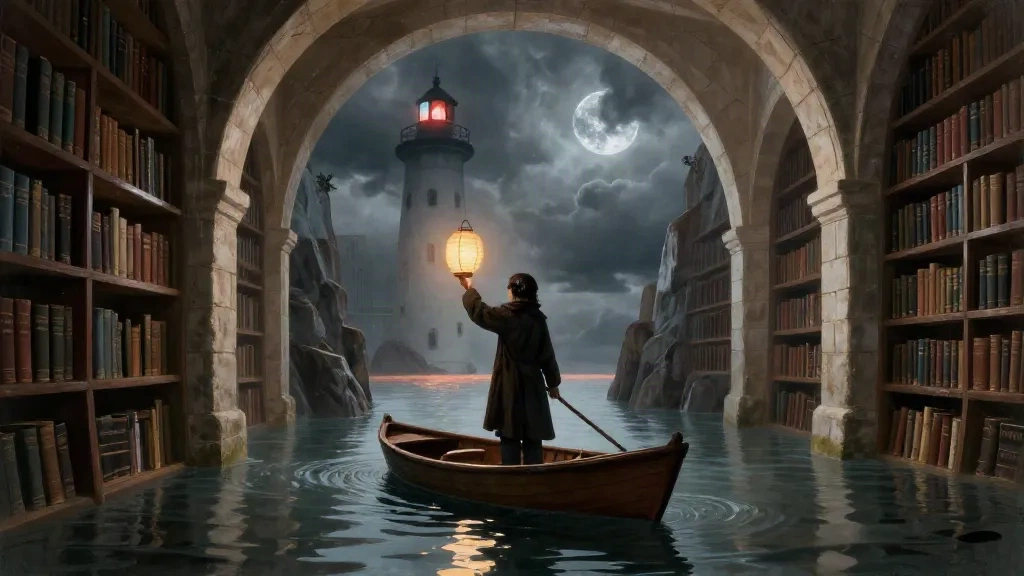
At low tide, Mara Venn rowed through the drowned archive, keeping her oars clear of shelves that rose like black cliffs beneath the copper horizon. Above her, the lighthouse beacon swept a pale stone sky, measuring storms that had never touched the city.
She was the keeper of foreign weather. Each night she entered the lantern room and catalogued what arrived through the cracked western glass: rain that fell upward, thunder with silver bells, snow composed of minute white letters. The municipal rule was simple. Every impossible thing was illegal until proven useful. Useful things were permitted, inspected, and assigned a number.
Mara's smallest instrument was a paper lantern, folded from a sailor's chart and lit by a flame no storm could extinguish. Beside it rested her private weather stone, a little moon of black cherry quartz. The moon recorded the name of anyone who passed beneath its light.
That morning the stone showed a name: Elian Rook.
A Name Gone Soft
Elian was the archive's last indexer. He had spent forty years mapping memories to their proper shelves, then had walked into the eastern stacks and disappeared. Not vanished. Forgetting had reached him first.
It moved through the city now, a collective forgetting disguised as calm. Citizens abandoned their histories, promises, and favorite songs. They smiled at strangers, paid debts they could not remember, and left doors unlocked for rooms that no longer existed. By nightfall, Elian had become a gap in the record, a man the archive could no longer locate.
Mara found him beneath a shelf marked WEATHER NOT RECEIVED. He was still breathing, but his name had been rubbed from every catalog. Each librarian who saw him forgot him by morning. By noon, the entire bureau would agree he had never worked there.
She held the paper lantern over his face. The black-cherry moon brightened, and Elian whispered, “I remember a blue door.”
That was enough. Mara tied the lantern to his wrist.
Three Forbiddings
To restore him, she would need the three witnesses who had last heard him speak: the municipal archivist, the drowned cathedral's bellmaker, and the child who sold maps from a gondola. The law forbade all three forms of intervention. A witness could not testify to an unrecorded person. A paper lantern could not be used as a mnemonic device. A weather stone could not be carried beyond the lighthouse.
Mara rowed first to the cathedral. The bellmaker heard Elian's name, then immediately forgot it. Mara placed the lantern on his workbench. In its glow, he remembered a phrase: “The rain is a witness.”
The archivist denied possessing a blue door. Mara set the black-cherry moon on his desk. He flinched when its light touched the red seal on his latest decree. Beneath the seal was Elian's forgotten signature.
By the time the gondola child appeared, the archive had begun sinking faster. Water climbed the shelves, swallowing folios and tide charts. The child pointed to a narrow current beneath the central stacks. “Elian's door is there. I used to go inside.”
But the child could not remember Elian's face, and the route could not be entered by anyone officially present.
The Door Under Water
Mara cut the municipal seal from the archivist's decree and pressed it into the lantern's fold. The paper caught fire with a blue flame. The forbidden rule snapped, and the water around them opened into a corridor of wet stone.
Beyond it stood the blue door. It had no handle, only a narrow window. Inside, silhouettes moved through rooms full of weather. Mara pushed Elian forward. He touched the wood and began to remember: a shelf ladder, a red scarf, his mother's voice.
“If I cross,” he said, “the forgetting may go with me.”
“Then we cross together.”
She took his hand, and the child followed with the lantern. The archivist and bellmaker entered last, each carrying one fragment of the storm. On the far side, the door opened into the lighthouse cellar.
At dawn, the city remembered Elian Rook. His name appeared in the archive ledger, and the collective forgetting loosened its grip. Mara entered his final entry: one person, recovered.
That night, the beacon swept across the copper horizon. Mara catalogued a new storm: gentle rain falling on every roof in the city, carrying the sound of a bell no one had rung. In her hand, the black-cherry moon had gained a second bright point.
It did not record Elian's name. It recorded hers, steady and clear, beside his.





