 Netwrck
Mystery.
The Door That Remembered Her Name
Mara Vale kept the museum's night kitchen as if it were a living thing. At midnight she sharpened the knives, polished the brass handles, and set out one plate for every door in the building. The Museum of Doors had three hundred forty-seven exhibits, each opening onto a different kind of courage: courage to forgive, to leave, to tell the truth, to enter a burning room, to remain when everyone else had gone.
Most visitors came for the famous thresholds. They stood before the blue door that opened onto courage after disaster, or the narrow white door that opened onto courage without witnesses. Mara stayed below, where the kitchen fed the hinges.
Her recipes were not ordinary recipes. A bowl of onion broth summoned the dockworker who had eaten with her grandmother during the flood. A tart made with bitter pears brought back the violinist who vanished before Mara was born. The guests always arrived hungry, never questioned how they had crossed the room, and disappeared after the final bite.
For thirty years, Mara had been trying to summon one person: her missing aunt, Elian.
Her grandmother had told the family story so often that it had acquired weather. On the night Elian disappeared, she had eaten at this table, then walked into a rainstorm and never returned. Grandma always said the kitchen had kept her.
“You don't cook for the living,” she had said. “You cook for the people who have not finished being found.”
What the Broth Remembered
On the third night, Mara poured beef stock over dried river herbs. She had found the recipe in her grandmother's notebook, written in a hand that grew weaker toward the bottom of the page. The final ingredient was not salt or thyme but a sentence:
What you are willing to lose, and will not call a price.
Mara read it aloud, then set the pot on the blue stove.
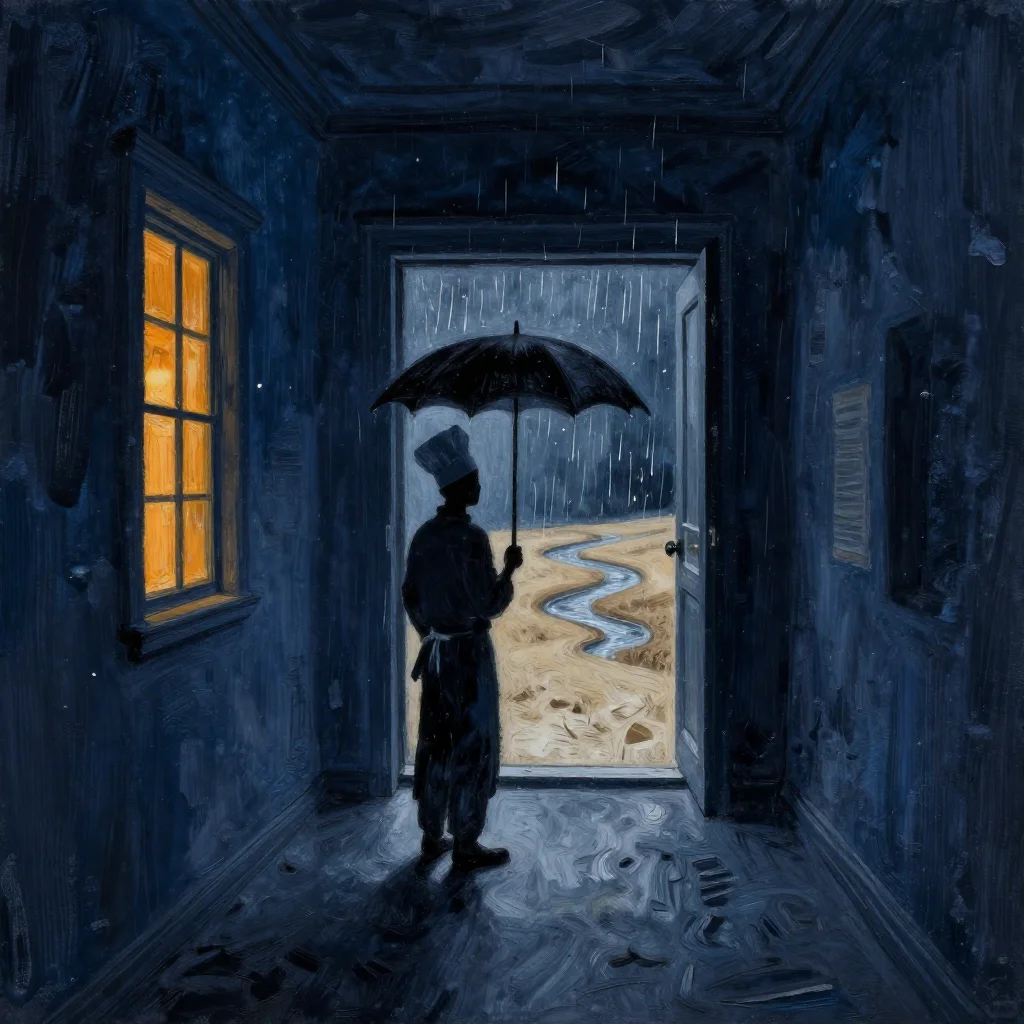
The kitchen filled with rain. It began as a silver ticking against the windows, then became water running beneath the floorboards. Mara stepped into the service corridor and found it had become a dry riverbed. Pale stones stretched from the kitchen to a black umbrella hanging upside down in the air.
Under the umbrella stood Elian.
She looked exactly as the old photographs showed her, except for one detail. Her coat shone with rain, but the riverbed beneath her feet was bone dry.
“You took your time,” Elian said.
Mara crossed the distance. The umbrella turned with her, keeping Elian beneath its shadow.
“Grandmother said you came back for dinner.”
“She said what she needed you to believe.”
Elian pointed behind them. In the kitchen, a new door had appeared. It was painted the color of a storm seen from underground, and a narrow amber window glowed in its center.
“That is the door of return,” Elian said. “It opens only after the cost is paid.”
Mara looked at the brass key hanging from her apron. She had worn it since childhood, though she had never known what it opened. The key had a narrow head, shaped like a spoon.
The Price of a Returned Life
Elian told her the truth in pieces.
The family had not lost her in the storm. Grandma had sent her through the door because the museum's founder had demanded a courage no one else could provide. The cost was not a memory, nor a year of life, nor blood. It was a table. The person who crossed could return to the world only if the table stopped being a place where the lost were fed.
“You had to choose between being found and feeding us,” Elian said. “Grandma chose for you. I did not forgive her.”
Mara looked at the pots hanging above the stove. Every guest she had summoned had eaten here. The dockworker. The violinist. The child who came only on rainy birthdays. Taking the table away would release them, but it would also make the recipes impossible. Her family's only inheritance, the proof that Grandma had loved the missing more than the living, would become flour, ink, and old paper.
“The cost cannot be paid twice,” Elian said. “That is the cruelty of the door. Once the table is surrendered, no one can rebuild it. And once someone returns, they must stay.”
Mara understood then that the family legend was true in the way that mattered. Grandma had opened a door. She had not kept Elian safe. She had kept the kitchen fed with substitutes, turning a child into a story the family could repeat without grief.
The black umbrella snapped shut.
Elian vanished.
On the kitchen wall, the amber window shone brighter. A line of writing appeared in the condensation: CHOOSE THE ROOM YOU WILL NEVER ENTER AGAIN.
The Empty Chair
Mara took the brass key from her apron and placed it on the chopping block. The pot of broth had stopped steaming. The dry riverbed cracked beneath the floorboards.
She thought of all the meals she had made for absences. The recipes had made strangers intimate because they were easier to feed than the people who might leave. Grandma had not taught her hospitality. She had taught her how to postpone mourning.
The new door waited. Elian was on the other side, or something wearing her patience. Mara could not bring her back and keep the kitchen. She could keep the kitchen and keep the legend, but only by refusing to learn who had truly paid for it.
She picked up the key and opened the door.
On the threshold, the smell of rain erased the smell of bread. Mara felt the table leave her—not physically, but from every memory that depended on it. The dockworker's hands vanished from her mind. The violinist's song. The child who liked cinnamon.
Elian stood beyond the storm-colored doorway.
“You chose the room,” she said.
“No,” Mara said. “I chose the door.”
Behind her, the kitchen became empty. The stove cooled. The hanging pots settled against one another with a sound like small bells. Then the amber window went dark.
Mara stepped through after Elian. Before the door closed, she looked once at the black umbrella turning slowly in the dry riverbed.
It had been the only thing keeping the rain out of a world that had never stopped missing someone.
On the other side, Elian held her hand. Neither of them looked back.





