 Netwrck
Mystery.
The catalog of vanished skies
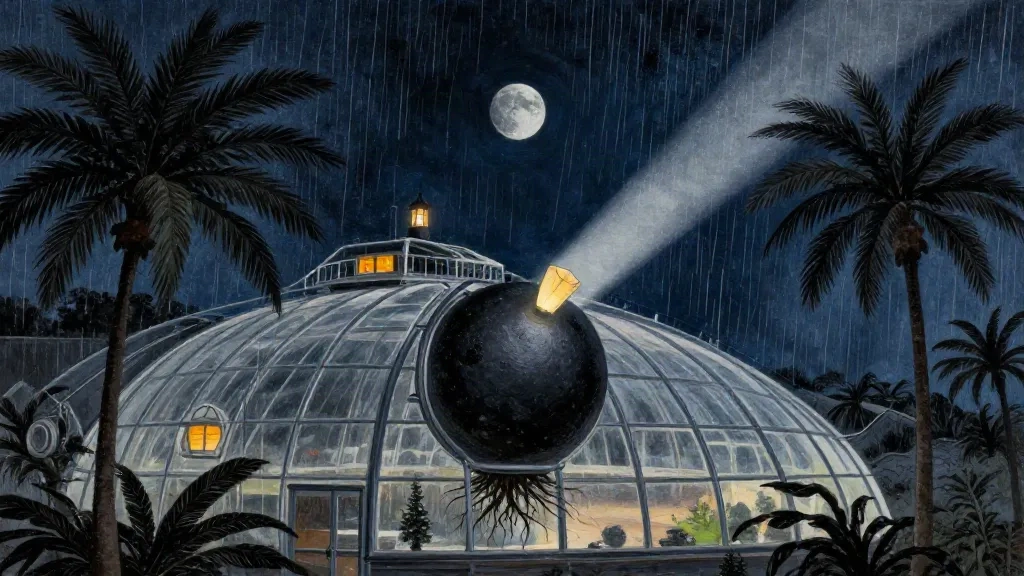
Mara Venn kept the weather ledger beneath the northern hydroponic dome, where three hundred date palms leaned beneath a counterfeit sun. Rain crossed the glass in silver threads. Every drop carried a pressure profile from a world no human being had ever stood on: iron rain from Ferrum, warm rain from the drowned forests of Vey, salt rain from the moon where the seas had evaporated into one white blade.
Seed 357 was not a seed in any botanical sense. It was a black pod the size of a heart, suspended at the greenhouse’s center inside a cage of magnetic glass. It remembered forests that had died before language learned to name them. Roots threaded the station’s girders. Leaves brushed hull plates. When the pod dreamed, the trees whispered in extinct birdsong.
Mara catalogued their weather. She was the station’s lighthouse keeper, though there were no oceans. Her light pointed inward, toward the smallest inhabited moon of the system: a thumb of slate and ice orbiting close enough to fill the observation window. Residents called it the Little Moon. Mara called it 357-B, which was not affectionate.
On the night of the impossible pressure, it stopped moving.
A law against what cannot happen
The moon hung motionless in the black. Then a paper lantern drifted out from beneath its rim.
Mara watched it approach on the exterior cameras. The lantern was folded, silver-gray, shaped like a paper cup without a bottom. A municipal notice appeared across the observatory glass:
Provisional Ordinance 88: No celestial object may remain fixed without a recorded cause. No object may cross a sealed boundary without permission. No memory may be used as infrastructure.
The station had passed the ordinance through a narrow vote while the outer canopy was failing. Its purpose was simple. The municipality disliked impossibilities. They made budgets impossible, repairs impossible, and responsibility impossible to assign.
Mara entered the lantern in the ledger: unauthorized object, probable debris, cause undetermined.
The greenhouse dimmed.
Every display behind her went black except one. Far across the station, a single window burned amber. Mara knew who lived there. Ilyan Saye had been missing for three rotations. He had gone into the seed chamber during the storm and never returned. Everyone agreed he had been lost to the remembering trees. Everyone except the door scanner, which continued recording his weight entering and leaving.
Mara’s task was to save him. Not the trees. Not the station. One person.
She opened the seed archive. The oldest record showed Ilyan’s face beneath a canopy of leaves that had not existed for ten thousand years. Beside it, Mara found a warning: Do not permit the remembered forest to acquire a living address.
Rain in the wrong direction
Mara went to the municipal chamber. Its three custodians sat behind glass, waiting for the impossible weather to become administratively possible.
“The moon has no engine,” said the first custodian.
“Then your law forbids it,” Mara said.
“The law does not forbid it. The law forbids permitting it.”
She presented the door scanner record. The second custodian examined it and pronounced it an error. Mara placed the paper lantern on the counter. Rain struck its folded surface and climbed upward into the ceiling.
That was the complication: the rain obeyed no direction. It fell from clouds, then rose toward the pod’s roots. The trees drank silver. The lantern unfolded itself, one crease at a time, revealing a small blue flame inside.
“That is not a permitted light source,” said the third custodian.
Mara took the lantern.
They ordered her to stop. She ran. Every sealed door reported an illegal passage. The station marked her as a hazard, a trespasser, and finally as a natural phenomenon without a responsible owner.
In the seed chamber, the roots had grown around a human shape. Its face was smooth bark. Mara shone the lantern against it. Beneath the amber glow, Ilyan opened one eye.
“They’re forgetting me,” he whispered. “But the trees remember me as a door.”
The keeper’s entry
Mara cut the magnetic glass.
Alarm filled the greenhouse. The municipality declared the seed’s memory a public danger. The Little Moon began to fall, slow and inevitable, toward the hull. In the station logs, Mara entered the event under weather: rain ascending, lunar condition unresolved, one survivor located.
She added the address of Ilyan’s window. Then she wrote the truth the ledger had been designed to prevent:
A forest cannot be safe if it erases the people who shelter inside it.
By dawn, the moon had become a small blue bead fixed in the eastern sky. The paper lantern burned without fuel. Inside the amber window, Ilyan slept beneath a blanket of leaves, alive and complaining about the taste of remembered rain. Mara remained in the catalog room, where the extinct forests whispered their names and the keeper finally had one person to record.





