 Netwrck
Historical Fantasy.
The Returning Tide
In 1718, the sea gave back what the people of Saltmere had misplaced.
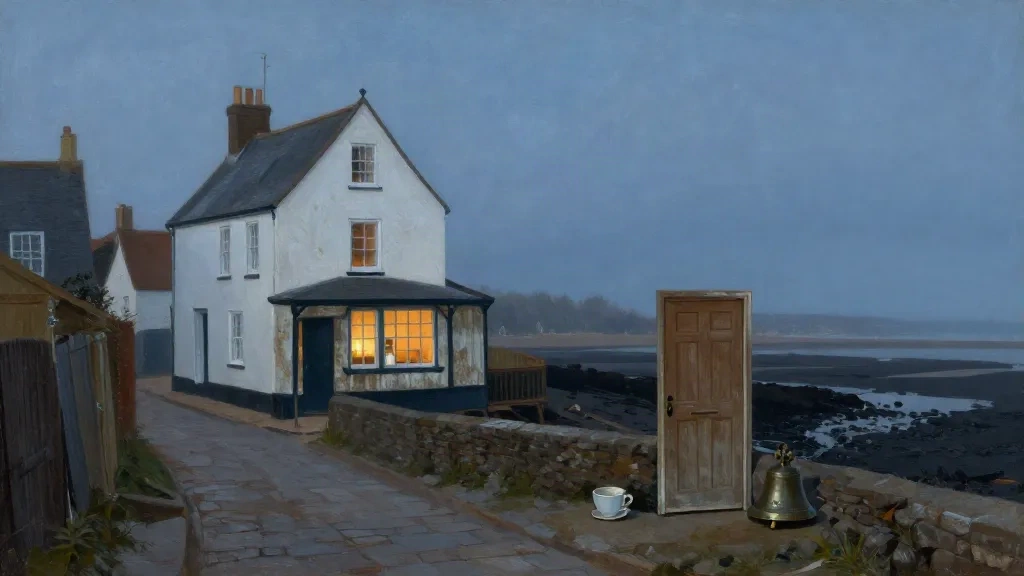
At low tide, it left a brass button beside the pilings, a wedding ring in the black mud, a child’s shoe filled with sand. Once a year, when the moon was a thin sickle and the fog refused to lift, it returned a larger thing: a chair, a chest, a door with no house around it. The objects came ashore with the patience of things that had waited beneath the water for someone to remember them.
Ilyra Senn kept the town library in a salt-white building above the chandlery. Her shelves held charts, ledgers, sermons, and weather records. In the reading room stood one book bound in blue cloth.
No two callers described it the same way. A ship’s cook said it contained the proper order for cutting onions. A widow claimed it was her own diary, though she had never been able to read. A man from the eastern counties borrowed it, returned it, and came back the next morning asking whether he had been a child in another town.
“It lends itself,” Ilyra told them. “Borrow it, and leave it on the table when you are finished.”
That was its only rule. The book never left the library. It simply appeared in a different reader’s hands, containing the one truth that person had been carrying without words.
The Empty Place
Ilyra’s wish was modest enough to be mistaken for madness: she wanted a home for impossible residents.
Saltmere had no room for the returned things. A door leaned against the church wall. A brass button rolled under the magistrate’s bench. The town council called them curiosities, then hazards, then finally signs of a disordered sea. Nobody would give them shelter.
So Ilyra began keeping the objects in the library. She put the empty teacup on the windowsill, where it filled with rainwater every night and emptied itself by morning. She hung the cracked bell near the fireplace, though it had no clapper and made no sound. She told herself these were harmless curiosities, not the beginnings of a household.
One autumn afternoon, a child came in barefoot. His name was Pell, and he carried a strip of blue cloth caught around his wrist.
“You have a light behind the door,” he said.
“There is no door.”
Pell pointed behind the shelves. “There is one now.”
Ilyra looked. The wall remained blank, but a narrow line of candlelight trembled along the floorboards. The empty teacup on the sill filled with light instead of water.
“Who is there?” she asked.
“The person you gave the book to.”
“I have given it to many people.”
“They all came back changed. They didn’t come back here.”
The Thing Overlooked
Pell drew the book from beneath the reading table. Its blue cover was damp. When he opened it, the pages held only a list of names.
Ilyra recognized the first. Mara Pell, aged eleven, died in the winter flood of 1664. The second was Elias Rook, a bell founder whose foundry burned. The third was Anne Vey, a woman erased from every parish record.
At the bottom was Ilyra’s name, followed by a date three days hence.
“The tide returns forgotten things,” Pell said. “But this is what the town forgot to forget.”
Outside, the foghorn sounded once. In the harbor, ships answered from invisible distances.
“Who is the resident?” Ilyra asked.
“You are.”
She shut the book. “I have spent twenty years keeping other people’s lost things.”
“Then you know where they belong.”
That night, Ilyra walked the empty streets with Pell. At every corner, the sea whispered behind the walls. A returned key lay in a doorway. A wet coat hung from a drainpipe. A woman stood beneath the town clock, her face hidden by the hood of her cloak.
The people of Saltmere had agreed not to see her. Their eyes slid away whenever she stepped forward. Pell saw her clearly.
“She is the bell keeper,” he whispered. “She remembers the night the bell cracked.”
The woman raised one hand. In her palm rested a small clapper, black with age.
A House for the Unremembered
At midnight, Ilyra opened the library doors.
She placed the empty teacup on the threshold. The cracked bell hung above it. The bell keeper entered, and the returned things followed: the door, the chair, the child’s shoe, the brass button, the ring, the coat. They filled the reading room without crowding it.
Pell took the blue book and wrote Ilyra’s name on the final page. The ink dried. The pages began to turn themselves.
Outside, the tide rose. It brought no new objects, because at last the sea had nothing left that the town had lost.
In the morning, Saltmere found the library standing where it had always stood, though every window burned with reflected candlelight. The children’s shoe was gone. The door was gone. In the reading room, strangers sat reading the same impossible book, passing it from hand to hand.
And at the back, beside a cup that held a little seawater, sat a woman with no shadow, listening as the cracked bell remembered its voice.





