 Netwrck
Surrealism.
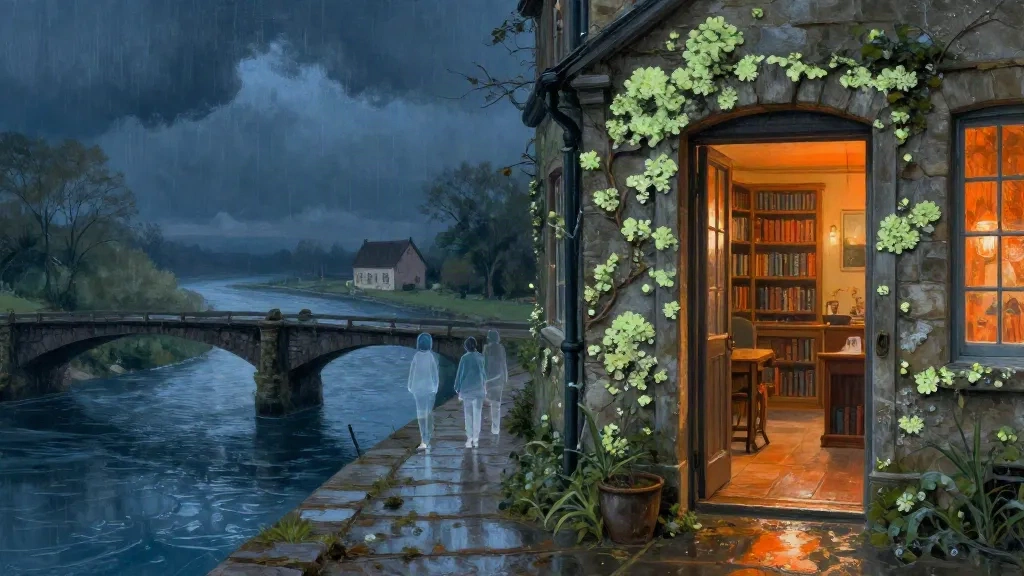
At the end of Cinder Quay, where three bridges met the river without quite agreeing where the banks ended, librarian Oren Vey kept an empty teacup on the desk. It had no chip, no stain, and no memory of tea. Whenever someone asked, he said it belonged to the tenant who had not arrived yet.
The Book of Unbuilt Rooms
Oren’s library occupied a narrow house at 768 Lantern Street. Its shelves held histories of vanished marshes, grammars for languages spoken by weather, and one book with no spine. The book appeared under different titles but never changed: A Room Will Remember You. Its cover showed an empty doorway glowing in blue storm-light. Whoever borrowed it disappeared for a night and returned describing the same place: a small house beside a river, with a kitchen, two chairs, and a garden where the soil grew doors.
The borrower’s name disappeared from the library ledger. So did every promise that had excluded them. The bell above Oren’s door, cracked from its first chime, rang whenever the book was returned.
Oren understood then that it did not lend shelter. It lent permission.
The Child at the Toll
On a wet evening, a girl named Mael arrived and asked to borrow the book. Oren told her no one could stay in the room unless the town had promised them a place. She pointed toward the river.
“You don’t see him,” she said.
Beneath the central bridge, a man was repairing the stones. His hands moved through the mortar, his boots left prints, and his reflection trembled in the water, yet Oren saw only wet brick. Mael watched him plainly.
“The town agreed not to see,” she said. “That does not make him stop being there.”
Oren gave her the book. Before midnight, every bridge in Bellwether began to hum. The town’s oldest promises had been made by people who were no longer alive, children who had not been born, and strangers who had been erased from the records. The bridges remembered, for bridges cannot witness a lie without becoming one. Under their spans gathered the residents no map acknowledged: a woman whose shadow had wandered off, a boy with two names, a translucent fisherman who smelled of deep rain.
The Empty Cup
They entered the library without opening the door. The cracked bell struck once for each of them. Oren set his empty teacup in the center of the room. The invisible man lifted it, though his fingers passed through Oren’s. Steam rose between them.
“You have a promise,” the man said. “But you have never offered it.”
Oren looked at the ledger. Beneath his name, every entry ended with a condition. A house for the worthy. A bed for the useful. A future for the understood. Oren had spent years lending impossible rooms to people the town feared, but he had never imagined a home for the impossible themselves.
He took a pen and wrote: No resident shall be asked to become smaller than they are.
On the bridge, the tollkeeper demanded a memory in exchange for passage. The river rose beneath the arches, dark as a witness under oath. The invisible man placed one stone in Oren’s palm. Inside it was a pulse, patient and small.
What the River Kept
By dawn, the three bridges had opened. Their planks formed a road across the flood, and the river carried every forgotten resident toward the unbuilt house. The garden there grew doors for their missing hands, their absent shadows, their names that had been swallowed by rain.
Oren arrived last. Behind him, Bellwether’s bridges fell silent one by one. The cracked bell remained in his library, but the empty teacup stood on the new kitchen table, full at last.
Mael looked through the doorway at the town and the home beyond it. “What will the bridges promise now?” she asked.
Oren listened as the river, witness to every broken vow, answered with a sound like distant hooves.
“That there is room,” he said.
By evening, a light appeared in every window of the house that had never been promised. The river kept its count. The bridges held. And at 768 Lantern Street, the empty place in the ledger began, carefully, to fill itself.





