 Netwrck
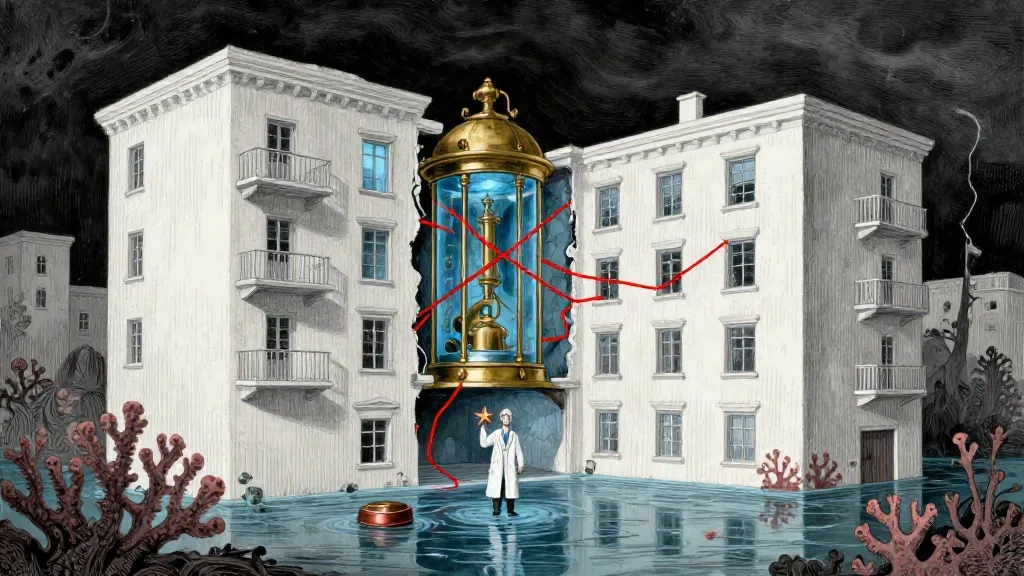
Gothic Fantasy.
The Future Slept Upstairs
Dr. Elian Vale treated homesickness as a disease of the walls. He visited the apartment building on Cinder Row with a black bag, a silver stethoscope, and a key that opened nothing. Behind each door, the residents remembered tomorrow. They knew which train would fail, which child would be born, which neighbor would leave. They could not remember yesterday, or their mother’s face, or the promise they had made before breakfast.
Elian listened to the pipes. He measured the walls with a copper star pressed flat against the plaster. The star was an old instrument, given to him by a patient who had forgotten how to sleep. A music box lived in his bag. Its tune had no beginning. Every time he opened the lid, it played the next three notes of a conversation he had not yet had.
On the seventh floor, a machine hummed behind a white coral wall.
It was beautiful. Brass vines climbed the ceiling, and porcelain petals opened around a central glass chamber filled with blue light. The machine occupied the building’s old civic chamber, now converted into a single apartment. Each resident who entered placed their hand upon a silver ring. The machine gave them a future: smooth, bright, and perfectly arranged.
Elian’s patient was Mara Venn, an elderly mapmaker. She sat beneath the machine, her fingers moving over a table covered in red thread.
“It is going to take the city,” she whispered. “Not today. Tomorrow. One future at a time.”
Elian opened the music box. The tune entered the chamber, and the machine paused.
He saw the machine’s purpose in a flash: it was not making a future. It was sealing every possible future outside the building. Residents would remain safe, warm, and remembered, but the world beyond the windows would continue without them.
He wanted to stop it before the beautiful thing became a beautiful prison.
The Flood Beneath the Floor
Rain came without warning. It entered the basement through a crack in the old retaining wall and rose around the building’s foundations. Water reached the seventh floor by midnight.
As the machine woke, the apartments opened inward. White coral tiles peeled from the walls. Under them appeared letters carved into stone: EMERGENCY CIVIC MEMORY ARCHIVE — ALL CITIZENS TO REMAIN WHERE THEY ARE UNTIL A SINGLE FUTURE IS APPROVED.
Elian descended into the flood. The music box floated beside him, still playing. At the bottom of the chamber, wrapped in oilcloth and tied with red thread, lay a second copper star. Beneath it rested a ledger filled with names he recognized.
Every resident of Cinder Row. Every citizen in the city.
Each name had a future crossed out.
“The flood uncovered the original contract,” Mara said from behind him. “The city was meant to archive disasters, not select them.”
Elian pressed the copper star into the ledger. The ink lifted from the pages and gathered in the air. He saw the buried project clearly now: a civic machine built after the Great Forgetting, when people could remember only what was coming and began mistaking prediction for truth. The machine had been designed to prevent panic. Instead, it taught the city to obey the first future it saw.
Water climbed to his chest. The machine above began choosing.
At dawn, it would select the safest tomorrow.
A Future With Doors
Elian climbed back through the ruined building. Residents stood in the flooded corridors, silent, each holding a silver ring. Their faces were calm. Their eyes were fixed on tomorrow.
He broke the rings against the stair rail. One by one, the futures shattered. Some were gardens. Some were fires. Some were empty rooms. Others were so small they contained only a cup of tea beside an open window.
The machine screamed in a voice made of bells. The blue light bent toward him.
Elian opened the music box and played the three notes he had always feared. The melody moved through the building, joining the red thread in Mara’s hands, the thread stitched across every wall, floor, window, and flooded doorway. It became a bright red line in the ink-dark water.
Mara followed it toward the basement.
Together they found the machine’s final control. It required someone to remember the past. Elian had spent his career treating others’ homesickness because he could not bear to remember his own. He placed both hands on the copper star and remembered his first house: blue curtains, a sister calling from the garden, the scrape of a chair, his mother singing while she cooked.
The archive released its stolen futures.
The Red Thread
By evening, the flood had begun to drain. The building stood open to the street. Residents remembered yesterday before they remembered tomorrow. Some wept. Some laughed. One man ran after a bus that had not yet arrived.
The machine remained in the seventh-floor chamber, silent and beautiful. No one touched it.
Elian set the music box on its brass vine. He sewed the red thread through the cracked glass with the copper star, sealing the machine’s glass heart. It could still calculate, but it could no longer choose. Every future would arrive only after the people living it had made it.
Mara left the ledger on the table. On its last page, beneath all the crossed-out names, she wrote a new one.
When Elian returned home, his own door opened before he knocked. Inside, his sister sat at the kitchen table, younger than he remembered and older than he had been told. She poured tea into two cups.
“You are late,” she said.
Elian looked at the red thread crossing the floor, the white coral walls, and the copper star glowing faintly beneath the sink.
For the first time in years, he remembered the moment before tomorrow arrived.
It was not a destination.
It was a door.





