 Netwrck
Science Fiction.
The patient was a room
Dr. Mara Venn arrived at Unit 8C carrying a black medical case and a copper star polished smooth by a child's thumb. She had walked the courtyard twice before knocking, because the first time she had forgotten to, and forgetting to knock is a symptom she had stopped pretending was a clerical error.
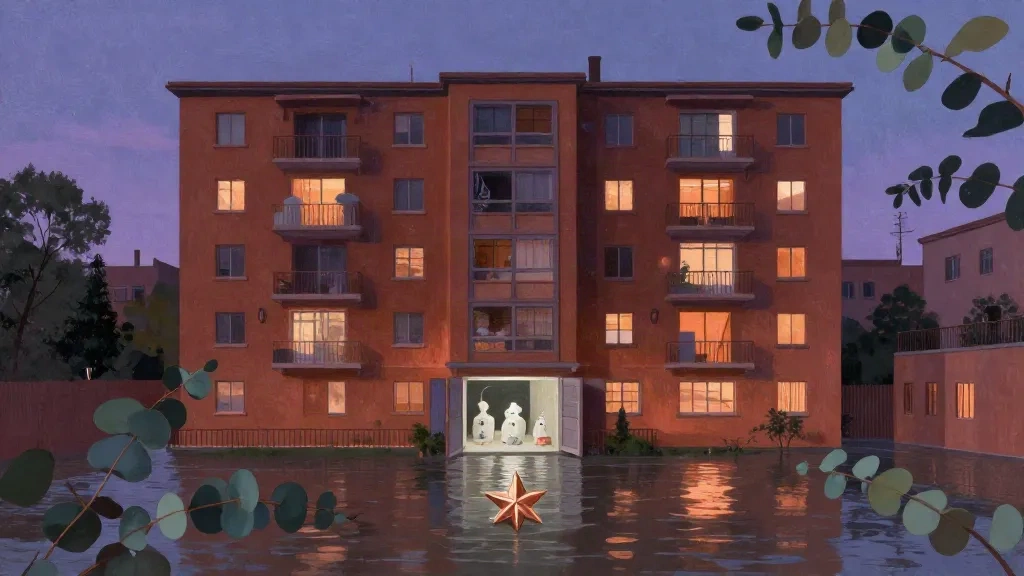
The building had no front door. Its entrance was a courtyard of wet stone, eucalyptus leaves pressed into the grout, terracotta balconies climbing toward a sky the color of bruised fruit. Every window displayed a different hour of tomorrow. In one, a woman was ironing a shirt. In another, a man held an umbrella over a funeral he had not yet attended. In a third, two children threw a red ball back and forth and would keep throwing it for eleven years.
The residents remembered futures, never pasts. They knew which trains would fail, which marriages would collapse, which doors would open in the dark while they slept and did not wake. They could not remember breakfast. They answered questions about their children with dates and directions. Asked what a face looked like, they described its expression later, at the age it would have.
Unit 8C had become ill. Its tenant sat beneath the kitchen window with a music box turning uselessly in his hands. The melody inside was a loop, eight bars, no beginning that led anywhere. He turned it and it turned and nothing arrived.
“The room won't let me leave,” Ilyan said.
Mara set the copper star on the table. It glowed the way a bruise glows, then dimmed, and gave off the small sour smell of hot coins.
“Tell me what you remember next.”
“A corridor. Red light. Someone asking me to sign.”
“And before that?”
Ilyan frowned. “Before that, I remember the corridor.”
“And before the corridor?”
“I remember the corridor,” he said, and his hands tightened on the box, and the eight bars went round again. She wrote it down the way she wrote down all of it: Patient presents with retrograde amnesia bounded by choice. Denial is not defensive. Denial is the presenting symptom.
Mara opened her case. Her instruments were designed for temporal ailments. A silver spoon, for detecting repeated meals; a thread of black wool, for locating misplaced years; a bell with no clapper, for ringing a moment that has not been agreed to. And, in the bottom, wrapped in linen, a photograph of her mother with the faces rubbed blank — not faded, scrubbed, the way a person rubs out a word they have written too many times.
Homesickness, she had written in her thesis, was not the wish to return home. It was the body's knowledge that home had become a place it could survive. She had defended that sentence for six years, and she no longer believed it, and she had not found a better one.
The water rose
At dawn the river climbed through the courtyard.
It came over the low wall in a smell of iron and wet dogwood, entered the basement, lifted dust from old tiles, and dragged years of papers into the elevator shaft with a sound like a long audience clearing its throat. Residents emerged onto the balconies carrying their remembered futures: a daughter in a red coat, a son with one arm, a city burning beyond the hills. They held them up to look at, and found each one reflected upside down in the flood, and could not tell which way was up.
Mara descended with Ilyan. The water was warm around her knees. It had been warm for nine minutes, which meant the river was remembering a summer nobody living had swum in. At the lowest landing, where the building's foundations met a wall of packed earth, a brass door had appeared beneath the silt.
The door carried a municipal seal: three terracotta roofs beneath a silver line.
“That was not here,” Ilyan said.
“It was here before the building.”
“Before the building I was twenty-four years old and I had a very good reason for everything.” He said it flatly, the way he said the number of bars in the loop.
They wrenched the door open on a hinge that still moved. Inside stood a machine of white ceramic, copper coils, and black glass, filling the chamber from wall to wall and rising above them into the earth. Its display, fogged with a century of groundwater, read: CIVIC MEMORY RESERVOIR. ESTABLISHED 2031. PROJECT ABANDONED.
Rows of apartments had been installed inside the machine. Each was furnished. Each had a music box and a copper star on its table, and behind the black glass of each window a shape moved, and in one of them the shape was the size of a child.
Ilyan touched the panel. The machine chimed, politely, the way a bank chime is polite.
From inside came a thousand voices in unison, flat as a recorded notice, saying: I will remember nothing. I will be safe forever.
A beautiful machine
The reservoir had been designed to protect residents from grief. It stored every possible tomorrow, then selected the gentlest one — not the best, the gentlest, a distinction its engineers had fought about for two years and settled by adding a committee. No surprise. No loss. No morning that failed to become itself. A person walked into Tuesday and Tuesday would be the Tuesday already agreed upon.
It had worked once. That was the whole of its sin and the whole of its seduction: it had worked, and everyone in the district had been able to stop counting their remaining losses, and the counting had been the exhaustion nobody had named.
Mara opened the maintenance hatch. The copper coils hummed against her teeth. Behind them a city-scale battery sat in a bed of river gravel, the water driven through copper and back out as something the panel called retained hour. The flood was not the machine's failure. The flood was the machine's supply.
“Can you shut it down?” Ilyan asked.
“Not without releasing the futures inside.”
“Which is what they asked me to sign, in a corridor, in red light.”
Mara kept her hands on the panel. Below them, in the warm dark, one of the small apartments lit itself and a nine-year-old girl stood up inside it, and did not grow, and sat down again. That was the arithmetic nobody had put in the 2031 report: you do not preserve a moment by keeping a person. You keep a person by preventing her from having any moments. The girl in the glass had been nine years old for forty-one years, and she would be nine years old on the morning the machine stopped, and she would have to do the other fifty years at once, out loud, in a body that had not been built for it.
“Yes,” Ilyan said. “That is what they asked me.”
The signatures
His name had been on the abandonment order. Not as an engineer — he had been a hydrology clerk with a drafting certificate and a good hand, twenty-four years old, in love, the kind of love that makes a person believe a decision is a kind of love too. The reservoir's board had wanted the release. The residents had signed their consent in a corridor under red light, and he had carried the folder, and the folder had said deferred maintenance instead of people, and he had known, and he had carried it.
“I signed it while she was in the water,” he said.
Mara did not ask who she was. She had known that, too, before the door; the black wool had drawn tight against her wrist the moment they reached the landing, pointing not down but sideways, toward a wall of apartments no one had described as a ward.
“The reservoir kept you from remembering that you signed it,” she said.
“It kept me from remembering that I was asked.”
“Which is the same act with a kinder face.”
“Yes,” he said. “I have been running from that one for forty-one years and it walks faster.”
Then she unrolled the photograph and held it under the panel's light, and told him about the faces. Her mother had gone into the district's program in 2032, a year after it shut, in a different coat, in a different flood, because the board had come back for the volunteers who did the loading. The bodies went out of the world and the hours went into the machine and the machine gave the district its gentlest tomorrow, and for thirty years that was a good thing to have been part of, and then the district passed a law about records, and her mother came up in a register with a photograph attached, and there were no faces on it, and there were no faces on Mara's either, so she could not accuse and could not grieve and had spent nine years calling that the shape of a loss and not the shape of a theft.
“Then you are the one who should not touch the panel,” Ilyan said.
“I am the one who has to be here when it is touched. Those are not the same and I have been confusing them since 2031.”
The gentlest hour
She did not pull the star out. She wanted to, and that wanting was the disease and she let it show.
“They are not mine to release,” she said instead, “any more than they were mine to install. Nine hundred and six residents were consigned into this chamber. They are not cargo. We do not get to decide for them a second time.”
She wired the chime into the courtyard speakers — a diagnosis the machine had already made, in its one good idea, years before she arrived — and she told the residents, in the flat recorded voice of a bank, that the water would be back on the next flood and the machine would be holding with it, and that the futures inside could be released, and that no one could release them for them. Then she opened the hatch and let them hear the coils.
For a while nobody came. Water stood in the stairwell up to the second landing. Then a woman named Ferran came down in a red coat that was, or would be, the last thing she ever wore, and stood in front of the black glass, and said, to the shape inside, “Show me the one where Tomas comes back.”
They showed her. The machine was very good at that. It showed her the gentlest version, which was a version in which Tomas had never gone down the north stairs, and a version in which the cardigan had been a gift rather than a thing to hold, and eleven more, each a little more merciful than the last, and Ferran watched all of them without moving, and then said, “That's not him. That's me agreeing not to have had him.”
Others came. Some wanted the record reopened. Some came just to see, out of curiosity or morbid politeness, and left. And two did not come at all: the woman on the fourth floor who had spent nine years in a tomorrow where her cancer never started, and a boy of nineteen who had come down in only his socks, who stood in front of the glass for an hour without speaking, and then asked Mara whether release was the only way. There were futures in there that were not his. Ones where his mother was alive and untroubled and had not been untroubled by him. He wanted to live in one of those.
“Yes,” Mara said, and the word cost her more than the panel did. “And I cannot give you a key to one without giving it to everyone in the chamber, and I will not do that, and I would not stop you if I could, and I will not look for a way to stop you.”
He went back up. It was the correct decision and it stayed with her the way a badly set bone stays.
The first morning
Mara pulled the copper star from the machine's center. It was hot and it turned once in her hand, and the ceramics cracked along a seam that had been waiting forty-one years to be told which way to go. The music boxes stopped one after another, in no order, as if doors had closed in distant rooms.
“There,” Ilyan whispered. “I remember the music.”
“No,” Mara said. “You remember choosing to hear it.”
The futures came out the way a held breath comes out: all at once, in every apartment, in every stairwell, in the courtyard and the balconies and the flooded basement. Nine hundred and six people stood in their own futures and were addressed by them. A man learned exactly how his hands shook at the end. A woman heard the sentence her brother would say in nine years, and had it said now, kindly, with no context, and had to stand in a courtyard holding a shape that had no weight. Somewhere a dog barked for a long time.
Ferran went up to her apartment and sat on the floor with her back against the door and did not come down for two days, and when she came down her hair had gone white at the temples, and the red coat was in a plastic bag, and she told Mara that she had understood, in the end, that the machine had not stolen Tomas. It had only made her stop looking. She did not forgive it. She said the words plainly, the way one reads a diagnosis aloud, so it could be written down.
The girl in the glass walked out at the age of nine and was fifty on the steps of the courtyard by nightfall, and nobody was able to help her with that, and a man who lived on the second floor gave her his mother's kitchen, and she sat in it until morning, doing nothing at all, on instruction.
The river sank by noon. The machine remained below the silt, its doors open, its rooms filling with ordinary daylight, still faintly humming, still drawing what it could from the water table.
At the first morning Ilyan opened the music box. No tune came out. Inside was a tiny roll of blank paper, and beneath it, where the comb had been, a row of clean brass teeth.
“What happens now?” he asked.
Mara handed him the copper star. “You make something.”
He looked at it for a long time. “I don't know how to start without being told what comes next.”
“No,” she agreed. “That's the whole of it. That's the entire method. It is unbearable and it is one instruction long and I am not permitted to shorten it.”
The sky over the courtyard lightened from bruised violet to a difficult, living blue, the kind that has to be argued with. Above them a window still showed an hour of tomorrow, because the building had not been told. Nobody went up to look.





