 Netwrck
Fairy-Tale Fiction.
The Tenant of Tomorrow
By morning, the Marrow House had begun remembering the future.
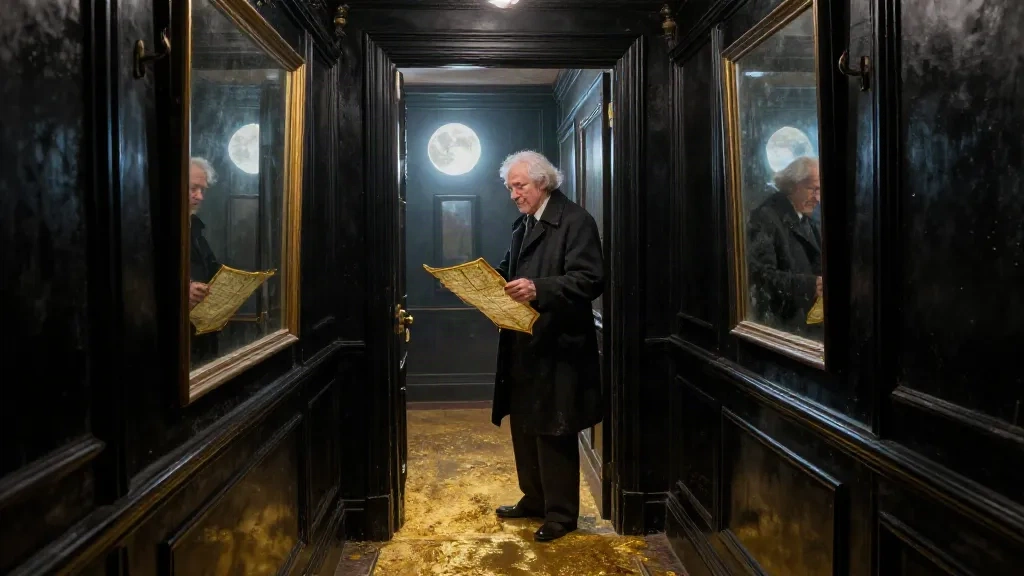
Its tenants could recall only what had not happened yet. They opened letters before posting them and knew which elevator would fail on Thursday. They left breakfast uneaten when the day announced its funeral. The building stood on a narrow street beneath a cold moon, its windows black with lacquer and its brass numbers newly polished, as though someone had come through in the night with a cloth and an appetite.
Silas Venn lived in apartment 4B. He was a retired actor, remembered chiefly for a final performance in which he had played a king dying before his kingdom discovered it was already gone. Reviewers had called it restrained. They had not understood that he was acting from a script he had written himself, years earlier, in a house much like this one. He had spent sixty years leaving rooms. Now he possessed one peculiar privilege: he could re-enter any room he had ever left.
It had begun as a memory and become a key. When Silas turned from a doorway, the room remained behind him, patient. Years later he returned by thinking of the exact angle of its light, the squeak of its chair, the particular breath its walls had learned.
On the table beside his bed lay a folded map, its creases softened by his grandmother's hands. Across the paper she had written one promise:
I will keep the eastern room empty until the family learns to tell the truth.
She had died before the promise was fulfilled. Her son, Silas's father, had let strangers rent the room and never once mentioned the map. Silas had done worse. He had read the same promise every morning for thirty years and never asked why an old woman's handwriting could weigh anything at all.
Rooms for Falsehoods
At noon, the house complained.
A crack opened along the eastern wall, splitting the wallpaper into pale seams. Dust spilled out, followed by a floor, a chair, a narrow bed, a ceiling painted with constellations. The room was warm. Someone inside was humming a music box.
Silas recognized the tune. Isolde had played it when she made her promise, moving her finger on the brass lid as though winding a star. The tune was wrong. Its last note arrived before the others, as though the melody had learned to lie about its ending.
“A lie has taken root,” said the superintendent, who never looked at tenants directly.
“In whose?”
“She does not keep names. She keeps the order they came in.” Roon turned the brass key ring over in her hands, counting by touch. “Yours is old, Mr. Venn. Old and load-bearing.”
Silas entered. The door shut behind him.
Inside, a girl sat beneath a black-lacquer window. Gold dust drifted through the moonlight and settled on her sleeves. She wore a coat from an age before Silas was born, buttoned to the throat, the way children are dressed when someone expects them to be taken out in cold weather and be brought home.
“You're late,” she said. “I was promised the room.”
“You cannot remember a promise.”
Her face tightened. “I remember the future. You will forget me tomorrow.”
Then she told him the thing the house did not know it knew: that Isolde had not made her promise in a metaphor. In the spring of 1949, in a town with a name Silas had never been able to pronounce, a girl named Wren had stood in a doorway and been handed a paper moon by a woman who swore she would find her a room of her own. The girl had crossed three countries looking. She had been eleven, then nineteen, then thirty-one. The house had collected her, because the house is where promises go when they are spoken with conviction and no means.
Silas searched the map. Behind the folded paper was a small brass key. He had overlooked it for thirty years because he had been reading the same promise instead of listening for the door it opened.
The music box stopped.
Another wall split. A new room appeared, filled with mirrors. In each reflection the girl was older: a young woman, then an old woman, then a corpse wearing a thin gold crown, her hands folded on a narrow bed exactly like the one behind her.
“Every lie adds a room,” said Silas.
“No,” she answered. “Every unkept promise does. A lie is only the shape a promise makes when it's too frightened to stand up.”
The Inventory
Silas went down to the basement, because the house kept records and he wanted to be lied to in writing.
The boiler room had been converted without ceremony. Shelves of ledgers lined the wall, each spine labelled not with names but with hours: Tuesday, Ten Past Four; Thursday, Before the Rain; That Spring. Roon had a rule about tenants who came down here uninvited, which was that she would answer any question except the one they had come to ask.
He found his own volume. The entry for the night his family moved out was written in his father's hand, pressed hard enough to score the page beneath.
Left the flat. Told the boy he would come back in the morning. Boy said he didn't need anyone. Rented eastern room to a man from the office. Rent was needed.
Two lies in one line, and a truth hiding under them like a man under a bed.
The boy had said it at nine. Silas remembered the doorway, the cold stair, his grandmother behind him with the map half out of her apron, saying his name in the tone she used for things that were true. He had not refused the map. He had refused the sentence before it, because he had decided, at nine, with the terrible logic of children, that needing someone was a debt that could only be called in at the worst possible moment, and that the safest moment never came.
Isolde had put the map in his pocket anyway. He had thrown it under the bed of the new flat, and it had waited there eleven days, and then his father had swept the room, and the map had come to Marrow House by itself, the way a bill does.
He read the other volumes on the way up. A woman on the third floor had known in advance that her son would drown in the canal and had told no one, because telling would have proven she loved him, and she had needed to be told by a doctor in a corridor. A widower in 2A had known he would outlive his own house and had never moved, and the house had loved him for it, and he had died in a chair with the radiator warm. The Marrow House, Silas understood, was not a monster. It was a clerk. It kept what it was given, in the order it was given.
But the eastern wall was not in any ledger he could find. It had no hour. It had a name, scratched very small into the plaster near the floor, in handwriting he had spent a lifetime failing to read as anything but his own.
The Actor Returns
Upstairs, the crack had widened. Two new rooms now showed through it: a kitchen where a man he did not recognize was eating, alone, at a table set for two; and a hallway where a woman in a nurse's uniform stood with her hand on a doorframe, listening to something on the other side, and had been listening for a very long time.
“I cannot reopen a room I never left,” Silas said to the girl.
She opened the music box. Gold dust spilled from its empty mechanism, falling upward toward the painted constellations before it vanished.
“You left this one when you were nine. You stood in the doorway and said you did not need anyone.”
“I don't remember standing in a doorway.”
“You remember the room. The doorway was only the door you used to get out of it.”
He closed his eyes and entered the room he had left at nine.
It was the same room: cold moonlight, black lacquer, gold dust, the map beneath the window. His younger self stood there with his hands in his pockets, performing the pose of a boy who did not require anything. His grandmother stood behind him, and she was not asking him to stay. That was the cruelty of it, and the mercy. She was asking him to be certain, and she would accept whatever he chose, and she had already decided to keep the room anyway.
Silas turned to the boy. “I was afraid to come back.”
The boy nodded. He was not patient with him, which was correct.
“I wanted her promise. I wanted someone to swear something at me and stay alive to keep it. So I made it impossible to give me one.”
“Then ask,” said the boy.
“I asked for a moon,” Wren said from behind him. “Not from her. From the whole house. Give me a room and I will stop asking.”
Silas opened his eyes. The walls stopped splitting. The music box began again, this time with every note in its proper place.
What the Girl Wanted
There were, he was given to understand, three ways the eastern room could end.
The first was admission: for every falsehood he said aloud, the house would take a wall, and by the fourth there would be nothing left of the Marrow House but a corridor and a clerk. His father's death was coming on Thursday. Silas had known it since Tuesday, standing in the hall with his coat on. He could go up to the seventh floor and knock and say the sentence that would cost him the house, and then his father would not die on Thursday, and neither would the Marrow House, and neither would Wren, because the clerk would have no walls left to build her in.
The second was occupancy. The promise had been a room, and rooms are discharged by being filled. If Silas took the eastern room himself, it would be full, and the promise would be satisfied, and Wren would be finished — not killed, he understood, but closed, the way a letter is closed, the way the music box was closed with its last note missing. She would become a thing the house remembered instead of a thing the house owed. He would have a room, and he would never again be able to leave it.
The third was the one his grandmother had written and never had the strength to ask for: keep a room open by telling the truth about why you left it. Not apologizing. Not forgiving. Just the sentence, the true one, the one that cost something.
“You would be able to stay,” Wren said. It was not cruelty; it was the flat tone of someone reading a term. “Your grandmother stayed. Look what it made of her.”
She showed him the mirror again, the last one, the corpse in the gold crown. “Kept empty, I grow old. Filled, I stop. Open, I —” She stopped. The gold dust trembled on her sleeves. “I don't know what I am on the other side. Nobody in this house has ever left a room on purpose.”
Silas thought of his grandmother's hands on the map, the way she had softened the creases, as though keeping a thing smooth was the same as keeping it safe. He had spent his life performing certainty on stages and refusing it in kitchens. He had played a king who could not say “I am dying” to make an audience feel something, and the reviews had praised his restraint, and he had accepted the praise, and he had not once asked who had died.
“There is a third thing you haven't counted,” he said. “I can re-enter any room I have left. If I open this one and leave it, I can come back to it. Whenever I want. For the rest of my life.”
Wren went very still. “You'd come back and find me empty.”
“Yes.”
“That's not a promise,” she said. “That's a schedule.”
“Then say the sentence yourself. Tell me why you left the room in Wroclaw. And I'll stay in it long enough to hear it.”
The Eastern Room
He said the true thing. It took him three attempts and the third was ugly.
“I left the house because my father looked at me the way men look at a bill they did not expect,” he said. “And I decided that if I needed anything I would have to be able to lose it in front of witnesses, and I could not. So I made myself not need it, and then I could not need him either, and he was never told, and he died on Thursday without ever knowing that his son was in the same city.”
The mirrors cleared one by one, like breath leaving glass.
Wren did not age. She did not restore either. She stood in the cleared room in her buttoned coat with her hands open at her sides, and Silas understood that she had been asking for a room the entire time and had been handed a sentence instead, and that this was not the same, and that it might have to be.
“I don't forgive you,” she said, which was the first honest thing she had said to him, and he was grateful for it in a way that shamed him, because a child's refusal is the only uncomplicated mercy the world still offers.
“I know,” he said. “I'll be here tomorrow.”
“You can't remember me tomorrow.”
“I can re-enter any room I have ever left. It's the only thing I have never once managed to do well.”
At dawn, Roon found Silas asleep in the hallway, holding the folded map. The eastern wall was a narrow door painted black, with no handle on this side. Behind it, faintly, a music box was running, and then stopping, and starting again, always one note short of the end.
On the map, beneath the old promise, a new line had appeared in gold dust:
Keep a room open by telling the truth about why you left it.
What the House Forgot
The Marrow House gave up the future by Thursday, and nobody thanked it.
The woman on the third floor came down to Roon's desk and said, with the terrible calm of a person who has practiced a sentence, “I would like to telephone the police about my son.” They found him at the canal's edge with his coat folded beside him, dry, and no explanation, and she wept, and it was the ordinary kind of weeping that is really just a body finally permitted to do arithmetic.
Silas went up to the seventh floor on Wednesday night. He stood in the corridor outside his father's door for forty minutes, knowing exactly what came next and exactly what he would say to prevent it, and he did not knock, because knocking would have been for him. He knocked at ten on Thursday morning, instead, with coffee, and his father opened the door and said “You look terrible” and then, after a moment that lasted six years, “I did not think you'd come.”
“I was afraid to,” Silas said. “I am afraid now.”
“Sit down,” said Ruben Venn. “You're no good at it, but you can learn.”
The house did not collapse. That would have been a lesson, and the Marrow House had apparently run out of those. It simply became ordinary: a building on a narrow street, cold, badly heated, with brass numbers that needed polishing. Roon retired in the autumn and left behind the key ring, which the new superintendent could not count by touch and so counted by eye, and found the numbers always one short.
Wren kept the room. She did not fill it, and she did not leave it, and once a month Silas walked the four flights and stood in a corridor with no handle on his side of the door and talked through the wood, at length, about nothing that a room could be asked to hold: the current performance, the price of heating, a woman on the third floor who had begun, cautiously, to speak to strangers on the stairs. Once a year the music box sounded through the door at three in the morning, running to the end and stopping there, the whole melody, the true note, and then silence.
He had spent sixty years leaving rooms. This one he attended. And if it occurred to him, most nights, that a promise is not a performance but the space one keeps available for another person, he did not say so aloud; the house had taught him what happened to sentences that were only for the saying.





