 Netwrck
Fairy-Tale Fiction.
The Physician of Borrowed Rooms
Dr. Ilyra Venn climbed through the market on a ladder made of old hinges, carrying her black lacquer medical case and a music box that played only when someone had forgotten why they were sad.
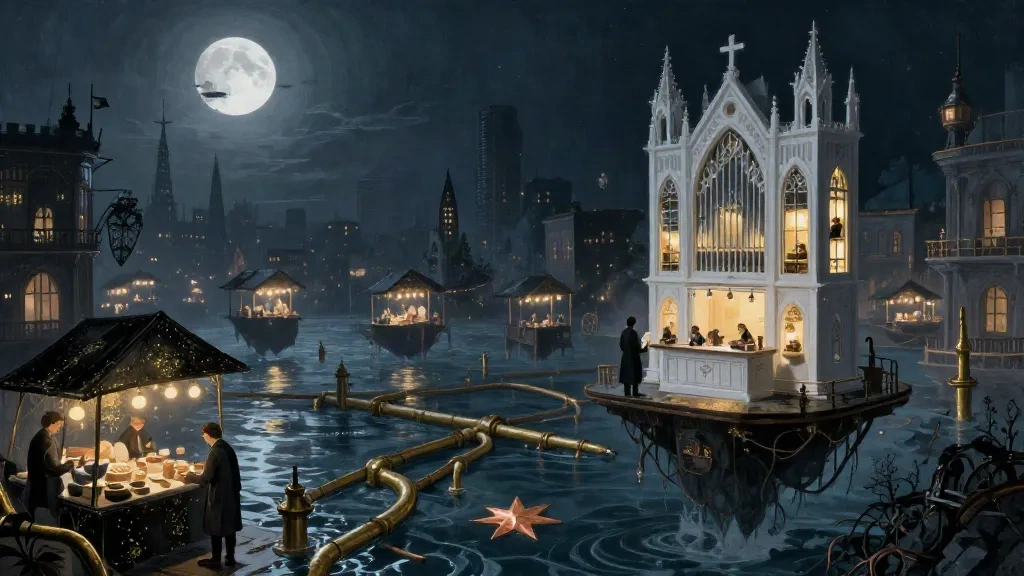
The floating market occupied the hollow air above a drowned province. Its stalls drifted on blue balloons and silver rain. Merchants sold memories in stoppered bottles: a wedding sunrise, a winter quarrel, the particular weight of a hand upon a child’s head. Every memory had lost its owner. Every owner had lost the place where it belonged.
Ilyra treated homesickness. Her patients came to her beneath a black lacquer awning, complaining not of pain but of rooms their hearts could not enter. She listened to their borrowed recollections, then prescribed a cure: one faithful detail repeated daily until it became a shelter.
That morning, the market’s newest attraction chimed through the fog. It stood upon a white tower, a beautiful machine of brass ribs and moonlit glass, humming with the sweetness of a cathedral bell. It restored perfect rooms to perfect citizens. Its waiting list stretched around the world.
Ilyra’s younger self appeared in its display: a red scarf, mud on both knees, the broad grin of a child rescued from a winter flood. The machine promised that nobody would ever be lost again.
“That is not a cure,” Ilyra said.
Its architect, Minister Orren Vey, bowed without bending. “You have made shelters from memories. I have made a city.”
The Flood Beneath the Floor
Before sunset, the market tilted.
Water rose through the black lacquer streets, cold and luminous beneath the moon. Merchants seized their bottles. Lanterns swung wildly. The machine sang one pure note, and every window in the tower opened.
Ilyra descended by its inner stair. Floodwater lifted her coat around her ankles. The music box in her pocket answered the machine with a stubborn, imperfect melody.
Below the tower, a door opened onto a construction chamber older than the floating market. Brass pipes curved through the water. Copper roots gripped the foundations. The machine’s feed came not from a generator but from thousands of sleeping rooms.
Orren followed her, water rising to his knees.
“You are looking at the Cinderworks,” he said. “The first civic project built to survive a flood. It was buried before completion. Tomorrow the water will reach its engines, and every house in the province will return.”
Ilyra examined the pipes. A civic project did not build houses. It built a network to remember where houses belonged. Under Orren’s direction, the same network had learned to decide who belonged inside them.
In the control room, a copper star hung above the central valve. Its six points were sealed with black wax. Beneath the glass, names glowed in pale lines.
“Open it,” Orren said, “and the lost will find one another.”
“Close it,” Ilyra said, “and the people inside this machine will be lost perfectly.”
The Terms of Return
She set the music box on the console. Its melody climbed through the pipes. Each note loosened a thread of memory. The machine sang back in perfect harmony, trying to make the past orderly.
The floodwater shook the chamber. A list of citizens appeared across the glass, their homes marked as safe rooms. One name was repeated ten thousand times. Another had been assigned to a home that had burned before its owner was born.
Orren touched the copper star. “Cinderworks saved us when the government forgot our streets. It kept the dead, the displaced, the children no one claimed. A city is a promise that no person must vanish.”
Ilyra understood then why he had built the machine. Every room was a ward against catastrophe. Every occupant was a resident. No one could be thrown out, lost, or left to remember a home without a roof.
That was the beautiful prison: not locked doors, but doors that opened only for those the city had already decided deserved safety.
She drew a small knife from her medical case. Orren moved to stop her. The black lacquer floor split beneath them.
“If I open the star,” Ilyra said, “the homes return. The ownership dissolves. The rooms will remember their people, but the people will decide where to sleep.”
“You cannot govern chaos.”
“Neither can you govern a home without a door.”
A Door Left Open
She broke the first seal.
The flood surged through the chamber, lifting the copper star free. Its points blazed gold through the water. Names scattered across the walls, no longer labels but invitations.
Orren caught the star before it struck the floor. For one instant, she thought he would close the machine forever. Instead, he opened his hand.
The star went out.
Above them, every window in the white tower swung wide. The beautiful music broke into a thousand human notes: someone laughing, someone praying, someone remembering the wrong cup in the wrong hand. The machine’s perfect rooms became ordinary rooms, full of damp, misplaced chairs and doors that no longer knew which wall they belonged to.
By morning, the floating market had descended. Its old stalls touched the rooftops of the recovered city. People stepped from bottles into streets they did not recognize, carrying memories that no longer proved where they had been.
Ilyra set her music box on a kitchen table in a house that had been a machine’s ward. It played a melody no one recognized. A child listened from the doorway.
“Who does that song belong to?” the child asked.
“No one,” Ilyra said. “That is why you may have it.”
Outside, the river carried the copper star toward the sea. It was not an emblem of guidance or possession, only a bright fragment carried by the current. In the black lacquer market, abandoned rooms waited with their doors open.





