 Netwrck
Fairy-Tale Fiction.
The Guests Before the Snow
At the Vesperglass Resort, shadows arrived before people did. They crossed the frozen lake without feet, slipped beneath the unlocked doors, and waited in the ballroom with their hands tucked like polite guests.
Ilse Venn arrived on the last train, carrying a black lacquer case and a silver spoon that had belonged to her mother. The spoon was bent at the neck, as though someone had tried to make it remember a different mouth. Beneath her collar she had tucked a white feather.
The resort manager, Mr. Sarn, met her beside the hearth. “The rooms are prepared,” he said.
A low note sounded inside Ilse’s case.
She opened it. Her violin was untouched.
“The rooms,” Mr. Sarn repeated, “are prepared for whoever arrives next.”
The note had come from the truth, as it always did. Since childhood, Ilse had heard it whenever a person said what they meant. Lies passed through her like wind. Truth had weight and tone. A father confessing theft made a sour note. A friend admitting fear made a small, bright one.
She looked at the shadows gathered along the stair.
“What happens when the winter ends?” she asked.
Mr. Sarn’s smile remained fixed, but the room gave a note like a cracked bell.
“It doesn’t,” he said.
Outside, snow began falling upward.
A Note in the Walls
The winter had lasted one generation already. It began when the resort’s storyteller, Elian Voss, vanished from the guest register while describing the hotel’s final sunrise. He had walked into the north gallery and never emerged. In his place came a woman no one recognized, wearing his coat and carrying his notebook.
She told the story every evening at midnight. Each telling changed something. The lake became a road. The ballroom became a forest. The guests who left were replaced by guests who had not yet come. When the storyteller said winter would end, the snow thickened and the lake forgot the sky.
Ilse wanted to build a place that could survive her. She had spent years composing music for theaters that burned, audiences that forgot, and halls whose names changed between performances. Now she sketched a cabin on the back of the waiter’s ledger.
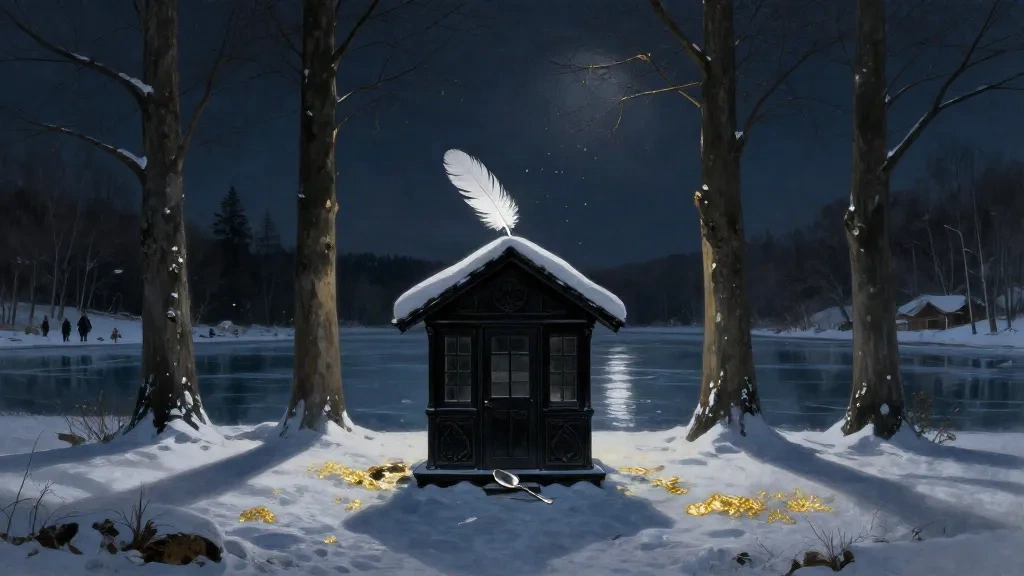
It would stand beyond the storyteller’s reach. Every beam would be joined without glue. Every nail would point downward. Its door would open only to someone carrying a true name.
The white feather was for the roof, the silver spoon for the threshold, and black lacquer for the walls. “A house can be a witness,” she told the carpenters. “It doesn’t have to be a stage.”
They laughed until the blue scarves in their pockets began to speak.
The Generation of Cold
By the middle of winter, the resort had three hundred years of snow in one season. Icicles reached through the ballroom roof. The shadows grew teeth. Guests who told the truth woke with frost in their mouths.
The storyteller came to Ilse’s workshop wearing her mother’s face.
“You cannot build outside the tale,” she said.
“I am not building outside it.”
“Every ending is a door.”
“Then I’m building the hinges.”
That night Ilse played. She began with the note she had heard from Mr. Sarn, then added the bell-like sound of the resort’s lie. The storyteller’s face flickered. Behind her, the unseen guest rooms filled with people who had never arrived.
Ilse’s music could not command the winter, but it could make every true thing in the building answer. The carpenters confessed they had once burned a guest’s luggage. The cook admitted the soup was watered. A child said she had never wanted to be a princess, only a boatman.
One by one, the true notes entered the walls.
The storyteller screamed in seven languages. The white feather lifted from Ilse’s collar and set the roof against the falling snow. The silver spoon spun on the threshold, polishing away every false shadow.
The House That Stayed
At dawn, the lake showed a path of black water. The ballroom had returned, though its windows still reflected a winter no one could enter. Children ran across the ice without leaving footprints. The old generation had aged another year, but no more.
Elian Voss stood inside Ilse’s finished house. His face was his own again.
“I tried to give the winter an ending,” he said. “Then the ending gave me a story.”
Ilse heard the note of truth and held the door shut.
Outside, the storyteller raised her hands. She demanded the cabin be renamed, claimed its walls, declared its rooms a story that could be retold.
Ilse answered with the violin. Not the music of the resort, nor the music of the winter, but the plain sound of wood fitted into wood, a spoon placed flat on a threshold, a feather holding back the weather.
The cabin did not shine. It did not freeze. It remained.
In later winters, travelers came to Vesperglass and asked who had built the little black house beyond the lake. The children who knew the answer said only that it was made for anyone who told the truth.
Then they went inside, one by one, while the shadows waited outside.





