 Netwrck
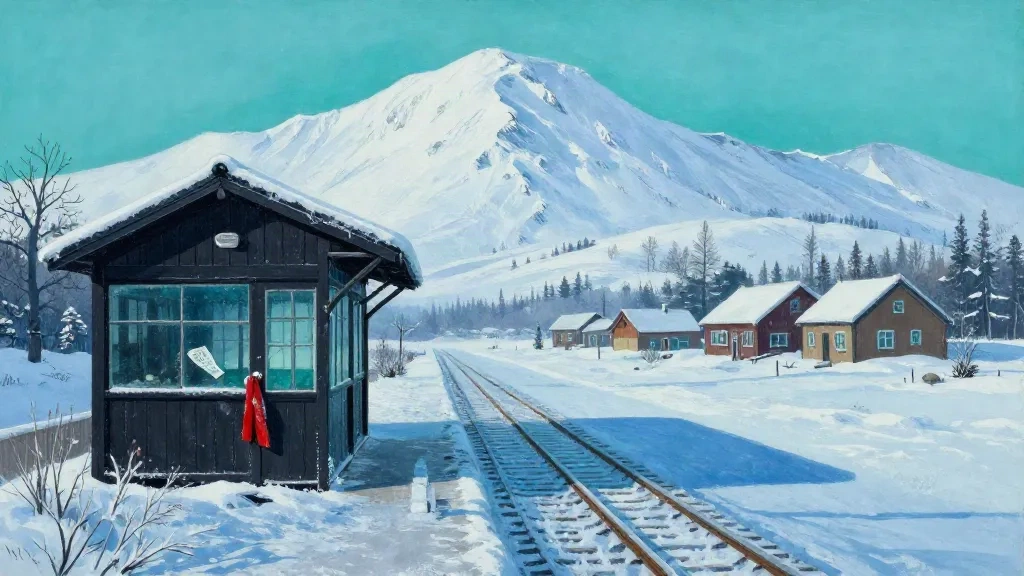
Folk Horror.
Blackglass in February
Mara Venn arrived at Blackglass Resort on the last night of the ski season, carrying a black medical bag and a brass thermometer that froze despite her coat. The village stood beneath a white ridge, its houses closed like clenched mouths. Every chimney breathed. Every gate had already grown the shadow of the gate beside it.
Her patients were not people, though the village called her nurse. A widow lived in a house whose stairs kept turning toward the lake. The Varga family had not spoken since their son drowned, and their kitchen would not hold heat unless all three chairs were occupied. In the Borodin boarding house, every mirror showed a different winter.
She treated these places the way other nurses treated fever: patiently, with small instruments, and without asking whether the illness was real.
On the final morning, she received a call from the stationmaster, Elias Vale. He stood outside the clinic with his timetable clenched beneath one arm.
“There is a departure,” he said, “that never left.”
The Missing Passenger
Elias had run Blackglass Station for thirty-seven years. He believed endings were scheduling errors. A delayed train, a misfiled letter, a death announced on the wrong platform—none of these were conclusions, he said, but clerical failures waiting for correction.
He had marked the 5:42 to Orison in red pencil. The line was straight through the snow. Beside it he had written All passengers accounted for. Underneath, in a different hand: Except the house.
Mara followed him to number nine, a narrow chalet beneath the lifts. A red scarf hung from its doorknob, stiff with frost though the radiator inside burned. On the step lay a train ticket dated three winters earlier.
The door opened before she touched it.
Inside, a family waited around a table. The mother held a cup without drinking. The father looked toward the window every few seconds. Their daughter, barely nine, wore a blue coat and smiled as if Mara had come to take her home.
“We need to leave,” the father said.
“Then leave,” Mara replied.
He gestured at the chairs. “Someone has to stay.”
On the table sat a second red scarf, folded beside a return ticket. The destination had been scraped away.
A Dawn Below the Platform
Elias opened the cellar door. Warm air rose from below, carrying the smell of wet wool and iron. At the bottom, a narrow stair descended past the foundations. Mara saw a platform in the earth, lit by a soft cyan dawn that leaked through the walls.
The station clock showed 5:41. The clock hands moved backward.
“I tried to cancel the platform,” Elias said. “But the train kept arriving. Your house is on the schedule now.”
On the platform, a train waited without smoke. Its windows glowed frost-white. A conductor stood at the far carriage, holding the red scarf.
Mara understood then that the house had not been abandoned. It had boarded the train, taking its occupants with it. The village had mistaken their absence for grief and called it haunting.
She climbed aboard. Inside, every seat was occupied by a house, a wardrobe, a cradle, a shattered lamp. In the last compartment sat the daughter.
“My mother won’t speak to my father,” the girl said. “So the house split into two rooms.”
At the next station, the doors opened onto a summer field. The mother stepped down. The father remained. The girl stood between them, clutching the old ticket.
The Last Bell
Mara cut the ticket in two with her scalpel and placed one half in each adult’s hand. The conductor objected, but Elias pulled down the departure bell with both hands.
“No one leaves until the names agree,” Mara said.
At dawn, the mother called the daughter by her first name. The father said he was sorry. Neither was enough. The train demanded a departure, and the house pulled at its timbers.
So Mara did what she had done for every homesick house: she asked each of them what they needed.
The mother needed to be heard. The father needed to remain. The daughter needed a door that opened both ways.
When they spoke together, the carriage filled with the scent of hot iron and pine. The house unfolded around them, rooms becoming rooms again. The red scarf flew from the conductor’s hand and settled across Mara’s shoulders.
Elias rang the bell. The false dawn vanished.
At Blackglass, number nine stood quietly in the snow. Inside, three people were arguing about breakfast.
Mara left the ticket on the hall table. By spring, the stationmaster had marked the 5:42 terminated. In the margin he wrote, for the first time in his career, No missing passengers.





