 Netwrck
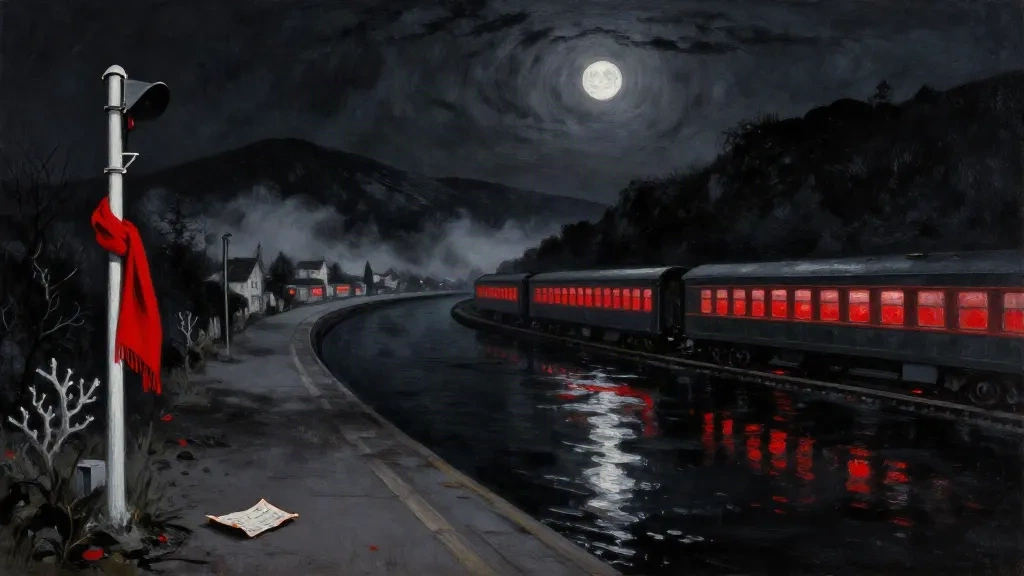
Gothic Fantasy.
The Nightward Boundary
Mara Venn arrived at Bellwether in November, carrying a black medical case and a red scarf knotted twice around her throat. The town was split by the river, which ran north by day and south by night. At midnight, the water turned without pause, carrying barges, lanterns, and sometimes houses toward the wrong bank.
Her work was not the usual nursing. Bellwether's houses suffered from homesickness. They would refuse to warm their chimneys, grow icicles in summer, or turn their doors toward rooms no one occupied. Mara listened to floorboards and knotholes, pressed her palm to walls, and prescribed repair, companionship, or a clean window.
The red house belonged to Ilyan and his sister, Neve. Their father had left years ago, and the last words exchanged between them were spoken over a kitchen table, beneath a train ticket neither had used. Neve now packed every night. Ilyan polished the old signal lantern and pretended not to notice.
Mara's desire was simple and nearly impossible: repair their last conversation before Neve boarded the morning train and left Bellwether for good.
A Defect in the Timetable
Stationmaster Pell found Mara beneath the north platform, listening to a brick wall complain about a childhood.
“The house is grieving,” she said. “It wants its north window.”
“Windows do not grieve.”
“This one has letters from the river.”
Pell tapped his watch. “Everything has a departure. Grief merely chooses the wrong hour.”
He believed every ending was a scheduling error. Twice each week he moved milestones on the board, postponing weddings, farewells, and deaths until the town had forgotten what each was for. At midnight, when the river reversed, he changed every destination sign.
That night Neve came to the station with a red scarf wrapped around the handle of her trunk. Ilyan followed, carrying the unused ticket. The river slid beneath the bridge, black and patient.
Pell raised one finger. “Train to Orison departs at 12:17.”
“The timetable says midnight,” Ilyan said.
“Then midnight has been rescheduled.”
He set the brass whistle to his lips. Its sound travelled under the water, and the platform tiles began changing places.
What the River Carried Back
Mara climbed into the red house and found it trembling in both directions. The front door had opened toward Orison while the kitchen leaned toward Bellwether. On the table lay the old ticket, its date faded but its red thread still bright.
She tied her scarf through the door handle. “If a house is homesick,” she said, “it needs a destination it can remember.”
Neve laughed without warmth. “It already remembers him. He only remembers leaving.”
Ilyan took the ticket. “I came back,” he said. “That should have been enough.”
“It was not enough when you kept standing at the departure board.”
Outside, the stationmaster's whistle sounded three times. The train arrived with its carriages full of white coral, wet ink, and shadows that belonged to people who had never lived. Its lamps shone like windows in a house beneath the river.
Neve stepped toward it. Ilyan followed halfway. Between them, the red thread lifted from the ticket and crossed the platform, the rails, the black water, and the pale walls of Bellwether.
Mara saw the town stitched into two halves, each convinced it had been abandoned.
The Last Departure
She did not stop the train. Instead, she climbed onto the station board and pulled down the destination cloth. The river struck the bridge below, reversing with a sound like a long-held breath.
Pell shouted, “There must be an arrival.”
“Yes,” Mara said. “Not a postponement.”
She turned the board blank. The train slowed. Neve looked at Ilyan across the space between them, and the old accusation loosened in her face.
He offered the ticket. “Keep it. I should have given it to you with an answer.”
Neve took it, then tore it in half. One piece she put in his palm. The other she tied around the red scarf Mara had left hanging from the door.
When the river turned, the house did not split. Its windows faced both banks. In the morning, the station board filled with destinations, but no train left until every person aboard had answered to a name.
Mara returned to the south bank. The stationmaster had redrawn the timetable by hand, leaving one column blank.
“For what?” he asked.
“Anything that has not chosen to leave.”
At midnight, the red thread crossed the station wall, the roof tiles, and the pale surface of the reversed river. Wherever it passed, the houses stopped sighing.





