 Netwrck
Science Fiction.
Shadows Before Snow
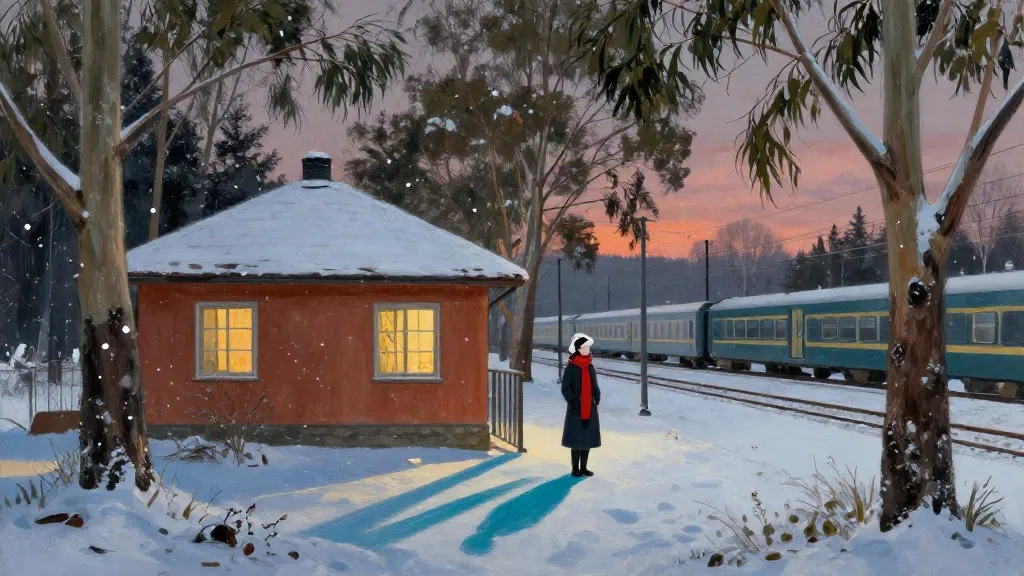
At Veilfall, shadows reached the resort before the guests did.
They slipped beneath the pines, crossed the frozen ornamental pond, and climbed the stairways of the guesthouse while the sky remained the color of bruised fruit. Terracotta roofs held a thin rind of snow. Eucalyptus leaves, improbable this far north, shook in a wind that had not yet arrived.
Elian Voss was the village nurse. She carried a black case, a red scarf she never removed, and a key to the old sanatorium that nobody used except for storing abandoned luggage.
On the morning the final train was due, she found the shadows gathered outside Number Six.
The house stood at the end of Ridge Lane, shuttered for the winter. Its shadow, however, was open at every window. A woman’s silhouette sat at the kitchen table. A man’s stood behind it. Both reached toward the center chair, where the house itself seemed to be holding its breath.
Treatment for Homesickness
Veilfall’s houses had always suffered from the arrivals. They grew faint around unfamiliar luggage, misremembered doors, and left marks on winter luggage tags. Most could be persuaded with salt, peppermint tea, or a clean sweep of the hearth.
Number Six had refused every remedy.
Elian’s patient was not a guest. It was a relationship.
Inside, she found the couple’s lives arranged around a single departure. His coat hung on the left side of the wardrobe. Her medicine rested beside two cups, one of them still warm. On the table lay a red scarf and a train ticket.
The ticket was valid for the morning train, but its departure had been crossed out. Beneath the crossing, in a child’s careful capitals, someone had written: HE SAID HE WOULD STAY.
From the station came the sound of a bell. The stationmaster, Oren Vale, arrived without knocking, carrying a lantern and a timetable swollen with winter rain.
“Every ending is a scheduling error,” he said.
Elian looked at the ticket. “This ticket has no ending.”
Oren set the timetable on the table. “Then the resort has misplaced it. I have spent forty years correcting departures. A delayed train, a missed connection, a husband who arrives after the wife has gone. Endings are merely lines drawn by people in a hurry.”
He tapped the crossed-out time.
“This one can still be corrected.”
The Stationmaster’s Error
Outside, the shadows began walking toward the station.
Elian followed with the red scarf around her wrist. The scarf had belonged to her mother, who had left Veilfall by train during a measles winter and sent back one letter, addressed to a house that no longer existed. Elian had spent years treating homes that missed their people instead of admitting she had missed hers.
At the platform, the stationmaster unfolded a second timetable. Its pages were blank except for one line in faded blue ink.
Passengers who depart together may not arrive alone.
“That is not railway law,” Elian said.
“It is what the tracks remember.”
A train approached without sound. Its windows were full of shadows, each seated upright, waiting for a name. Oren pulled the lever. The rails shone with a seam of eucalyptus green.
Then he took the ticket from her pocket.
Elian had not felt him take it. He held it above the tracks, and the paper changed in his hand. The crossed-out time lifted. A new time appeared: 11:47.
“Every ending,” he said, “is a chance to correct the mistake before it.”
But the train was not late. The house was. Through the falling snow, Number Six cast a shadow across the platform, its empty rooms reflected in the carriage windows. The seated silhouette had vanished.
Elian understood then that the stationmaster had mistaken departure for disappearance. Her patient was not refusing to let the woman leave. It was refusing to forget the man.
Arrival
She stepped onto the track.
Oren shouted. The train stopped. In the silence, the red scarf unwound from her wrist and lifted toward the dark windows.
Elian entered Number Six again and placed the ticket on the kitchen table. Then she folded the scarf into the center chair, where the absent family had been reaching.
“A house is not a station,” she said.
The walls gave a small, tired settle. The cold loosened from the floorboards. In the wardrobe, the man’s coat and the woman’s coat brushed each other as if passing on a crowded stair.
Outside, the train departed empty.
At dawn, the couple came home.
The woman carried the red scarf. The man carried the ticket, restored and unused. They did not explain why they had returned. Elian did not ask. Some cures begin with allowing a person to arrive before deciding where they belong.
Later, Oren found her at the sanatorium.
“No ending,” he said.
Elian looked at the blank timetable.
“No,” she said. “Only a service arriving late.”
He set down the lantern. Beyond the pines, the shadows of the resort gathered beneath the bruised sky, waiting patiently for guests who had not yet decided to leave.





