 Netwrck
Fantasy.
The Patient in Copper Street
By violet dusk, the house on Copper Street had developed a cough.
Mara arrived with her black case, a red scarf knotted twice around her throat, and the settled expression of someone who had already rehearsed leaving. The house's windows rattled. Its chimney breathed out flakes of old snow.
“Homesick,” Mara said.
“Houses do not get homesick.”
“This one has a train ticket under the doormat.”
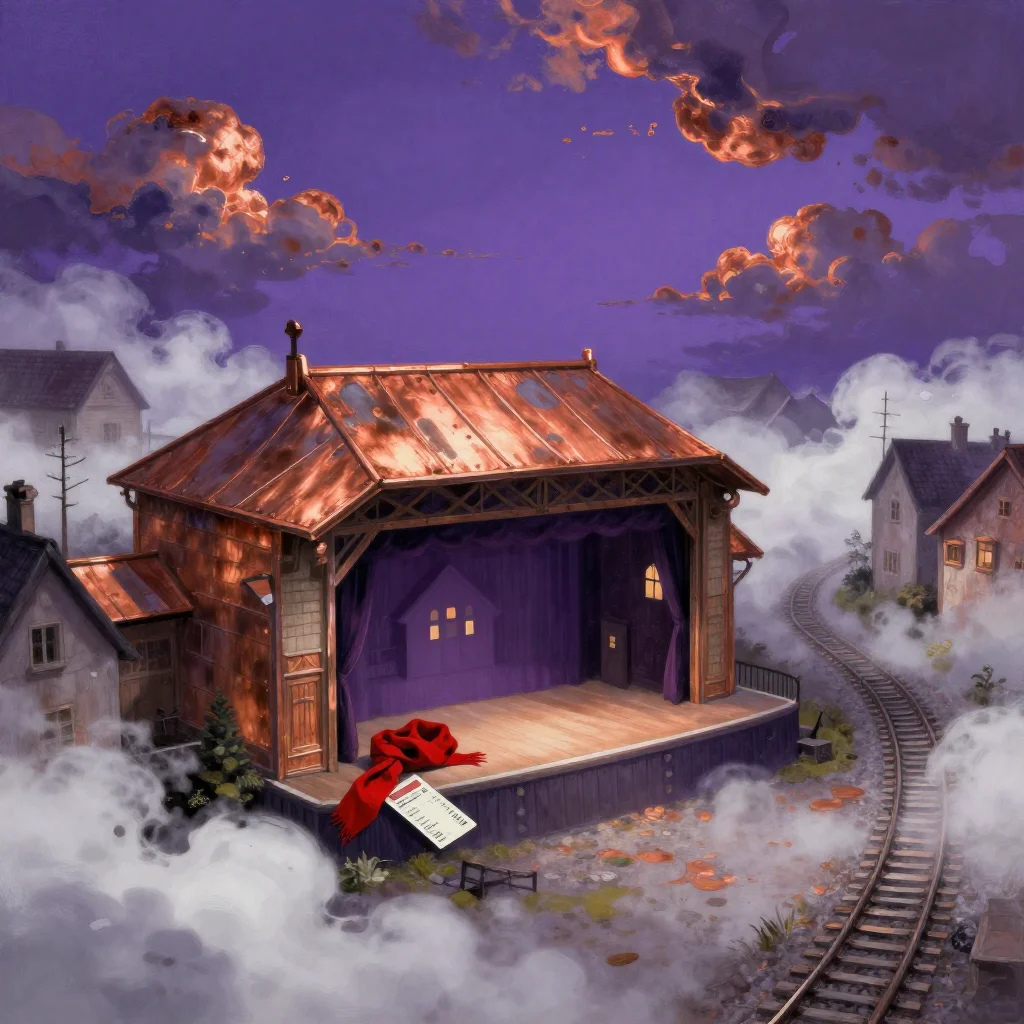
She held the ticket out to her. The paper was warm, printed for a departure that would occur tomorrow morning at 6:17. Mara's name was written in pale ink, though she had never taken a train.
Inside, the walls were divided into rooms that had once been bedrooms. One held a forest. Another held the smell of wet stone. In the kitchen, a kettle rose from the table and poured itself into a cup.
“Every so often, a house begins packing,” Mara explained. “It puts its memories in boxes. It leaves one room empty. Then the people inside it start saying things they do not mean.”
Elian looked through the doorway at her sister. The house had given her a cough, a rattling pipe, and a red scarf, but it had not given her the courage to ask why she was leaving.
“Who is the speaker leaving?” she asked.
Mara glanced toward the stairs.
The Theatre Under the Roof
The village theatre stood behind the clinic, though no road led there. It opened only when a discarded ending was needed. Mara said people brought them here: endings that had grown too sharp to carry, endings rescued from fires, endings rejected because the hero died at the wrong hour.
They entered through a door made of blackened oak. Inside, hundreds of endings hung from the rafters on silver threads. Some were no larger than a comma. Others spread across the walls like storms.
There was one made of copper wire, one that smelled of apples, and one bearing the repeated sentence: You are the only one who can leave.
At the rear stood a stationmaster in a uniform the color of tarnished bronze. He punched tickets that belonged to no railway.
“Endings,” he said. “Mistakenly filed under departures. Every scene is merely a transfer between two people. Every death is a delayed arrival.”
Mara pointed at the ticket. “Then tell us why this house has bought a place on the 6:17.”
The stationmaster examined the paper. “Because someone put it there.”
“Someone?”
“A person who believes silence is less expensive than a farewell.”
He stamped the ticket. The theatre shook. Somewhere above them, a hidden bell rang once.
What the Walls Repeated
Elian treated houses as bodies. She knew which joints needed warmth, which floors were feverish, which doors held grief too tightly. But the Copper Street house resisted every remedy.
In the front room, a small voice kept saying, “I will stay.”
Under the stairs, another whispered, “You are the one who leaves.”
In the attic, a third voice argued, “I never asked you to go.”
Elian followed the sound to the room beneath the roof. There, the walls were covered in charcoal writing. Every line was a sentence Mara had said during their last summer: I don't mind. You should have a life. We are not that kind of family.
At the bottom: Please don't ask me to stay.
Mara stood beside her, silent.
“I thought if I said it enough,” Elian said, “it would become true.”
“What?”
“That you were leaving because you wanted to.”
The house shuddered. The red scarf on Mara's neck brightened to the color of a warning lamp.
“I am leaving because you would not look at me,” Mara said.
Elian turned. “I looked at you every day.”
“You looked through me. You treated me like a room that might collapse if you opened the door.”
The stationmaster's voice travelled through the walls. “One final scheduling error. Departure withheld until acknowledgment.”
Mara pulled the ticket from Elian's hand. On its back, fresh words appeared: Return fare issued only when both passengers speak.
The 6:17 Performance
They returned to the theatre at dawn. The discarded endings stirred overhead, whispering in their paper cages. The stationmaster had opened a platform that ran nowhere, its rails bright beneath the violet clouds.
“If I say I forgive you,” Mara said, “does that make the ticket valid?”
“No,” said the stationmaster.
“And if I say I want you to stay?”
“Also no.”
Elian stepped onto the platform. “The ending I discarded was mine. You came back for the festival because I sent a letter. You came back because you thought our father was ill. You came back because this house was calling you.”
Mara's face tightened. “I came back because you were my sister.”
“I know.”
The train arrived without a sound: a long carriage of cloud-white light, windows clouded with frost. Mara took the red scarf from her neck and placed it around Elian's shoulders.
“I do not want to repair the ending we had,” she said. “I want a beginning where we tell the truth before the leaving.”
Elian removed the ticket from the conductor's hand and tore it once, then again. The platform shook. Across the theatre, every discarded ending burst into pale sparks.
The house on Copper Street stopped coughing. In the morning it would ask for curtains, burn bread, and leave a cup beside the sink. The sisters would argue about whose turn it was to water the fern.
That was not an ending. It was a house making room. The conductor blew a cloud-white whistle, and the stationmaster, for once, had nothing to correct.





