 Netwrck
Weird Fiction.
Shadows at Vesper Reach
The first shadow crossed the snow beneath the saffron lamps three days before Iona Senn arrived to open her winter clinic. It came down from the mountain without a body, carrying skis longer than a door and a suitcase full of rattling ice.
By noon it sat in the chalet waiting room, knees sharply bent, watching the door.
“He arrives Friday,” said the stationmaster, Ivo Tern, unfolding the timetable across my examination table. “The 8:11. Shadow, destination, luggage. If the last train was cancelled, there is a return at 6:40.”
“Shadows do not miss trains.”
Ivo tapped the red column of departures with one black fingernail. “Everything misses trains, Nurse. The timetable is a promise made by people afraid of endings.”
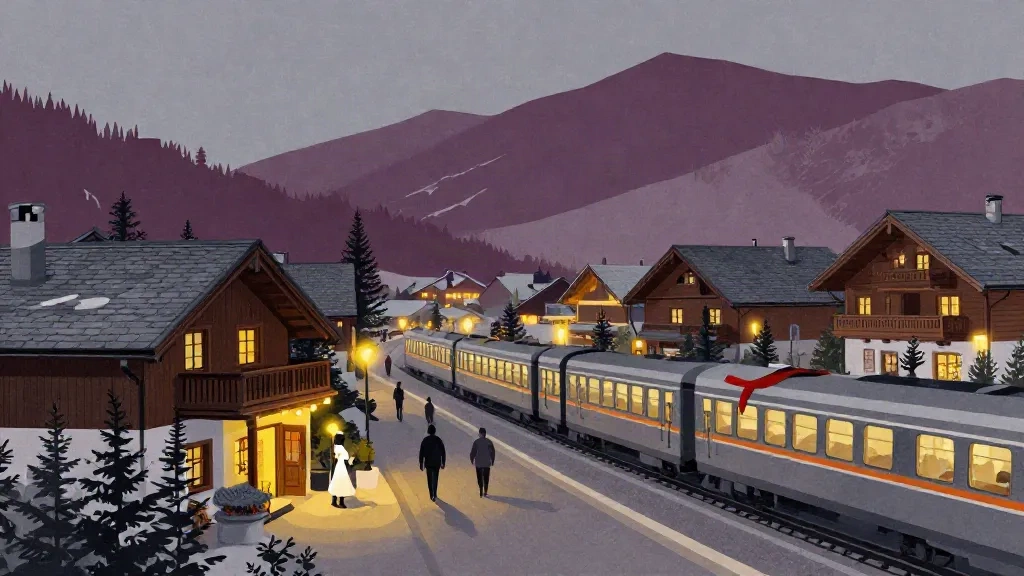
Vesper Reach was built in a fold of the mountains where winter refused to leave politely. Houses leaned together above the frozen lake, their chimneys smoking in unison. Guests arrived with roses, skis, and secrets, but the shadows reached the village first: under porches, behind curtains, along the rails.
That evening, chalet fourteen began coughing.
Its windows shivered. Frost flowered across the floor in the shape of open hands.
A House with a Fever
Inside, Iona found rooms moving restlessly. A chair slid away from the table each time she approached it. Shoes lined the stairs facing the door. In the kitchen, every mug turned its handle toward the mountain.
“Homesick,” I announced, writing in the patient ledger.
The ledger marked the address: Elin Vey, chalet fourteen, traveling alone.
“Homesick is not an illness,” said a voice behind me.
Elin’s daughter stood in the lamplight, red scarf looped twice around her throat. A burn scarred the shape of a cigarette on her wrist. She looked at the ledger as if it were a door she had spent years refusing to open.
“It is here,” I said, “when the walls repeat what everyone avoids saying.”
Elin’s shadow appeared behind her. It was already packed. A paper train ticket showed between two pale fingers, dated for the morning after tomorrow.
“She leaves then,” I said.
“She leaves at 8:11.” Ivo’s voice came from the hall. He had not knocked. “The season changes at 8:11. If the shadow is delayed, departure is delayed.”
The house slammed all its doors at once.
Elin crossed to the fireplace. “I did not come here to apologize.”
“Then why bring the red scarf?”
Her hand closed over the wool. Outside, the saffron lamps blinked once in the smoke-grey air.
The Timetable of Faults
For the next two days, chalet fourteen rehearsed its last meal.
At breakfast, the kettle whistled the tune Elin used to hum. At noon, the stairs counted her daughter’s footsteps in a voice like a broken hinge. The house filled every silence with the argument they had carried home seven years earlier: a locked bedroom door, a fleeing father, an apology shouted through the banister.
“You think pain is a train,” Elin said to me on the second night. “Something leaving on a schedule.”
“I think your house has been holding the timetable for you.”
Ivo had nailed his schedule to the kitchen wall. Beside each shadow’s name, he wrote a revised departure. Beside each blank, he drew arrows.
“A home does not heal by forgetting its occupant,” he said. “It heals when the occupant agrees where they belong.”
That night I climbed into the attic and found the original ticket behind the eaves. It was not Elin’s. It was mine, issued three years before, after my sister left for the coast. I had carried her red scarf ever since, telling myself the wool had kept her warmth.
Chalet fourteen shuddered. A shadow opened the front door.
“If I go,” Elin said, “the house may keep me forever.”
“If I leave,” her daughter said, “you may forget how to follow.”
I could not tell whether the house had spoken or the women had. Perhaps that was the diagnosis.
Arrival and Departure
At 8:02 the next morning, smoke-grey light filled the valley. Ivo arrived with a red-painted clock and a hammer.
“Every ending is a scheduling error,” he said. “Give me the return time and I will correct the timetable.”
I took the hammer. We removed the board from the kitchen wall.
Behind it, the plaster carried a second timetable, written in a child’s careful hand: RETURN 9:26. I FORGIVE YOU. I FORGIVE ME.
Elin read it aloud. Her daughter pulled off the red scarf and placed it between them on the table.
“I am not promising forever,” Elin said. “I am promising the return journey.”
At 8:09, the stationmaster struck the bell. Shadows lifted from every chalet and streamed toward the tracks, but they stopped at the station sign. The living followed slowly, carrying roses, skis, and the same red scarf between them.
The house became still. Not cured. No home is cured of weather, memory, or the people who leave. It only learns which doors to open.
Iona Senn closed the ledger. On the final page, beneath the usual diagnoses, she wrote: Patient departed. Patient returned. Distance remains, but it is no longer contagious.





