 Netwrck
Weird Fiction.
The House With a Fever
Every morning, Nurse Ilyan found houses shivering.
Not from cold. The cottages along the river had damp in their walls, but the house beyond the mill had a different illness. Its windows clouded from the inside. Its chimney breathed smoke-grey air even when no fire burned. Once, a child had scratched a map of the western provinces into its front door, and the map had curled like old bread.
“Homesick,” Ilyan told the house, pressing her palm to the plaster.
The floorboards answered with a faint click, then a click in reverse.
She had treated broken limbs, failed harvests, and the fevers that followed bad water. A house could be a patient, though its pulse was difficult to find. The village considered this a local specialty, much like making cheese or predicting rain.
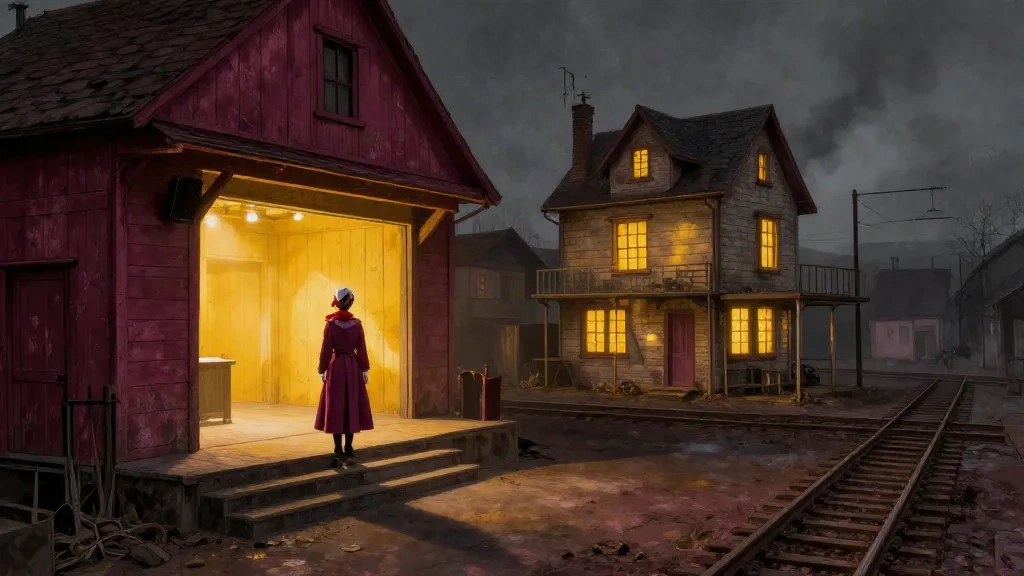
That evening she found a woman waiting beside the millrace. A red scarf hung from her hand, bright as a strip of saffron flame in the smoke-grey dusk.
“My sister is leaving,” the woman said. “She leaves at dawn.”
“Where?”
“Wherever she has not been.”
The woman pointed toward the theatre.
It stood at the edge of the village, taller than the church and shaped like a row of open mouths. Its windows shone with the yellow of old stage lamps. On every nail hung a discarded ending: a drowned city, a wedding interrupted, a king remembered only for his shoes.
“We met there,” the woman continued. “In the last act of a play. She played a daughter leaving home. I played the house.”
“Then the audience laughed.”
“They believed it.”
Ilyan looked at the scarf. “Perhaps the house did.”
Tomorrow’s Rehearsal
Inside the theatre, endings waited on numbered chairs.
They whispered in the wings, rehearsing their final gestures. A child’s last word trembled at the prompt desk. A battlefield went silent between every thunderclap. Near the stage, a marriage trembled on the edge of the third act, unable to decide whether to remain married.
At the conductor’s stand stood Stationmaster Pell, wearing a plum-colored coat and a watch large enough to require its own railway.
“Every ending is a scheduling error,” he announced. “A train leaves too early. A ticket is issued for the wrong hour. Someone forgets to announce the delay.”
He tapped his watch. “If I can correct the timetable, the ending becomes a beginning.”
“There are endings that should stay ended,” Ilyan said.
“There are no such things.”
He handed her a ticket. The paper was warm. Its departure time was tomorrow at 3:17, though the hour had never existed on the village clock.
On the back, in a hand she recognized as her sister’s, were six words: Come before the last carriage leaves.
Ilyan’s sister had disappeared seven years earlier. They had quarreled over their mother’s house, the last spoon, and the words each had failed to say before their mother died.
No one had spoken of the ticket since.
Pell pointed toward the stage. “The abandoned house’s ending is waiting in the wings. It will play at midnight.”
“And if the house does not want to perform it?”
“Then the house is obstructing the timetable.”
Two Passengers
The woman in the red scarf met them beneath the stage. She had brought the scarf on purpose. Her sister, Mara, waited at the tracks behind the theatre.
For years they had visited the same abandoned house after leaving the village. They had slept beneath its stairs, shared bread from its cellar, and made plans that required neither of them to speak the truth.
Now they stood on opposite sides of a yellow line.
“I thought you were going to stay,” the woman said.
“You thought I would change.”
“I thought you would miss me.”
Mara looked down. “I miss the house.”
“That is not the same.”
“It is where I learned what I was.”
Behind them, the stage door opened. A house emerged on four silent wheels, its windows glowing deep plum. Its front door was painted saffron yellow. From inside came the sound of luggage being packed and unpacked, over and over.
Pell checked his enormous watch. “The ending will begin whether you are ready or not.”
Ilyan climbed onto the theatre steps. The red scarf caught on a nail and pulled free from the woman’s hand. She watched it flutter, unable to reach it.
That was the answer. The scarf had been between them, a thing to offer, return, or surrender. No one had to choose a person when they could choose an object.
“Give me the ticket,” Ilyan said.
“It will send you away.”
“It may send me back.”
Pell opened his mouth to object, but the house began to cough.
The Last Arrival
At midnight, the abandoned house filled the stage. Its wallpaper peeled back to reveal fields, rivers, and a kitchen where two sisters had once argued beneath a burning kettle.
Ilyan stepped inside.
The house smelled of rain on stone. Its walls were warm. In the parlor, Mara sat at the table, younger than she had been, while the woman in the red scarf slept beneath the stairs.
“You came back,” the sister said.
“You left the door open.”
“I thought you would come through it.”
Ilyan took the red scarf from the younger woman’s hand and placed it around Mara’s shoulders. Then she gave Mara the ticket.
“The last carriage is leaving,” she said. “You can take it, or you can stay. I will not choose for you.”
Outside, Pell shouted that the schedule could not tolerate hesitation.
The house groaned. Its windows clouded, then cleared.
Mara stood. For a moment, she looked toward the kitchen, the stairs, the sister she had been. Then she kissed Ilyan’s cheek and stepped onto the platform.
The train did not arrive. Instead, the house folded itself into a small saffron-yellow door set into the stage wall. Through it came the sound of two people talking, finally, in the same room.
Pell found Ilyan beside the tracks at sunrise.
“The schedule is corrected,” he said.
“No,” she replied. “The ending was chosen.”
She still had the ticket. It had changed overnight: the departure time now read 3:17, and beneath it someone had printed a return platform.
In the village, the abandoned house stopped shivering. The red scarf stayed with the woman in the plum-colored room. And every night, the theatre performed one discarded ending, then left the stage dark for those who still had somewhere to go.





