 Netwrck
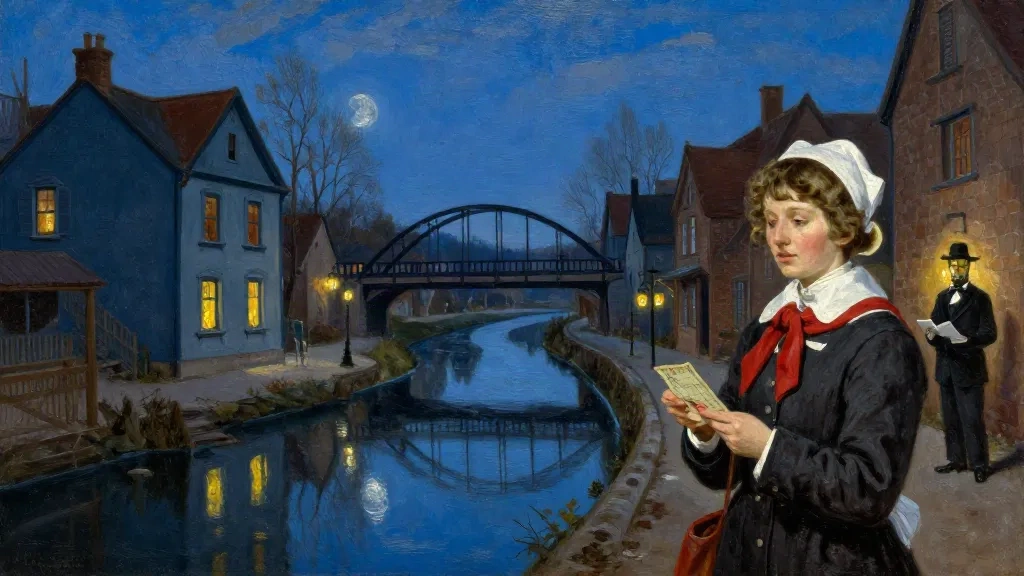
Historical Fantasy.
The River's Other Bank
At half past eleven, Nurse Elian Voss locked the dispensary and walked toward Bellwether Lane, carrying a tin of camphor, a roll of clean linen, and the small brass key every house in town had given her that winter.
Bellwether was divided by the river, though the river changed direction at midnight. On ordinary nights it ran west beneath the iron bridge, carrying winter ice toward the marsh. At the stroke of twelve it turned east, as if remembering a different country. Buildings along the old quay woke with wet floors. Anchors pointed the wrong way. Doors opened onto rooms that had been sealed for years.
One house on the wrong bank had been calling since dusk.
It was narrow and blue-gray, with shutters nailed shut and a chimney that breathed through the keyhole. Elian had treated many homesick houses in her years: houses that carried their former tenants in the walls, houses that wept rust, houses that misplaced the living in their own corridors. Most wanted only a small repair. A returned letter. A name spoken over the threshold. A chair moved back beneath a table.
On her knee she found a red scarf.
It smelled of tobacco, woodsmoke, and the lavender sachets sewn into the lining of soldiers' coats. A train ticket was tucked beneath one end, its date already faded. She recognized both objects, though she had not seen them for nine years.
Scheduling Error
The woman inside was Mara Keene, Elian's daughter, though the house did not know which of them had left.
Mara sat beside the cold hearth with one hand pressed to her throat. Her luggage waited by the door: a black trunk, a sealed engineering case, and a return ticket for the morning train.
“You came to take the house,” Mara said.
“I came to ask why it is calling.”
“That is the same thing here.”
Outside, the stationmaster's bell rang. He arrived in a coat the color of old iron, carrying a lantern and a ledger swollen with damp.
“There,” he said, pointing toward the river. “Midnight is a departure. The east bank is outbound. The west bank is arrival. If anyone claims the timetable is wrong, they are merely refusing to board.”
Mara looked at the ticket in Elian's hand.
“That isn't true,” she said.
“Everything ends on time,” he replied. “Sometimes the platform is misplaced.”
He set the ledger down. Names had been crossed out in blue pencil, then restored in red. Beneath them, departures were listed twice: once by the hour and once by the direction the water had taken.
Elian saw the date on the ticket. The morning after the night Mara had left for the capital, nine years before.
“You kept this?” she asked.
Mara's mouth tightened. “I kept it because you said it would prove I had a place to return to.”
Elian remembered the argument. She had called the departure abandonment, the capital a cold place, and the ticket a promise made by a frightened girl. She had not asked what Mara wanted. She had spoken until the room filled with her own certainty.
The Repair
The house shuddered. Its walls gave a long wooden sigh. Elian stepped into the narrow corridor and found every room facing a different year.
In the kitchen, Mara was six, eating soup too hot and crying without explanation. In the bedroom, Mara was fourteen, packing in the dark while Elian stood in the doorway accusing her of desertion. In the parlor, Mara was grown, speaking calmly about the life she wanted beyond the river.
“The house has stored the moments,” Elian said.
“It has kept the part you never heard,” Mara replied.
Elian opened the ledger. The stationmaster's entries blurred. A house could not mend itself with paper, but paper was what the station understood. She took the red scarf, tied it around the brass key, and placed both in the hearth.
“No,” the stationmaster said. “A departure cannot be recalled.”
“Then call it a postponement,” Elian answered.
She drew the ticket from the ashes. Its printed destination had changed. The capital became Bellwether, and beneath it appeared a line in Mara's handwriting: I stayed to hear the ending.
At midnight the river turned. Water rushed beneath the house, rattling the pipes, but no wall moved. The stationmaster's bell gave one enormous note, and his ledger blew open to a page marked only ARRIVED.
Before the First Train
Elian sat beside Mara until the blue light entered the shutters. She did not apologize for having been wrong. An apology would have been another demand, another speech. Instead she listened while Mara spoke of the capital, the years of silence, and the life that had grown there without her.
When the stationmaster announced the first train, Mara picked up the red scarf. The ticket remained on the table between them.
“I am still leaving,” she said.
“I know.”
“And I am still angry.”
Elian nodded. “You may come back to finish the argument.”
Mara glanced toward the river, now shining east beneath the returning sun. The house gave no cry, but its front door stood open. For the first time in nine years, the road beyond it looked like a choice rather than an accusation.





