 Netwrck
Science Fiction.
The Returning Things
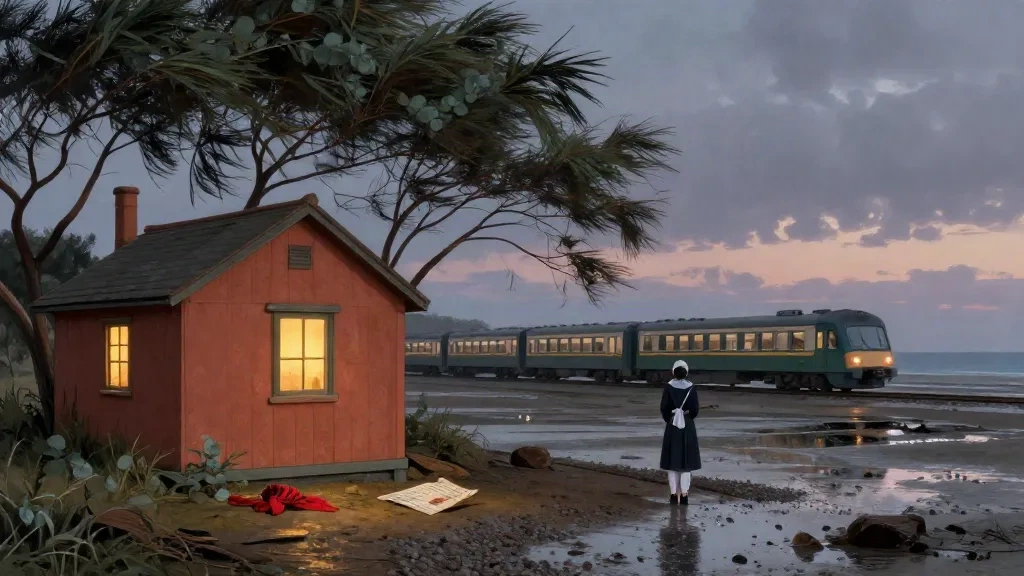
At low tide, the beach of Bellweather became an archive of what people had forgotten. A silver button. A child’s shoe. A bottle with no message. A red scarf appeared each morning on the shingle below the nurse’s cottage, damp as a wound and smelling of rain. Beside it lay a train ticket, its date faded but its destination still legible: NORTHBOUND, 6:10.
Nurse Iona Vale treated houses the way other doctors treated lungs. She entered by the back door, listened to the pipes, pressed her palm to the damp plaster, and asked what had been lost. Houses answered in their own ways: a cupboard opening at three in the morning, a bedroom growing too narrow, a stairwell repeating one nervous footstep.
On the morning the ticket returned, Iona found her sister’s childhood room feverish. Mara had spoken to their mother before leaving for the mainland, the last argument of their old life ending in slammed doors and a silence that had remained in every room. Mara’s train would depart Bellweather that evening. She had not come home to collect the red scarf, but the house remembered her voice anyway.
The Stationmaster’s Ledger
At the station, Ewan Voss arranged timetables as if they were surgical instruments. He believed every ending was a scheduling error. When the fishing boat failed to return, he renamed the next sailing. When a marriage ended, he added a column for the husband’s return.
Iona brought him the ticket. “Mara leaves tonight.”
Ewan examined the paper. “Then we delay the train.”
“You can’t delay a departure because someone is afraid.”
“I have delayed worse.” He tapped the wall of the ticket office. Beneath the peeling paint, old paint showed a timetable with no date. “Your sister thinks the thing she said was the last word. Your mother thinks the thing she did was the last answer. They have confused departure with conclusion.”
He pressed the ticket into Iona’s palm. The paper warmed. At the harbor, a bell rang without a hand upon it.
Treatment for a Home
The cottage had developed a cough. Iona opened every window and found the walls sweating salt. In the kitchen, two cups sat on the table, both full. The red scarf lay over the backs of both chairs.
She opened her mother’s sewing box and cut the scarf down. That was the wrong treatment. The room shuddered, and the ticket curled in her hand. She understood then that homesick did not mean empty. It meant occupied by an absence too large for the body to carry.
She phoned Mara. Their voices broke and mended between them. Mara said, “I said I wished she had never stayed.” Iona said, “I know.”
“I did mean it.”
“I know that too.”
Silence, but no longer the old silence. It had air in it.
Across town, the station clock stopped. Ewan began loading the train with spare timetables, shouting that the rails had forgotten their purpose. Iona left him there. A stationmaster could order the world only until the world asked for something he could not print.
What the Tide Could Not Take
At six, the northbound train waited beneath a sky like bruised fruit. Iona reached the platform carrying the red scarf and the ticket. Mara stood beside the carriage, one hand on the rail.
“I didn’t come to stop you,” Iona said.
“I know.”
Iona gave her the scarf. “Then come back before the next tide.”
Mara laughed, not because the request was funny, but because it was possible. Their mother had not come to the station. She was inside the cottage, holding the torn scarf ends and learning that repair could look like holding two pieces without forcing them into one.
The whistle sounded. The train began to move. Iona ran alongside it, matching its pace until her shoes filled with sand. Mara leaned from the window and held out her hand.
Iona did not take it. She reached up and touched the red scarf at her sister’s throat.
At dawn, the beach returned the scarf, whole and dry. The train ticket remained, its destination changed to BELLWEATHER, DEPARTED.
Ewan examined it, then opened his ledger. Under endings, he wrote: temporary. Under home, he wrote: under repair.





