 Netwrck
Weird Fiction.
The Book Below the Counter
On the seventh night of saffron rain, I lent the blue book to a courier whose shadow had six arms.
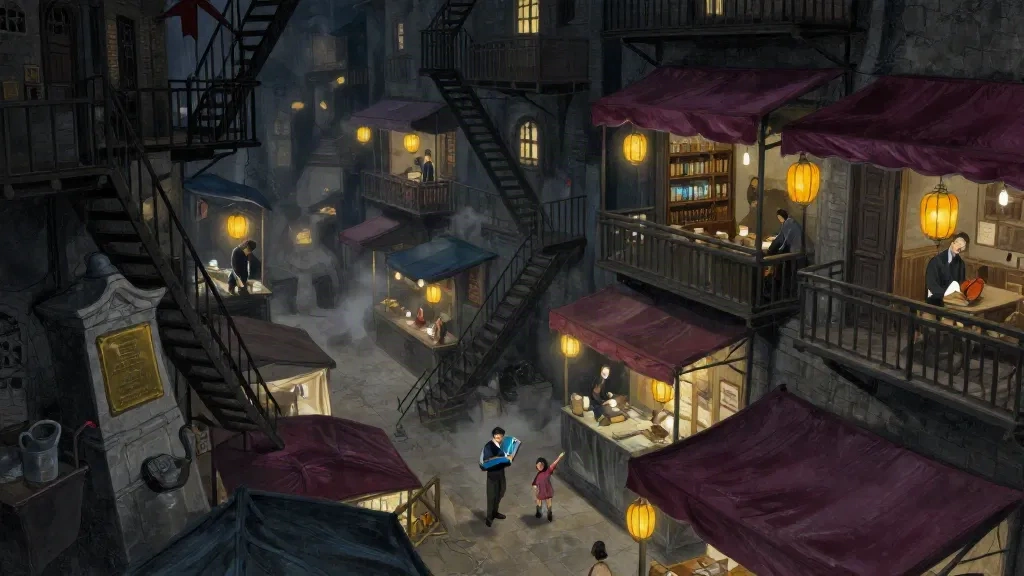
He stood at my counter beneath the market, where the city’s first floor ended in a black cliff and the night stalls continued downward along iron stairs. Above us, buildings leaned together like shut books. Below us, smoke-grey air pooled between canopies of plum cloth.
The blue book had no title. Its cover opened onto a hallway measured in footsteps rather than rooms. Whenever it was open, impossible residents appeared in its margins: a house with doors for eyes, a river that lived inside a person’s coat, a child made from the sound of bells.
“It needs a home,” the courier said.
“They all do,” I said.
I was not a keeper of the book. I was its librarian. My task was simpler and worse: to find it a house that would accept what it carried.
On the counter sat an empty teacup, white inside and brown around the rim. Beside it, the market’s cracked bell rang whenever someone made an agreement they intended to forget.
The Child Under the Stairs
The child appeared where the stairs turned into a wall.
She was perhaps ten, dressed in a coat too clean for the market. She pointed at a brass plaque bolted to the stone.
“That is not there,” I told her.
“You agreed it was not.”
The courier laughed uneasily. The blue book trembled in his hands.
I knew the child’s trick. It was not seeing hidden things. It was seeing the thing everyone else had agreed to overlook. The market had built its stalls around an absent landlord, a woman called Mara Venn who owned the rooms beneath the stalls and had vanished before anyone admitted she existed. Her name had been scrubbed from leases, debts, maps, and finally from memory.
“She rented rooms to impossible residents,” the child said. “Now she rents them to anyone.”
“No one can reach them.”
“You can. You have a book.”
The courier opened it. The hallway within had changed. At its far end, a narrow door stood beneath a smear of saffron yellow.
When the child touched the plaque, the cracked bell rang once. The sound came from inside the wall.
A Room Willing to Change
We entered through a gap that had not been there.
Mara Venn’s rooms were stacked beneath the market, each one furnished for a creature that had never been born. A ladder rested on the ceiling. Water climbed a staircase without wetting its steps. In one room, a door was slowly developing a face.
Every lease had the same missing clause: THE RESIDENT IS ACCEPTED AS FOUND.
I understood then. The city did not forbid impossible residents. It had merely agreed not to see them. Their homes became unreal because no one would name them as homes.
The courier placed the blue book on a table. The room inhaled.
Walls moved outward. The empty teacup on my counter appeared beside it, still empty, though its bottom filled slowly with a dark plum-colored sky. Outside, the market’s smoke-grey air lifted from the stalls.
People looked up. A woman carrying a tiger-sized shadow stopped bargaining. A child with a second face peeked from behind a spice barrel.
“If we open the book,” the courier said, “where do they go?”
“Somewhere that agrees to contain them.”
The Address at Dawn
By the time saffron rain stopped, Mara Venn had signed a new lease. The signature looked like a crooked stair.
The child took the bell from my hand. Its crack had widened, but the note was clearer.
“You searched for a home,” she said.
“For them.”
“There is one here.”
She pointed at the room around us. I had wanted a place for the impossible, not a place to live myself. I had mistaken the difference for principle because it made the work easier.
So I wrote my name beneath Mara’s. The blue book opened once more. This time its hallway led upward, through the market, past the first-floor windows, into a city that had no street below because it had finally made room beneath itself.
At the final landing, an empty teacup waited beside a bell with no crack.
It rang.
And the house below opened its doors.





