 Netwrck
Romance.
The Market of Unclaimed Things
By dawn, the floating market had gathered above the flooded roofs of Bellwether, its stalls drifting on silver ropes. Lanterns reflected in the black water below, though the lanterns themselves burned with the green light of deep moss. Merchants sold memories no one could claim: a wedding quarrel remembered only by a door, the sound of a child laughing in a vanished stairwell, a man’s last regret preserved in a jar.
Elias moved between them with a folded map under his arm. It was the map his grandmother had left him, its creases worn soft as skin. The marks led to the market but not to any stall. They formed a patient square around a blank center.
He had spent forty years leaving rooms. Dressing rooms, theaters, hospital waiting rooms, the narrow kitchen after his wife died. In his old age, people called it an gift, as if the past were a stage door he could open whenever the present became too loud.
He had never tried to return to the room he had left first.
The Room Behind the Wall
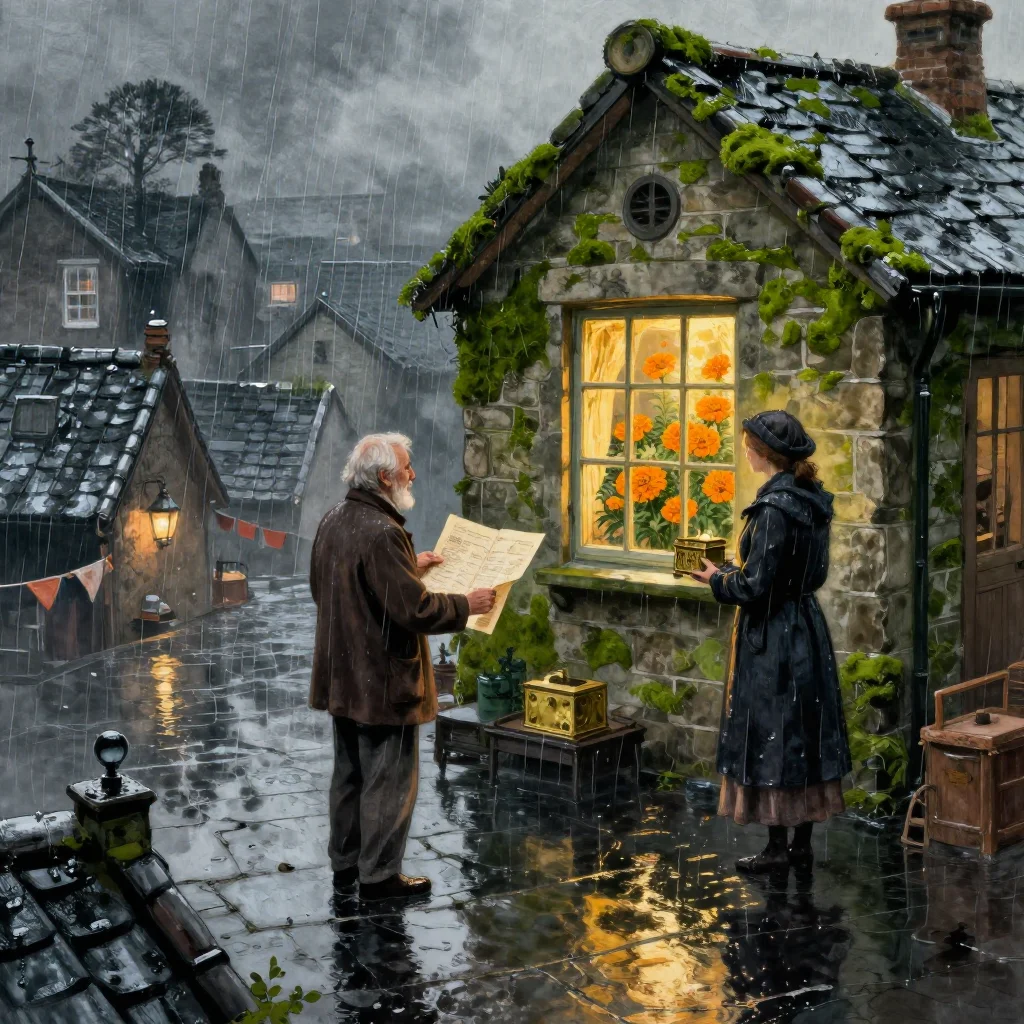
The house stood at the market’s far edge, its stone walls slick with rain and its windows glowing marigold. Elias recognized the house before he reached it: the crooked chimney, the blue-painted door, the little brass bell that had once announced his grandmother’s arrival.
Inside, the air smelled of wet stone and cinnamon. A woman stood at the stove, though her face was turned away.
“You promised me a room,” she said.
Elias knew that voice. Not his grandmother’s. His mother’s.
“You said when you were an actor, you would give me a room with a window.”
He had been young and boastful then. His mother had been dying, and he had mistaken promises for currency. He had promised her a room, a view, a life beyond the provincial theater where they performed.
“I made it,” he said.
“No.” The woman turned. Her face was young, untouched by the years he had failed her. “You promised to come back when I was afraid.”
A door appeared in the wall.
Elias understood then what the market was and why the house had followed him. It collected promises that had outlived their speakers. It built rooms around the places where words had bent the truth.
The Music Box in the Lost Stall
On the market, a seller named Mara kept a music box with no lid. Its melody was eight notes long, and whenever she wound it, somebody nearby remembered being forgiven.
Elias bought it. The seller was a narrow-eyed woman with rain in her hair. She had been his mother’s friend, though he did not recognize her at first.
“You never came back,” she said.
“I was afraid.”
“Yes.”
The word was not cruel. It opened another room inside the music box: a kitchen, bright with winter sun. His mother sat at the table. Young Elias stood in the doorway, nine years old, carrying a paper crown.
In the memory, he promised to be brave enough to become someone she had never met.
The market tilted. Stalls slid across the sky. Elias ran.
A House Without False Rooms
He returned to the house as the marigold windows flared. Inside, his mother’s memory waited beside the stove.
“I kept the room for you,” she said.
“There was no room.”
“There is now.”
She touched the map. The blank center unfolded.
Elias drew the door she had wanted: a window facing east, a chair beside it, a shelf for medicine and books. Then he placed the music box on the sill.
“I came back,” he said.
The house groaned. Walls shifted. No new room appeared.
His mother smiled. “That is the first true thing you have brought me.”
Mara was waiting outside when the rain stopped. She held the map’s torn corner, the piece he had never found.
“My grandmother made the promise,” she said. “She said someone would come for the room before the house learned how to lie.”
Elias took her hand. Behind them, the house settled into its old shape, holding one warm window, one open door, and no room for anything that had not been honestly named.





