 Netwrck
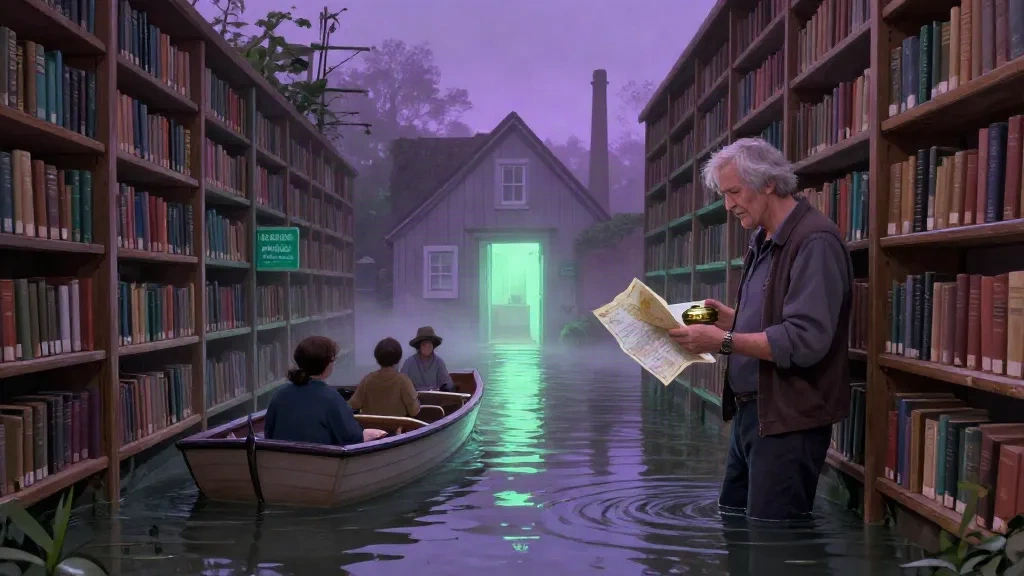
Hopeful Science Fiction.
The Room Behind the Stacks
At dusk, Mara Venn took off her shoes and stepped into the flooded archive.
The water reached her knees. Shelves rose from it like drowned buildings, their brass labels reflecting the violet storm beyond the clerestory. Three librarians rowed between the stacks, their oars making small silver corridors in the water.
“Looking for anything in particular?” called the nearest librarian, a broad woman with a green pharmacy sign reflected in her spectacles.
“A promise,” Mara said.
She had been an actor for forty-six years. Retirement had not made her less skilled at entrances. She could still arrive softly, turn her face toward the light, and persuade a room to become interested in her. The gift had followed her into retirement: any room she had ever left, she could re-enter.
Not a photograph. Not a memory. The actual room.
Her grandfather had promised her mother, before the flood, that their family would never let a lie become a house. Then he had disappeared into the archive during the first evacuation, carrying a folded map and a music box with no lid.
Now the city said he had died in the water. The house on Mercy Street said he had never lived there at all.
The librarian pointed toward the far stacks. “Promises are filed under unfinished business. Try the north wall.”
Rooms That Would Not Fit
Mara rowed past shelves swollen with paper. A child called from behind a row of atlases. A man stood in a doorway that had not been there when the water began rising, insisting the door had always existed.
The house on Mercy Street waited beyond the last shelf.
Its front door opened before Mara touched it. Inside, the wallpaper was damp asphalt gray. Lavender curtains hung over windows facing walls. Green light from a pharmacy sign outside turned the floor into a shallow tide.
“Grandfather?” she called.
The hall lengthened.
Doors appeared on both sides. A narrow room opened, smelling of dust and oranges. Behind it, a nursery grew in the space of three breaths. A stairwell climbed toward a ceiling that kept moving upward.
Mara clenched the folded map. The music box in her pocket began to turn, though no one had opened it.
She remembered the house’s old trick. Every lie spoken within it added a room. Her father had said so, then laughed and called it superstition. Her mother had refused to enter. Her grandfather had gone there every winter.
“He lived here,” Mara said.
A new room opened. Inside, a drowned piano stood on its end.
“He died here,” she said.
Another room opened. Inside, a child’s coat hung from a hook, dry and shining.
Mara’s anger was a bad compass. She pointed at the map. “You told me the route.”
“I never promised I would stay,” said a voice from the stairwell.
What the Box Remembered
Her grandfather descended carrying nothing. The music box’s tune lifted between them, one clear note for every lie the house had swallowed.
“The promise was to keep the route,” he said. “Not to keep myself.”
On the map, a lavender line ended at a room marked only with a green cross.
Below, a final room opened.
It was no larger than a closet. A music box rested on a dry shelf. Its lid was closed.
“Your mother wanted an ending,” Grandfather said. “I gave her a beginning instead. I found the room where the city had stored everything it could not say, and I locked it here.”
Mara looked at the box. “You lied to us.”
“Yes.”
The house shuddered. A new corridor appeared behind the closet, opening onto the archive’s bright upper windows. Green light poured through the pharmacy sign. The librarians’ oars knocked against their shelves, keeping time.
Grandfather placed the map in her hands. “Keep the promise by keeping the way through.”
Then he walked into the room and closed the lid.
The tune stopped.
Every lie the house had hidden loosened its hold.
Mara did not forgive him. She understood him, which was heavier.
A Door for Everyone
She opened the music box.
Inside was no mechanism, only a small brass key and a note written in her mother’s handwriting:
Do not promise the past will return. Promise the future a way through.
Mara placed the key in the map’s green cross. The closet became a doorway. Through it came the lost voices of the archive, calling for books, names, and one another.
The house tried to grow another room. Mara stepped into the doorway before it could finish.
Behind her, the walls narrowed around all the rooms it had built from fear and denial. The drowned piano fell silent. The nursery vanished. The hall became a hall again.
At dawn, the librarians rowed toward Mercy Street.
Mara did not restore the family house. She left its front door open, with a map beside it and a music box on the sill. Anyone could enter, anyone could leave, and no one would have to build a room to hide a lie.
Her grandfather’s promise was still waiting in the water.
Mara stepped into the first light and carried it ashore.





