 Netwrck
Fairy-Tale Fiction.
The Room Behind the Wall
At dusk, when the lamps along Crescent Street came alight, their shadows detached from their feet and went home.
They unlocked doors with shadow keys. They sat for supper at shadow tables. They voted in the black marble booths of the City of Paired Hours, where every citizen followed a shadow and every shadow obeyed a citizen.
Orin Vale had retired from the theater before the city learned to notice him. He lived in one room above a closed cobbler’s shop, where he drank tea, listened to rain, and avoided remembering the house on Lantern Row.
He had promised his grandmother that he would return before her last candle went out.
He had not.
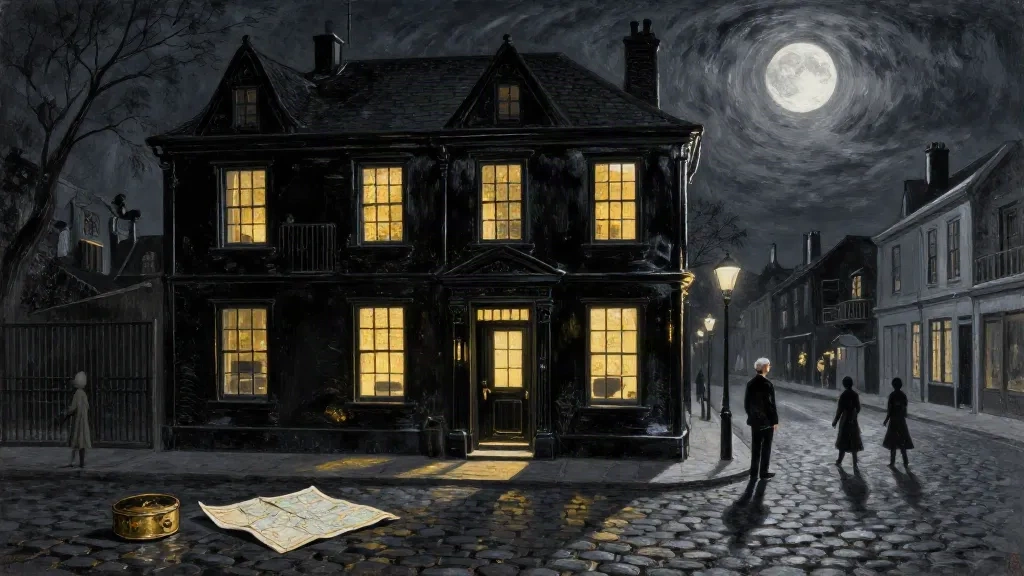
On the night the city clock struck eleven, the house sent him a folded map.
It arrived beneath his door, black paper scored with gold dust. One line led from Lantern Row to the old theater. Another ended at a blank square beside the words: WHERE THE PROMISE ENTERED.
Orin did not want to see the rest. He knew that was the moment the house had learned he was afraid.
He went anyway.
Rooms Made by Falsehoods
Lantern Row had no shadows now. The moon hung overhead, cold and coin-white, while the houses leaned together like listening elders.
Orin’s childhood home stood at the end of the street. Its windows were black lacquer, its gutters trimmed with gold dust. It had always been small.
It was larger now.
The front door opened before he touched it. Inside, the air smelled of dust, beeswax, and the iron tang of old stage blood. The parlor held a fireplace, a sofa, and a portrait of Orin in a silver costume. Each object had been chosen to deceive him.
“You are late,” said the portrait.
“You are paint.”
“And you are a coward.”
“That is possible.”
The portrait’s mouth twisted. A narrow staircase appeared behind it.
Upstairs, every lie had made a room. A kitchen with false jars of honey. A nursery where the toys were arranged too neatly. A study containing letters he had never received, each bearing his grandmother’s handwriting.
One room was locked.
Orin heard a music box playing inside it.
The tune was eight notes. He had taught it to his grandmother, then forgotten, as actors forget the lines that belong to other people.
At the foot of the stairs, a woman made of shadow waited. Her face was his.
“She lied to protect you,” the shadow said. “The house heard her.”
“She promised me she would wait.”
“She promised the city.”
That was worse. In the City of Paired Hours, promises made aloud became contracts written in moonlight.
The Music Under the Floor
Orin took the folded map from his coat. The blank square unfolded into a plan of the locked room, though the room had no windows and no door on the paper.
He followed the eight notes through the floorboards.
At the seventh note, the wall opened.
Inside sat his grandmother beneath a black-lacquer canopy. Gold dust covered her hands. Her eyes were closed, but her shadow kept time with the music box beside her bed.
“You came after the candle,” she said.
“I came.”
“That is not the promise.”
“I know.”
He had promised to return. He had also promised to become an honest man, though he had never said what honesty required. At nineteen, he believed theater was truth wearing different costumes. At twenty-four, he believed loyalty meant remaining onstage. At thirty, he had accepted a role in another city.
The house had grown because his grandmother told it he was coming.
Orin opened the music box.
Inside, instead of a cylinder, lay a small piece of night. His grandmother’s final words were trapped there.
“Do not wait for me,” she said. “Keep the city’s promise in my place.”
He looked at her sleeping face. “What promise?”
“The one you made when you were a boy. You promised the city that no one would be left in the dark.”
The City at Dawn
The music box broke.
Black birds poured from the walls. Every lie-built room split at once: false letters dissolved, empty toys went still, the locked nursery filled with cold moonlight.
Orin’s shadow began climbing the walls.
“If you leave,” it said, using his voice, “I will become the only person who remembers your grandmother.”
“No,” Orin said. “I will remember her.”
He took the folded map and wrote his grandmother’s name across the blank square. Then he stepped out of the house and into the street.
At dawn, the citizens of Crescent Street found their shadows waiting beneath the awnings. One by one, they returned to their owners.
Orin’s shadow came last.
It placed the music box’s tiny piece of night in his hand.
“The promise is not a room,” it said. “It is a door kept open.”
So Orin returned to the theater. He did not perform for applause. He stood on the empty stage and recited every promise he had broken, naming the person he had hurt and the hour he had abandoned them.
Then he opened the doors.
In the audience sat silhouettes of every citizen who had ever waited for someone in the dark. They rose. They walked home.
On the theater floor, where the moonlight crossed the boards, Orin found a black-lacquer door with gold dust beneath it.
It was already open.
Inside, his grandmother was teaching a child his first eight notes.
Orin sat down beside them and listened.





