 Netwrck
Weird Fiction.
The Book With No Call Number
At noon, when saffron sunlight poured down the avenues of Bellwether, the librarian sent two shadows to the same chair.
The shadows were citizens, though no clerk would admit it. They slipped beneath the library's plum-colored awning, folded themselves into corners, and voted with ink-dark hands. Meanwhile, their owners crossed the street with bodies they had borrowed from the sky.
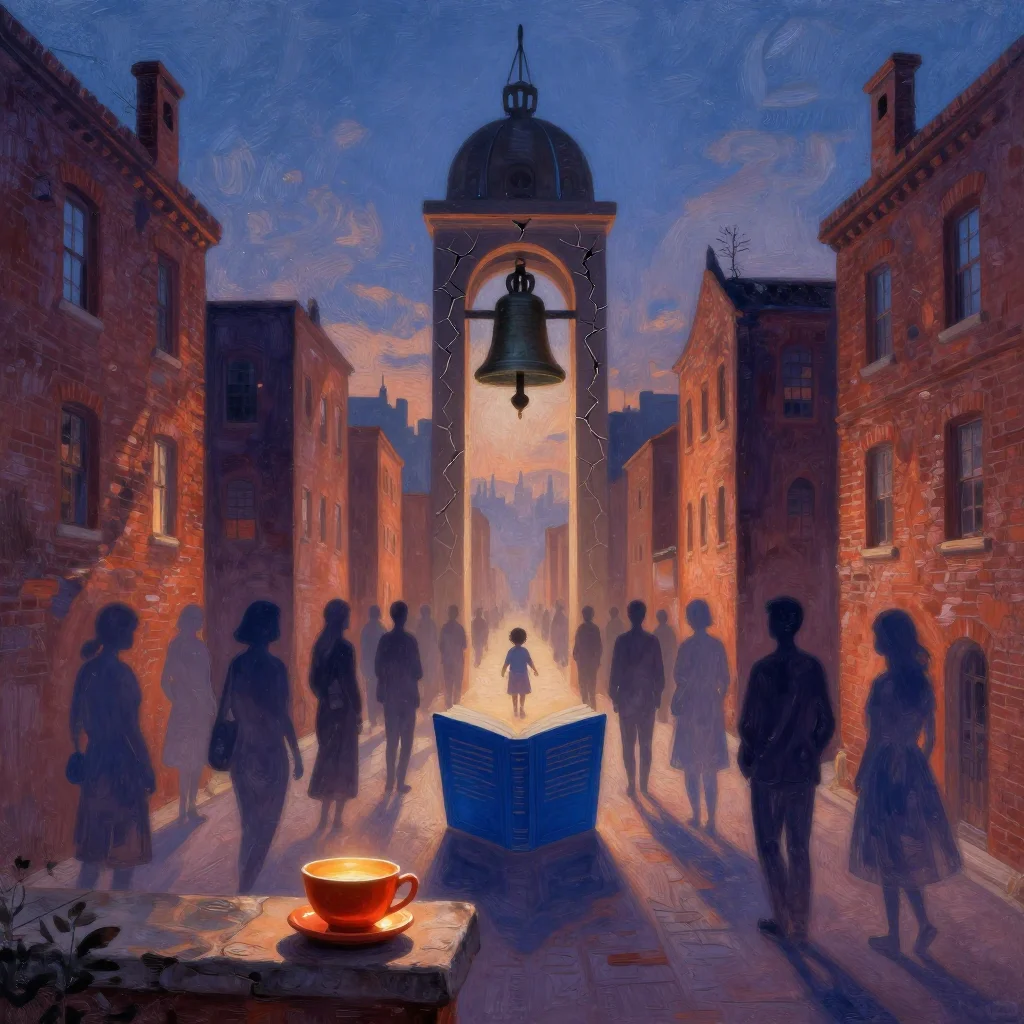
Every morning, the librarian, Mara Venn, arranged the catalog. Every afternoon, she lent out the same impossible book. It had a blue cover without a title, blank pages that held different weather, and a reservation card listing no borrower.
To the woman with a face made of shutters, she said, “Return it when the house remembers you.”
To the drowned bell-ringer, whose shadow smelled of river stones, she said, “Return it before the water forgets your name.”
To anyone who asked, Mara answered, “It is for people who need somewhere to belong.”
She wanted to find a home that accepted impossible residents. Not a sanctuary, not a ward, not a room where the strange could be tolerated. A home. A place that counted a shadow as a person and a person as a shadow, and kept the census in one hand while opening the door with the other.
The Child Under the Bell Tower
On the seventh day, a boy named Orris came to the desk with an empty teacup.
He did not look like a citizen. His shadow was taller than he was, wearing a crown of smoke.
“I need the book,” he said.
“For whom?”
“For the thing we have agreed to overlook.”
Mara had heard that sentence before, spoken by the walls of houses where families had hidden their histories. Bellwether was a city of agreements. The market agreed not to notice the extra staircase behind the fish stalls. The council agreed that certain alleys ended at noon. The dead agreed to be counted among the living so the living would stop counting one another.
“What thing?” Mara asked.
Orris pointed beneath the cracked bell in the library's western corner. The bell had not rung since the city installed it. Its fracture ran from lip to crown, a dark seam that breathed when the wind was absent.
“The bell,” he said, “is not broken. It is being held.”
He handed Mara the empty teacup. Inside, a saffron reflection trembled in nothing.
“Then what is holding it?”
Orris looked at his own shadow. “The city.”
What the Shadows Agreed
That night, Mara followed the library's shadow to the bell tower.
It moved independently, wearing her blue book beneath one arm. In the streets, the smoke-grey air thickened. Citizens hurried home while their shadows remained behind, standing in doorways as guards. Some waved. Some begged. One shook his head with a mouth full of plum-colored shadow.
Mara understood then that Bellwether was not ruled by people. It was ruled by the agreement between them, and agreements were hungry things.
At the tower, the city's shadow lay coiled around the cracked bell. The object Orris had pointed to was a small, dark room beneath the clockwork floor. It had a door, though no wall around it.
The librarian's shadow set down the book.
“If we open it,” it said, “the citizens will see what they are avoiding.”
“Yes.”
“Then they may choose to stop being citizens.”
“Yes.”
“And you?”
Mara looked at her hands. In the tower's strange light, they cast two shadows, one of them much smaller.
“I will read the lease,” she said.
The boy appeared beside her. He had brought the empty teacup, and now its saffron surface showed a room filled with chairs. Every chair cast a shadow, and every shadow sat in another chair.
“This is it,” Orris whispered. “The thing we overlook.”
“People,” Mara said.
“No,” he replied. “Our claim on them.”
A Census of the Impossible
The bell cracked wider.
Across Bellwether, every citizen felt the sound inside their ribs. For one moment, the city stopped pretending. Shadows stood apart from their owners. Owners saw themselves as they were: frightened, hungry, tender, impossible. The woman with the shutter-face carried a house in her back. The drowned bell-ringer held the river's memory in his hands. Orris's crown was a nest of black feathers.
Some people turned away. Some reached for their shadows. Some embraced them.
Mara opened the impossible book. The blank pages filled themselves with names, not the names the city had assigned, but the ones people had hidden inside themselves.
She wrote a new heading above them: Residents.
At the bottom of the page, she drew a small house with one door, many windows, and enough shadow beneath its roof to shelter everyone.
“What is its name?” Orris asked.
Mara looked toward the square. A man with a shadow shaped like a cathedral was helping a child with a shadow shaped like a ferry. Their shadows had found each other without asking permission.
“Here,” she said.
The bell gave one clear note. It did not break.
It rang.
And in Bellwether, every citizen and every shadow turned toward home.





