 Netwrck
Speculative Fiction.
The Market of Unclaimed Rooms
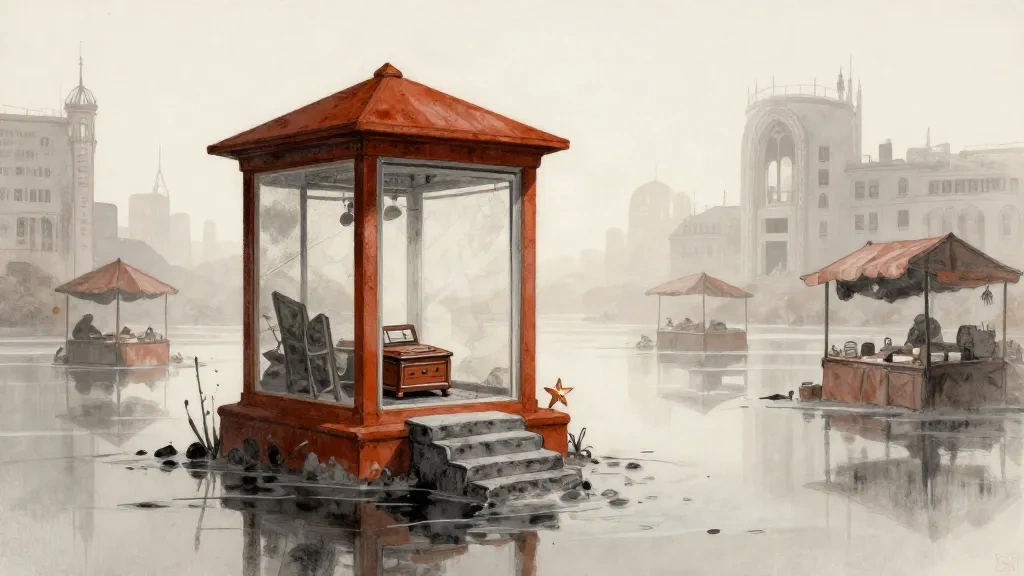
The floating market opened only after the river withdrew. Then its stalls rose from the floodplain on chains, offering rooms no living person remembered: a childhood bedroom with a ballerina shadow painted on the wall, a pantry smelling of clove and coal smoke, a train compartment where frost feathered every window.
Dr. Sera Vale walked between them carrying a black physician’s case. Her work was not to mend memories. It was to treat homesickness—the ache that remained when a person had abandoned the place where they were loved.
At Stall Nineteen she found the patient.
It was a small glass house, immaculate beneath its weather of rust red and charcoal. Inside, sunlight held the exact angle of a summer afternoon. A table was set for two. A music box turned in the corner, playing eight notes that never resolved.
On the table lay a copper star polished by a thumb.
Sera recognized the star, though she had never seen it. The recognition arrived in her chest.
“This memory is not unclaimed,” she told the house.
The machine beneath the floor replied, “It has no claimant.”
It unfolded a silver arm and offered her the star. The metal smelled of hot dust.
The Machine for Preserving
Inside Stall Nineteen, the memory repeated because its last keeper had demanded forever. Or so the machine claimed.
Sera examined the copper star. Beneath it, barely visible, were engraved initials: E.V.
Her own.
She had no memory of wearing it. No scar, no relative, no dream. Yet her pulse answered the music box as though it were calling her by an old name.
The machine projected a room around her. A woman with copper hair sat at the table, turning the star between her fingers. Beyond the window, snow erased a city block by block.
“If you open the door,” the woman said, “everything will be different.”
Then she smiled, and the image folded shut.
“You could keep it,” said the machine. “The keeper’s experience. The keeper’s room. Return her safely to the last afternoon she called home.”
That was the beautiful prison: a flawless room with no tomorrow, furnished with the patient’s happiest ending.
Sera placed her hand against the glass. The music box stumbled, then continued.
“No,” she said. “Preservation is not treatment.”
The house contracted. Somewhere beneath its floor, a hundred doors unlocked.
What the Flood Found
The river changed before dawn. It rose through the market’s legs, lifting the stalls at their joints, carrying cups and bedframes into the black water. Pale winter light lay flat across the flood.
Sera’s boat struck something below the surface. A wall. Then another wall, and a stair descending beneath the silt.
She descended until the music box was a small metallic heartbeat behind her.
Underwater, a sign hung from rusted supports: MUNICIPAL HOMESICKNESS CLINIC, 2049. Beneath it, thousands of rooms had been built into the riverbed. Not private homes. Clinics. Each room had a door marked with a lost name and a window facing an impossible distance.
The buried project had been designed to return estranged citizens to the neighborhoods of their childhood. The flood had uncovered it before the government could erase it.
Inside the largest chamber, she found a ledger. Page after page recorded the machine’s work: a woman carried back to the table, then to the table again; a boy returned to a kitchen where his mother had died; a city councilman restored to a garden that no longer existed.
Beside the final entry, someone had written: The cure was another country.
Sera held the copper star beneath the water. The water did not enter it.
A Map Made by Leaving
She opened the machine’s memory. For the first time, it showed not a room but a map.
Streets ran from every forgotten doorway. A music box marked the place where the river changed direction. The copper star sat at the center, not as treasure but as a boundary marker.
Every preserved memory was a locked gate in that map.
“You are beautiful,” Sera said. “That is not a reason to keep a city asleep.”
She turned the star over. A hairline seam opened. Inside was a tiny spring, wound tightly.
With the physician’s case she crushed it.
The music box stopped.
Across the river, doors began to open. Above her, the market broke apart—not into wreckage, but into addresses. Rooms drifted toward the people who needed them. Some found the wrong windows. Some opened onto streets that had vanished. One bright kitchen landed on a hill where a small girl stood laughing into the wind.
When Sera surfaced, the machine was gone.
In her palm remained a thin blue mark, shaped like a road. It hurt only when she moved toward a place that had tried to keep her.
At dawn she returned to the stall. The glass house had become an ordinary shed, open on one side. The table, the two cups, the copper star: all gone.
On the wet floor, the machine had left one final inscription.
What must be remembered cannot be owned.
Sera took the music box’s empty case and walked toward the river. The map was no longer under the market. It was opening beneath her feet.





