 Netwrck
Speculative Fiction.
The Actor and His Shadow
By winter, the city had learned to walk in two directions.
People crossed the iron bridges beneath rust-red clouds, while their shadows went ahead, opening doors, buying tickets, whispering into telephones. At noon, a man named Elias Vale stood beneath the clock tower and watched his shadow bow to a woman who did not see him.
Elias had been an actor once. He had played kings, widows, detectives, and a gentleman who swallowed a key. Now he lived in a rented room above a shuttered cinema and received a pension measured in coins of silver and regret.
His only possession of value lay inside his coat: a folded map, soft at the creases, marked with streets that no longer existed. Whenever Elias unfolded it, he could feel the faint pressure of a thumb where his grandmother had held it.
She had promised him that when he returned to the old house, she would tell him the name of the room she had hidden.
She had died before the house could be found.
A House That Listens
The map led through the charcoal district, where apartment windows reflected no sky, and beneath a railway arch tagged ROOM 18.
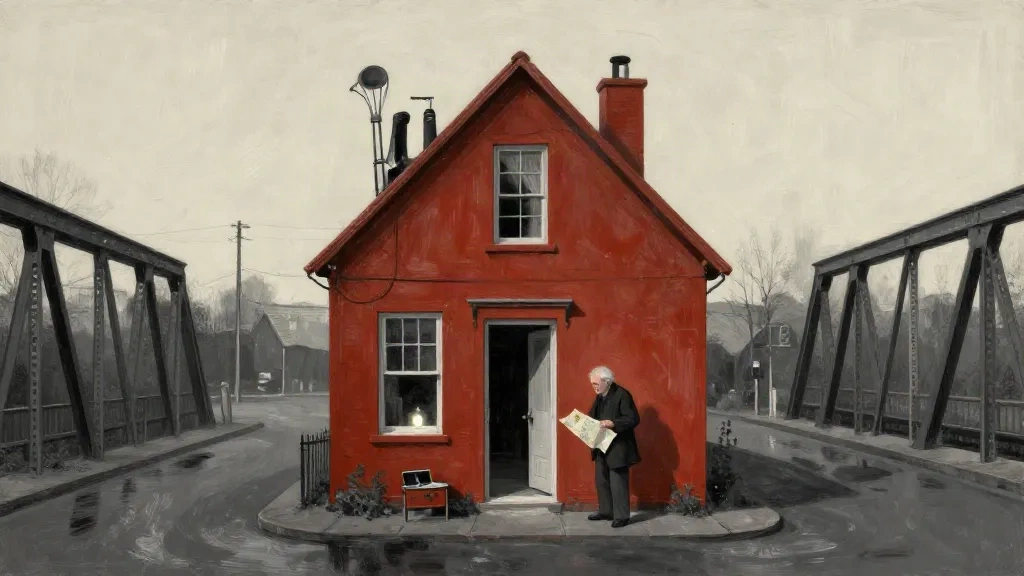
The house stood at the end of a lane that lengthened as Elias walked. Its front door was painted rust red. A music box sat on the step, playing four notes of a tune he had never heard.
When he opened the door, the house exhaled the smell of dust, cinnamon, and rain trapped behind walls.
“You came back,” said a woman in the hallway.
She had his face at twenty-five.
Elias looked at his shadow. It nodded.
“Grandmother,” he said.
“Don’t waste time.” The woman stepped aside. “The house is growing.”
As if answering her, a low knock came from inside the wall.
The hallway lengthened. A new doorway appeared behind a portrait of a man holding an empty cradle.
“You lied,” Elias said.
“I promised to wait.”
“You promised to tell me where you hid the room.”
“That depends on what you’re willing to admit.”
Elias looked again at the map. His grandmother’s mark had moved.
The Room That Was Never Left
He could return to any room he had ever left.
Childhood classrooms, hotel corridors, hospital waiting rooms, the narrow dressing rooms where other actors prepared their faces. When he stepped through the door, the past received him as if he had never gone.
He had entered Room 18 once as a boy, carrying a music box beneath his arm. His grandmother had made him play it for an audience of empty chairs. Then she had taken the box away and promised that one day it would open the room she had hidden.
“You said the room was behind the wardrobe,” Elias said.
The younger version of his grandmother smiled. “I said I would tell you its name when you returned.”
“You lied to the house.”
“I lied to my son.”
Another knock. Another doorway opened in the plaster.
Elias entered the nearest one.
It was the room he had left the night his grandmother died. A small bedroom stood in winter light. His younger self sat on the floor beneath an open window, holding the music box.
His shadow sat opposite him, older, with a face like folded leather.
“You promised me you would wait for me,” the shadow said.
“You were not me.”
“No. I was the part you left behind.”
Elias reached for the music box. The child’s fingers tightened.
Outside, the city’s citizens and shadows moved through streets that had doubled. A house of new rooms appeared at every intersection.
Keeping the Promise
Elias opened the music box.
The four notes repeated. On the third repetition, the bedroom wall became translucent, and behind it stood a narrow room filled with winter light.
Inside was a chair, a writing desk, and his grandmother sitting with her hands folded. She was not twenty-five. She was old, exact, and waiting.
“You kept the map,” she said.
“You asked me to.”
“I asked you to find me.”
“I came back.”
“That is not the same.”
The house groaned. A fresh doorway split the ceiling. Pale light spilled through it like snow.
Elias understood. Every lie added a room. Every room gave the house another direction to grow. The city could not hold it much longer.
“Tell me the name,” he said.
His grandmother looked at the music box.
“The room you made by leaving,” she said.
Elias placed the box in her hands.
“Then I’ll keep the promise I made to you: I will not return without bringing someone home.”
He stepped through the hidden room. The winter light closed around him. Behind him, his grandmother began to play.
In the morning, the house stood empty. Its walls were charcoal, its windows pale, and its door remained rust red.
No new rooms appeared. In the city, every citizen and every shadow turned toward the old lane, waiting for someone to come home.
Elias’s shadow walked ahead.
For once, it had not lied.





