 Netwrck
Hopeful Science Fiction.
The Keeper’s Last Performance
At sixty-eight, Elian Venn could return to any room he had ever left. Not in memory, which was unreliable, but with his shoes finding the same grit, the same draft, the same afternoon behind him.
He had used the gift only twice. Once to leave a theater before a producer called him washed up. Years later, he returned for a final bow nobody had seen.
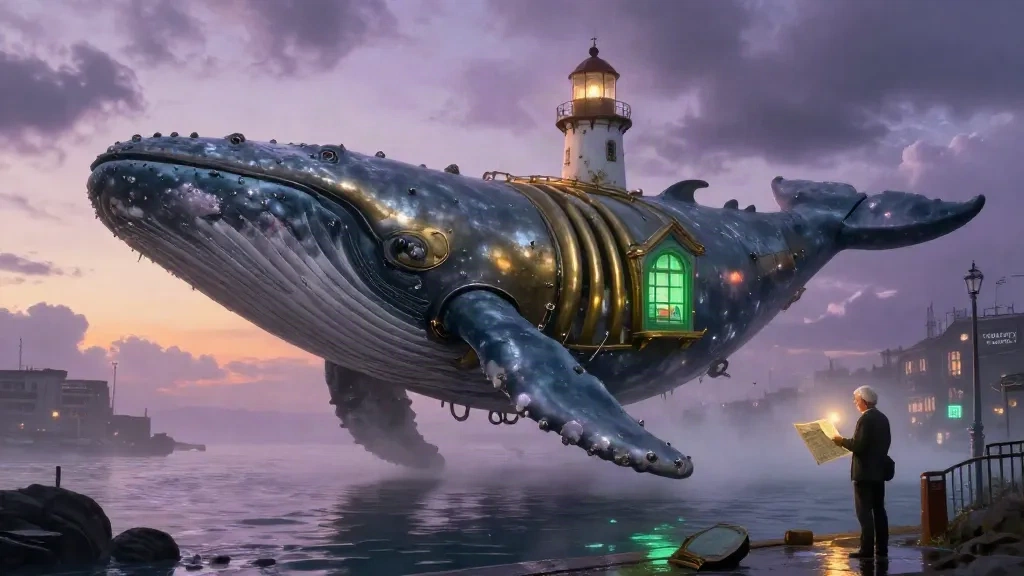
Now he kept the lantern atop Marrowlight, a lighthouse fastened to the back of a sleeping mechanical whale. The whale drifted above a flooded coastal city each spring, its vast ribs guiding it through weather, its small engines ticking beneath the floor like cooling stars. Below them lay wet asphalt, lavender weeds, and the green reflection of a pharmacy sign no longer attached to any wall.
Inside the lantern room waited the house: six rooms, crooked stairs, blue cupboards, and a music box whose silver key had been broken off in Elian’s hand. His daughter, Mara, had given it to him on her fourteenth birthday. That was the night he left the house for the last time.
Since then, it had grown a seventh room.
What the Walls Remembered
Elian unfolded Mara’s map across the kitchen table. Lavender paper, creased into a whale with one eye lifted toward the moon. She had drawn their route: from the theater district, through the old pharmacy, up the drowned hill, onto the whale’s back.
At the edge, in her careful hand, was a lighthouse. Beside it she had written: THE ROOM WE PROMISED.
When Elian was twenty-four, Mara had asked for a room of her own. He promised to build her one when he returned from touring. He returned years later with money, timber, and a speech rehearsed until every apology sounded noble. Then he entered the room she had prepared and looked for a reason to leave.
He was still leaving when she died.
On Elian’s eighty-first birthday, a nurse had asked where he was headed. He had said home. The sentence was false. He lived aboard Marrowlight.
That night the house groaned. A doorway opened beside the pantry. Beyond it waited a narrow bedroom painted the green of pharmacy crosses, with a bed made of folded maps and a window facing an ocean of open air.
On its door, someone had carved: NO MORE LIES.
The Room That Would Not Stay Still
Elian entered it. The room contracted, becoming a child’s bedroom with a paper boat on the sill. He stepped back, and it became an infirmary where Mara’s empty bed shone beneath green glass. He stepped forward, and beneath the ceiling, whale ribs bent inward like a closing cage.
“I came back,” he said.
Nothing stopped growing.
Behind him appeared a corridor crowded with doors. In one, two actors rehearsed lines beneath pink lights. In another, his producer offered him a contract. In the last, Mara sat at a desk sewing green cloth into curtains.
“You keep putting words where the truth should be,” she said, though he knew only the moonlight arranged her features.
Elian opened the music box. Its melody joined the walls’ ticking. The corridor went still.
“I was afraid you would not forgive me,” he said.
“I asked for a room, not a promise that you never disappointed me.”
Then a new corridor appeared between the first and second doors, blocking the past with its own future.
Elian understood the house at last. It had not punished him for leaving. It had been preserving the place left behind, adding a chamber for every impossible sentence by which he denied that place was real.
He began with the easy lies.
He said the theater had been full. A swallow moved through the rafters. He said the contract had required further travel. A window opened onto salt wind. He said he had forgotten. The house built a bathroom where forgotten things gathered in stopped bathtubs.
Then he told the difficult truth.
“I built your room. I left it empty. I returned too late. I kept leaving because your forgiveness would have meant I was forgiven too.”
The whale’s engines opened like enormous lungs.
A Door Facing Morning
Every false room vanished.
There was no punishment in this, no thunder. Only carpentry, patient and exact. The music box finished its final note. Warm daylight entered the pharmacy-green bedroom.
Elian crossed to the bedside table. The folded map was there, but older now, its whale drawn in charcoal. Mara sat beneath the window sewing a square of cloth. Not a ghost. Not a memory. A small new thing, alive enough to leave wrinkles across her fingers.
She did not say I forgive you. She had spent too much of her life making the world speak for her.
Instead, she held out a needle.
That spring, the whale carried Marrowlight above the city. Green pharmacy light moved across its plates while lavender clouds passed below. The lighthouse turned once, twice, then faced the dawn.
Elian left the house that evening. He locked the door behind him, though the house had already decided what it would become.
On the whale’s broad back, beneath the lantern, a bright window opened. No one made a speech. No one claimed the past had changed.
But the promise had changed shape at last: not a tower, and not forgiveness kept in reserve, but a room where two people could sit while the morning found them together.





