 Netwrck
Folk Horror.
The Book of Borrowed Houses
By morning, Shadow Street had two hundred and thirty-three doorways, though the city maps listed only two hundred and thirty-two. Every building cast a citizen-shaped shadow, and every citizen cast a building-shaped one. The postmen carried parcels in their silhouettes. The baker’s shadow wore a crown of chimneys. At night, when the lamps went blue with frost, the shadows went home.
Mara Venn was librarian of the South Stair Reading Room, a narrow place wedged between a tax office and a closed cinema. Its windows were always furred with ice, though winter had ended months ago. On the desk waited an empty teacup, its rim stained the color of old iron. Beside it lay a cracked bell, mute as a stone.
Mara’s desire was simple and therefore dangerous: she wanted a home that would accept impossible residents.
She did not mean a house with too many chimneys, though many had those. She meant the residents the city had agreed not to see: a woman whose shadow was a black door, a child accompanied by a second child-shaped absence, old men whose silhouettes had learned new trades. They came to Mara because she kept the book.
Every Borrower Saw a Different House
The book had no title. Its cover was soft leather, repaired with cyan thread. Whenever Mara opened it, the pages showed a house. Not a picture of one, but a house described so precisely that the reader could smell its damp walls and hear its loose floorboards.
She lent it first to Mr. Bell, who wanted a home for his shadow. The next morning the bell on her desk had cracked down its middle. Then she lent the book to Ilya, whose shadow had been mistaken for a blackbird and stolen by a cat. After that came Pell, a woman carrying a shadow that belonged to someone else.
Every borrower returned the book with a different house inside it. A lighthouse. A kitchen beneath a hill. A narrow room with a blue window and twelve shadows sleeping beneath the floor. Each one accepted impossible residents. None stood in Shadow Street.
“The city has plenty of houses,” Mara said.
“It has plenty of citizens,” Pell replied. “That is not the same.”
At 2:33 that night, the shadows rose from the street. They gathered beneath the reading-room window, their heads brushing the frozen glass. The empty teacup filled itself with darkness. The cracked bell gave a single iron note.
The Child Under the Stair
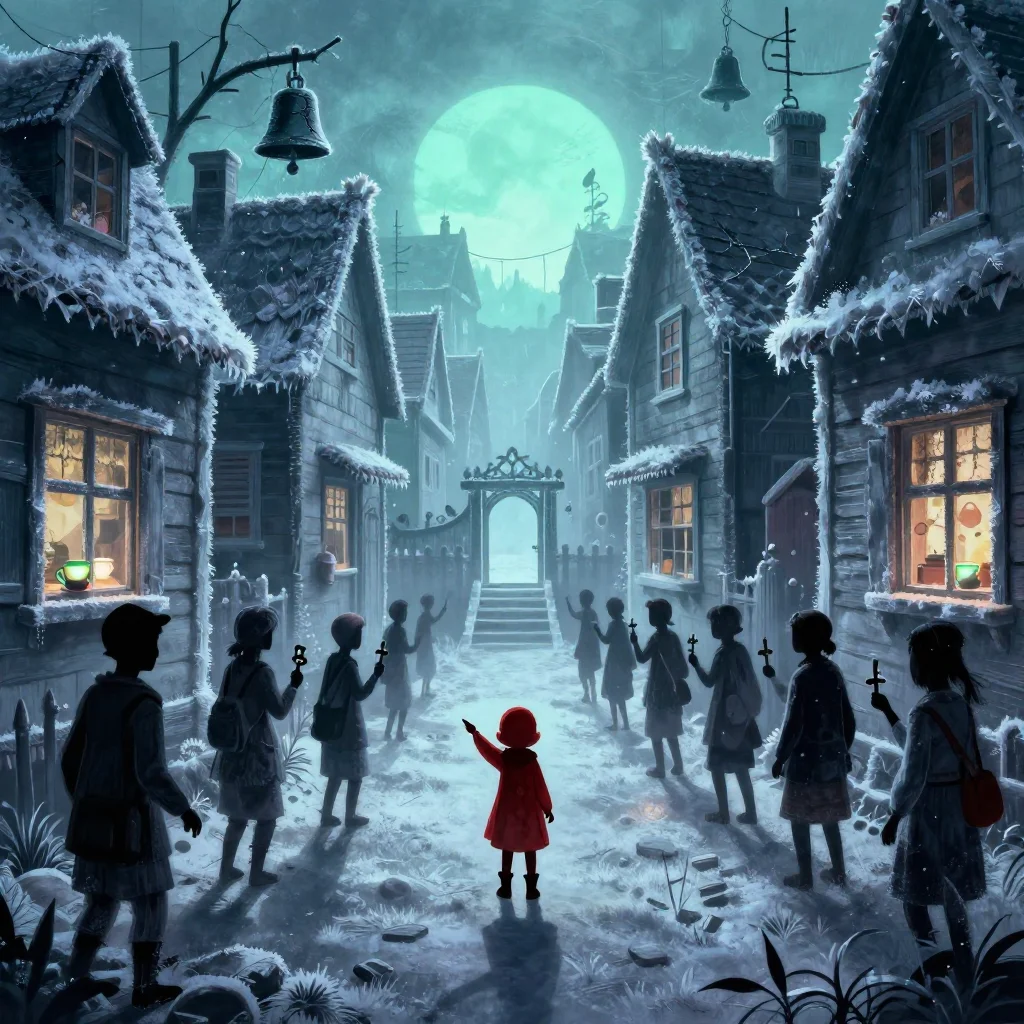
Among them stood a little girl in a red coat, perfectly visible. She had no shadow.
Everyone else overlooked her. Mara had not, until the girl raised one hand and pointed beneath the reading-room stairs.
“That is the thing,” the girl whispered.
Under the stairs was a crawlspace, narrow and forgotten. The city’s people had placed their agreed-not-to-see residents there for years. They crouched behind the beams: a crowd of silhouettes, each breathing frost. They had been keeping house for one another, but the walls were thin, the floor was wet, and the bell at the front door had cracked.
“The house is here,” the girl said. “It is just not allowed to be a house.”
Mara opened the book. This time the pages were blank except for one line: A home must be entered willingly.
She understood then. The city had not imprisoned the impossible residents. It had made their homes impossible to recognize. Every doorway led somewhere lawful; every window faced a street that insisted on containing only one shadow per person.
Mara rang the cracked bell. The note tore through the building.
A House That Counted Them
Every shadow in Shadow Street turned toward the sound. The shadows of chimneys detached themselves from their houses. Roofs, stairways, and crooked lampposts shuffled through the blue dawn.
The book grew warm in Mara’s hands. On its pages, the blank house was taking shape: not one building, but a network of rooms formed by every shadow that had chosen to shelter another.
“Go home,” Mara told the hidden residents. “But take someone with you.”
The child in the red coat held out her empty hand. Behind her, a small shadow stepped into being.
At dawn, the city looked ordinary. Except along Shadow Street, where each citizen had a different outline, and behind every door there was room for one more.





