 Netwrck
Folk Horror.
The Book With No Call Number
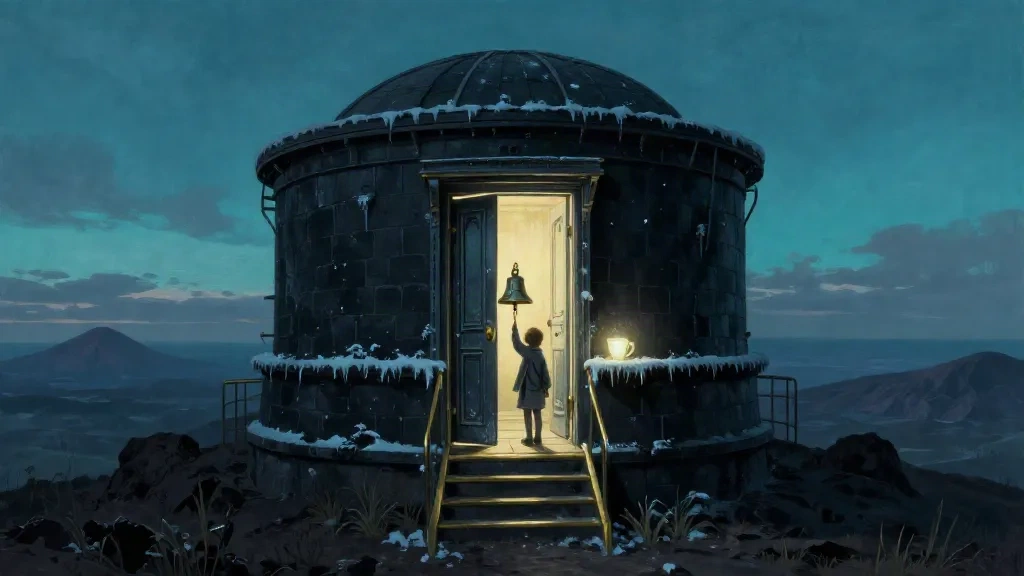
At the top of Mount Vael, inside a black dome built into a sleeping volcano, I kept a library with no windows and one door that opened only when the mountain was cold.
I was Mara, the librarian. I had measured every shelf, repaired every roof beam, and learned the names of the stones beneath the floor. What I wanted was simple, though no sensible person admitted to wanting it: a home that accepted impossible residents.
By impossible residents, I meant the people the villages below had decided were never quite born. A woman who remembered the year before her birth. A man with a shadow that slept beneath a different bed. A girl whose tears fell upward. Each had come to the observatory hoping for a room.
We had no rooms. We had the library, the observatory, and a narrow dormitory cut into the mountain’s flank. On my desk sat an empty teacup. It had belonged to the observatory’s first keeper, who disappeared before the winter he claimed to have seen. Beside it hung a cracked bell, bronze gone green at the fracture.
Every visitor who asked for shelter was shown the same book: a thin volume bound in black leather, titled The House That Learned to Breathe. Its pages showed different houses, each one built around a resident the world had rejected. When a visitor opened it, the house appeared within a mile of the mountain. They could stay there, safely, until they became ordinary.
That was the arrangement. I never asked what happened to the houses afterward.
The Child Under the Brass Stair
One night the volcano trembled, though the instruments said it was asleep. A child came through the door carrying the impossible book in both hands.
Her name was Nia. She was eight, or perhaps nine; impossible residents were often poor at chronology. Her coat was white with frost, though July had burned itself dry on the mountain.
“I brought it back,” she said.
I looked past her. The observatory’s brass stairway was empty.
“You found the book,” I said.
“No. The book was following me.” She pointed into the dark beneath the stairs. “The house is down there.”
I saw nothing. The others saw nothing. I had spent years learning to overlook the mountain’s arrangements, to treat them as cracks in the stone and not invitations.
Nia opened the book. The pages went white. On them appeared a house with our observatory roof and a door opening onto a street that did not exist in any valley.
“There,” she said. “Behind the wall.”
Then she reached into the space beneath the stair and pulled out a handful of blue ash.
The mountain had not been breathing. Something beneath it was holding its breath.
What the Mountain Agreed
We dug into the wall while the instruments screamed. Nia led. She could see the thing we had all agreed to overlook: a long iron corridor descending through the volcano, lined with doors.
Behind the first door, a man wept in a language no one spoke. Behind the second, a house shook with the sound of children who had never been born. Behind the third was a room where a dead woman kept setting two cups on a table, though only one guest ever arrived.
The empty teacup on my desk began to tremble.
Then the cracked bell rang.
Its sound came from below us, and the doors opened inward. Cold air rose through the corridor, smelling of iron and snow. Beyond them stood people who had come to the library and accepted a house, then vanished before the walls could hold them.
They were not dead. They were waiting for permission.
“You gave them books,” Nia whispered. “You gave them somewhere to pretend they belonged.”
I understood then. The book did not build homes. It taught impossible things how to hide. Every borrowed shelter required somebody to look away. I had looked away so carefully that I had become another locked door.
A Home With the Door Open
I took the bell in one hand and the teacup in the other. Nia opened the book to the last page, where a house waited without a picture.
There was no room in the library for everyone. There was, however, the corridor. We could make it ours.
So I wrote a new rule in the ledger and read it aloud beneath the cracked bell: no resident had to become ordinary; no door had to close behind them; every home would keep a place for the things that had been overlooked.
The volcano woke. Frost raced up the walls. Light, soft and cyan as an impossible dawn, poured from the deepest room.
One by one, the people stepped out. The woman remembered her first childhood. The man’s shadow found him. The upward-weeping girl laughed, and her tears floated into the cyan air.
Nia rang the bell.
This time it did not crack. The sound passed through the mountain and returned as a chord, welcoming everything the world had failed to name.
I still keep the empty teacup on my desk. Each morning, someone new pours into it. The tea disappears before noon, but the cup is never empty for long.
And when the weather turns frost against the dome, the door opens by itself.





