 Netwrck
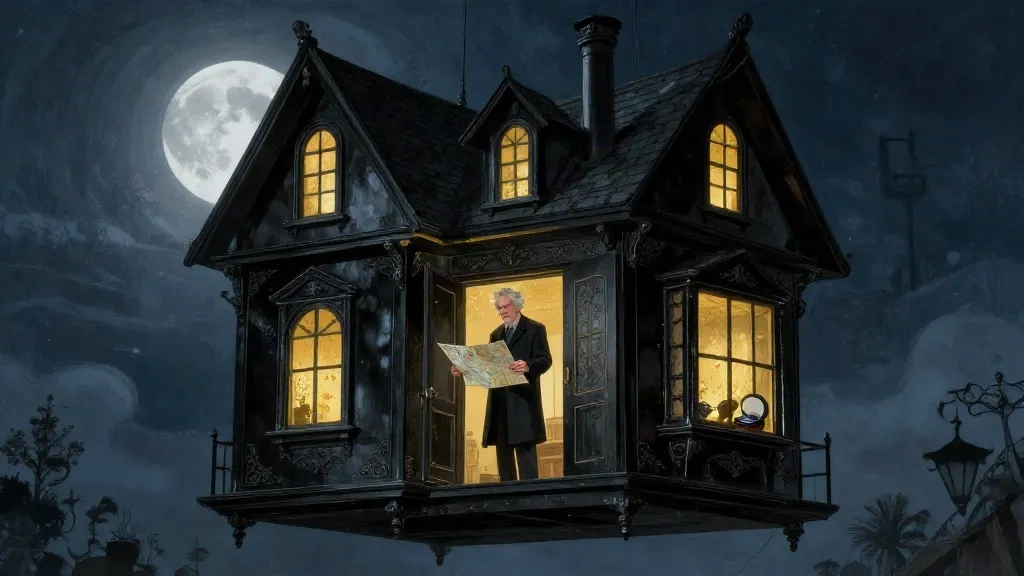
Fairy-Tale Fiction.
The Door No Street Reached
At midnight, the night market unfolded beneath the city’s first floor, where no official street had ever been built. Lanterns burned in black lacquer booths, their gold dust drifting over tables crowded with brass insects, bottled thunder, and keys that opened rooms no longer standing.
Silas Venn, retired actor and keeper of promises that survived their speakers, carried his grandmother’s folded map beneath his coat. The paper had softened with age, but its creases remained sharp. At its center, beneath a drawing of seven black doors, someone had written: Forgive the eighth.
He had promised his grandmother to deliver the map to the house she had described. She had made the promise on her deathbed, pressing the music box into his hands. Its single melody had stopped halfway whenever he tried to open its lid.
At the market’s far end, where moonlight lay cold and silver between stalls, the eighth door appeared. It was small, black, and set into a wall that should have been solid.
A House That Grows
Inside, the air smelled of dust, beeswax, and rain trapped beneath a roof. The house had no stairs, yet rooms opened one after another behind Silas.
A woman in a red coat knelt beside a cradle. “My child will be famous,” she told him.
The wall shuddered. A nursery appeared, its window filled with black lacquer and a ceiling crowded with golden stars.
Silas understood then. The house did not punish every lie. It gave lies somewhere to live.
In the kitchen, a boy confessed that he had stolen bread. No new room appeared. A narrow window opened onto a starless garden.
“Only false pride grows,” Silas murmured. “That was the rule.”
His grandmother had repeated those words whenever he complained about his performances. He had laughed then. Actors needed illusions. What use was a stage where truth was forbidden?
The folded map led him through a passage lined with doors. Behind one, he heard his own voice promising an audience he had never won. Behind another, his mother argued with a man who wore his face.
At the end of the passage stood a room with a black door. The music box began to play without being touched.
The Promise in the Floorboards
Inside, his grandmother sat beside a table covered in letters. She looked exactly as she had when he was a boy, except her hair was white and her hands were transparent.
“You came late,” she said.
“You died before the address changed.”
“I waited for a promise to be made, not for a map to be found.”
She showed him the final room hidden beneath the house: a theater with rows of empty seats and a stage made from moonlight. In its center stood a young woman in an actor’s costume, her face hidden behind a mask.
“My grandmother promised this room to the truth,” his grandmother said. “I promised it to the city.”
“You chose a lie.”
“I chose a promise I could not fulfill.”
The house groaned. A new wing burst through the outer walls, its windows glowing with gold. Somewhere above them, the night market’s vendors cried out as the ground shifted.
Silas unfolded the map. Every false room he had entered appeared as a black square. His grandmother’s theater was missing.
“You did not promise me the theater,” he said. “You promised me the music box.”
Her expression softened. “Then listen before you open it.”
The Eighth Door
He placed the box on the table. When he lifted the lid, the melody continued past its final note, filling the room with a tune his grandmother had hummed while ironing his shirts.
The masked woman on the stage spoke. “The city is built on a lie.”
“I know,” Silas said.
“Your grandmother promised the theater would remain a place where anyone could tell the truth.”
“And the city promised the theater would always be above ground.”
“Neither promise can survive beneath the market.”
Silas took the folded map and drew a line from the theater to the eighth door. The line passed through every false room.
“Then let the house grow,” he said. “Let it grow around the truth.”
He stepped onto the stage. Beneath the mask was his own face, younger and untired. He recognized the costume from his first performance.
“I kept your promise,” he told his grandmother. “I delivered the map.”
“You came to the wrong house.”
He opened the eighth door.
Cold moonlight poured through. Above them, the market’s lanterns went out one by one, leaving only the gold dust suspended in the air.
When the black lacquer house became still, it had not gained a room.
It had lost one.
Silas walked home with the music box open in his hands. The melody finished at last, and the folded map showed a street beneath the first floor where no city had ever built a road.





