 Netwrck
Folk Horror.
The Book of Returned Addresses
On the night the frost began, Mara found a black book on the reference desk, its cover cold as a spoon left outside. It had no title. When she opened it, the pages held a room.
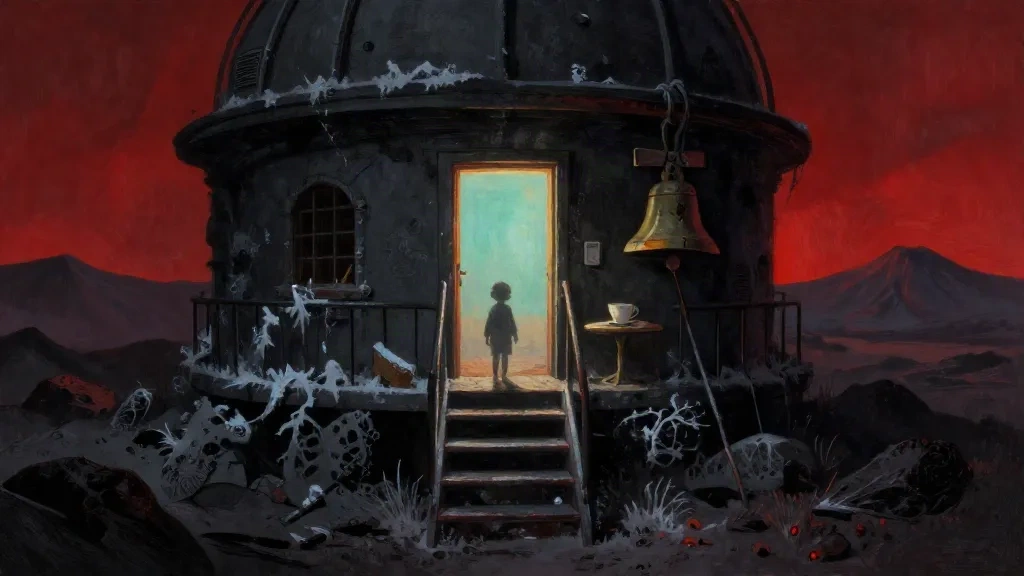
Not a drawing of a room. The actual room appeared behind the paper: a narrow hall, blue with dawn, a coat hanging from a hook, an empty teacup on the table. Beyond the window, a red field steamed beneath a sky that had never learned morning.
“Borrow this,” said the woman waiting at the desk.
“There is nothing written here.”
“There will be.”
The woman returned the book the following morning. Mara found another request waiting: a miner, a nun, a boy carrying a cracked bell. Each borrowed the same volume. Each returned it damp with thaw, though the mountain had not melted.
Mara’s office was below the observatory’s telescope chamber, where instruments hummed beneath iron ribs. The mountain slept around them, full of old pressure and warm stone. During the day she catalogued stars. At night she listened for doors in the walls.
She wanted a home that accepted impossible residents.
Her own room had one chair, a barred window, and a landlord who considered rain a personal insult. The observatory employed her because she could keep silence and correct footnotes. It did not ask what she had left behind.
So she began lending the black book whenever it appeared. She wrote no names in the circulation ledger. She asked only where the reader wished to return.
The Child Who Counted the Knocks
The child came in during an eruption of static. She was seven, wrapped in a coat too large for her, with a small bronze bell cracked from lip to crown.
“My mother says the book is empty,” she told Mara.
“Many people say that.”
“She says the house in it is empty.” The child touched the shelf without taking the volume. “But somebody is inside knocking.”
That night Mara heard it too: three knocks beneath the floor, then two, then a pause long enough to become intentional.
Through the observatory wall came the low growl of the volcano. Frost silvered the windowpanes. Cyan light seeped through the stone, an impossible dawn climbing upward from beneath the mountain.
The child opened the book. The room beyond the page was no longer empty. Something stood behind the teacup, keeping perfectly still. It had the outline of a person, though its head reached the ceiling and its hands were made of hinges.
The cracked bell began to ring without being touched.
Everyone else looked at Mara as if the child had interrupted the lesson. Even the thing in the book seemed to wait for her denial.
“You see it,” Mara said.
The child nodded. “You don’t.”
“I see a room.”
“No.” The child’s voice was quiet. “You see what we agreed to overlook.”
An Agreement With the Mountain
The observatory’s staff met in the dome beneath the telescope. They spoke of nothing, which was their oldest custom. Every sound had a classification. Every shadow had a measurement. A thing that was not recorded could not disturb the instruments.
Mara brought the black book. The thing in its room lifted one hinged hand and pointed behind the walls.
“It wants a home,” she said.
“Books do not want,” said the astronomer.
“Residents do.”
No one laughed. The cracked bell sounded once in the iron stairwell.
That morning they found the western door sealed by frost. Behind it was a staircase descending into warm stone, where the impossible dawn shone cyan and steady. Each step held a footprint. Some were human. Some were hoofed, clawed, or split into too many toes.
The child went first. Mara followed with the book. The teacup waited in the room at the bottom, still empty, though its rim shone with fresh tea.
“You can’t keep it,” the child said.
Mara understood. The tenant had been overlooked because every inhabitant had agreed that a house needs only one shape. A library with a librarian, a mountain with a telescope, a room with a door. The impossible had been forced to stand in the margins.
She wrote a new entry on the ledger. Not a name. A promise: all residents have rooms, all rooms are found, no one is agreed away.
The mountain shifted. Dust sifted from the dome. Across the observatory, every clock stopped at the same impossible minute.
A Door That Remembers
By dawn, the child had found a place beside the furnace. The cracked bell hung from the new stair rail, no longer cracked, though it still rang whenever a resident came home.
Visitors climbed from the valley. A woman with wet feathers. A man whose shadow had been given to someone else. Something with seven patient eyes. They asked for books, but Mara lent them keys.
The black book remained on the desk. Its pages held a hundred rooms, and in every room the teacup had been used. Tea steamed beside fresh cups. Shoes waited by the doors.
Then Mara understood what it was: not a catalogue of impossible homes, but a record of welcome.
She placed the book beside the ledger and opened both. The thing inside the pages had become small enough to fit between the lines. It carried the empty teacup in one hinged hand.
“Will you stay?” Mara asked.
“Only if the door stays open,” it said.
The child shook the bell. Across the mountain, one by one, hidden doors appeared in the frost.
Mara did not close the book again. The house she had wanted was not a room reserved for her. It was the house that made room.





