 Netwrck
Speculative Fiction.
Rows Through the Ruin
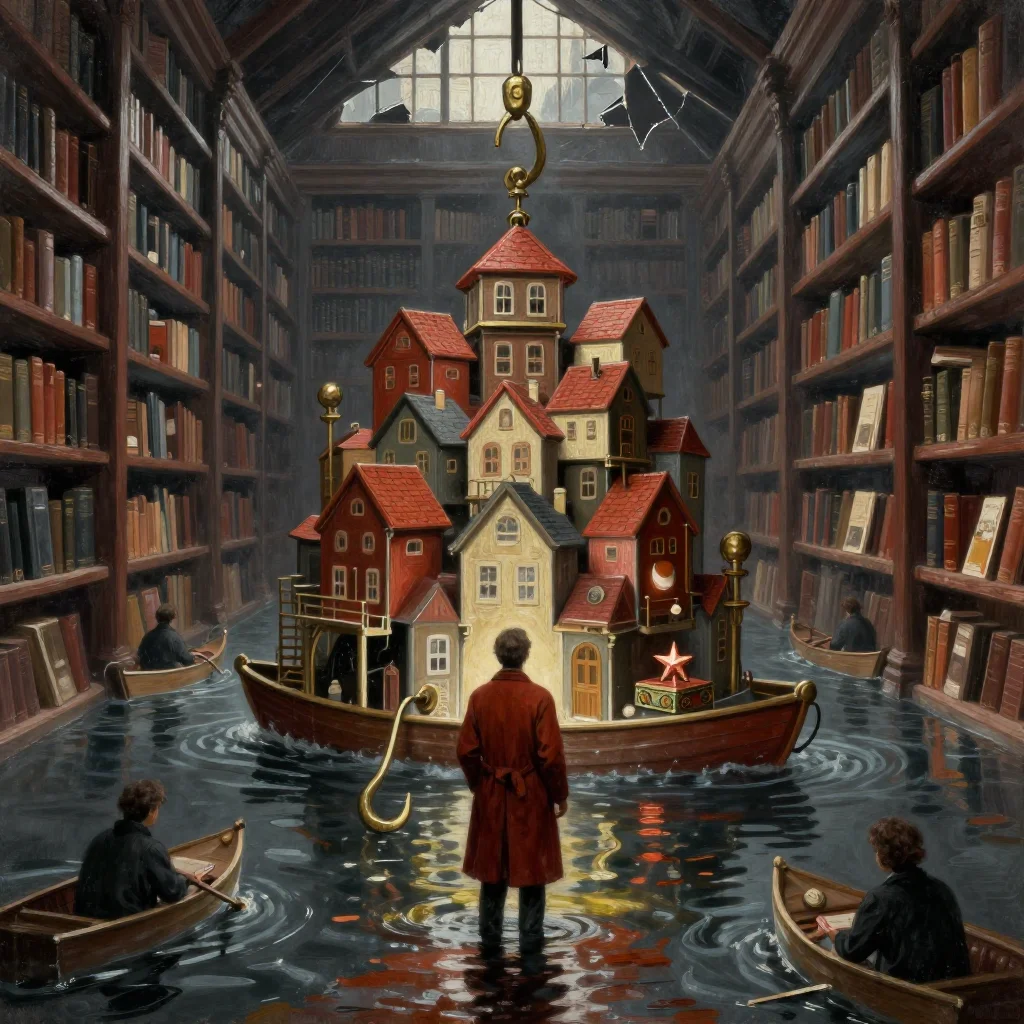
Dr. Ilyan Vey rowed beneath the shelves of the Central Archive, where the water had risen to the height of a seated child and turned every corridor into a drowned avenue. The librarians called the aisles lanes. They propelled themselves with brass hooks, slipping between shelves of tax ledgers, love letters, property deeds, and maps showing borders that no longer existed.
On the uppermost tier, where pale winter light entered through cracked clerestory windows, the archivists preserved the old air. Vey kept his office in a converted catalog room, with two beds, a coal stove, and a brass cabinet for instruments he did not use. He was a physician of houses.
“Homesickness,” he told his patients, “is not a misplaced body. It is a room that has started to breathe in your absence.”
His treatment was simple: find the absent room, name what had changed inside it, and open a way through. Sometimes the cure was a returned key. Sometimes it was a letter carried for eleven years across a country that no longer appeared on its stamps.
At dusk, beneath the music room, he heard the box again.
It played three notes, stopped, then began again. The melody belonged to no instrument Vey knew. Its tiny brass cylinder clicked in a rhythm like a heart learning patience.
On the desk lay the copper star he had recovered from the third-floor fire: a child’s ornament, blackened at one point, its surface still bright wherever a thumb had rubbed it.
The Project Beneath the Water
The machine appeared after the eastern levee failed.
Water poured through a breach in the old civic foundation and descended into a chamber the maps did not name. When the first archivist returned with a lantern, she found brass doors beneath the sediment. They were shaped like house fronts, each one engraved with a family name. A municipal seal above them read: DOMICILE CONTINUUM: PERMANENT RESIDENCE FOR EVERY CITIZEN.
The project had been concealed before the flood. Vey learned this from the surviving plans, their ink bleeding beneath wet vellum. The machine was intended to receive the memories of a household and reproduce them in a model home. Not photographs. Not recordings. A perfect arrangement of familiar odors, worn floorboards, unfinished sentences, and the precise angle of light through a kitchen window.
The architects called it a civic refuge. It could keep children from being sent away, preserve dead parents’ voices, and spare families the grief of moving. A resident needed only bring one object of importance. The machine would supply the rest.
Its inventor, however, had improved on refuge. A small wheel beneath each model permitted the machine to lock the surrounding walls once activated. A citizen could leave the memory house whenever he wished, but the house would retain his name, his habits, and a version of him that never aged. The city called this a guarantee of belonging. The plans called it continuum custody.
Vey stood before the brass doors while the librarians rowed behind him, their hooks tapping against the shelves. The music box sounded from inside.
He had brought the copper star because it belonged to Mara Ansel, a patient who had spent forty years trying to return to a house demolished before she was born. The star was the last object carried from it.
She stood beside him now, white-haired and steady, holding the star in her palm.
“It will make the house real,” she said.
“It will make a memory of the house convincing.”
“Memory is all I have.”
“Memory is not a lock.”
A Beautiful Prison
They entered through a narrow service passage. Inside, the machine occupied a chamber wider than the archive’s reading room. Its copper ribs rose to the ceiling, where they divided into thousands of small rooms, each containing a bed, a table, a window, and a figure made of pale wax. The figures wore the clothes of vanished decades. Some were laughing. Some were reaching toward doors that could not open.
The machine was beautiful in the way a well-kept mausoleum is beautiful. Every surface had been polished. No dust gathered on the false hearths. The false gardens bloomed under artificial seasons.
The inventor waited beside the controls, a dry man in a rust-red coat. He had escaped the flood by sealing himself inside.
“You misunderstand,” he said. “Pain is the only country that rejects its citizens. I offer a place where no one is forced to leave.”
Vey looked at the nearest room. A child’s shoes sat beneath the table. The window showed a field under summer rain, though the chamber lay beneath a winter sky.
“When does the person enter?”
“There is no entry. We have enough of them already.”
Vey placed the music box on the central console. He opened its lid. The three-note melody began, and the machine answered with hundreds of tiny bells.
Wax figures turned toward the sound.
The inventor smiled. “It recognizes what matters.”
“It recognizes what can be repeated.”
Vey took Mara’s copper star and placed it in the machine’s intake slot. The star was accepted. A house assembled around it: yellow wallpaper, a blue door, a kitchen smelling of onions, a child’s laughter from another room.
Mara stepped toward it.
Then Vey saw the walls begin to close.
He pulled the emergency lever. The machine screamed in a dozen voices. The house flickered, and for one instant he saw the real chamber through its walls: a room of valves, hoses, and clay jars collecting every detail that had ever been surrendered to the archive.
He understood the cost. The buried project had not been powered by electricity alone. It had been connected to the archive’s records, to the donated memories of thousands of citizens whose losses had been catalogued as recoverable. The flood had completed the circuit.
“Break the intake,” he said.
“That destroys the refuge,” the inventor replied.
Mara seized a brass hook from the nearest water boat. “It is already destroying the refuge.”
What the Water Kept
They broke the intake with the hook. The copper star shattered first, its bright pieces spinning into the machinery. The music box’s melody accelerated until the cylinder melted. Then the false houses began to collapse, one by one, their windows going dark.
The water rushed through the floor. The librarians rowed in from the shelves, hauling trunks and loose documents. People shouted names that had been filed under losses, clearances, and vacancies. Vey guided them through the passage, accepting hands at the archway.
The inventor remained beside the controls. His rust-red coat darkened at the hem. He claimed the machine was the only protection against permanent displacement. Vey told him that permanent protection was indistinguishable from permanent command.
At the final arch, the machine produced one last room. It was the house Mara remembered, and the blue door stood open. Beyond it, however, was not a field or a kitchen. It was the flooded archive, shelves rising from brown water, librarians rowing beneath winter light.
Mara took one step toward it.
“That is not my house,” she said.
She placed her hand over the broken star’s empty space, then turned toward the current.
They escaped as the ceiling opened. The archive settled by a foot, then another. The machine remained below, its copper ribs darkening, its beautiful rooms filling with silt.
The Direction of the Door
Months later, the water receded. The librarians rebuilt the upper walkways, but they left the lower lanes under a sheet of glass, visible from above. Visitors came to peer down at the drowned corridors. Children pointed out the brass hooks glinting like reeds.
Vey kept treating houses.
He no longer described homesickness as a room breathing in someone’s absence. He described it as the body remembering that it had once been allowed to choose a door. Sometimes the cure was gentle. Sometimes a patient left through the front hall while Vey pretended to check the weather.
Mara returned the copper star to him. One point had survived, polished by water into a tiny crescent. She kept the music box, though no melody came from it now.
“What should we call this chamber?” a young librarian asked, looking down through the glass.
Vey considered the submerged project: its homes, its locks, its thousands of rooms made to hold people in the exact shape of their longing.
“The flooded foundation,” he said.
He placed the crescent in the young librarian’s hand and pointed toward the doors. Beyond them, the city was damaged, rearranged, and impossible to recognize. It was also unfinished.
“Remember the direction of the door,” he said. “That is the part no machine can keep.”





