 Netwrck
Weird Fiction.
The Lending Room
At low tide, the shelves of the Ninety-Nine Library released a smell of salt, iron, and wet wool. Mara Venn polished the catalogue with her sleeve while the harbor withdrew beyond the salt-stained windows. Every tide brought the town back one forgotten object: a mitten from an abandoned winter, a key polished smooth by a vanished palm, a child’s shoe whose owner everyone remembered but no one could name.
The returned things went into the Lost Property Room. The lost books went to Mara.
For seven years she had lent the same book to different people. It had no title on its spine. Its pages were blank until a borrower opened it at the moment of greatest need. Then the ink appeared: a map drawn in saffron yellow, a recipe for swallowing thunder, instructions for opening a door in a wall that had never existed.
Each reader returned it changed. One woman found a house for her sister, who had become a flock of sparrows. An old fisherman read until his drowned wife came home with salt in her hair. A doctor discovered the correct name for the fever stealing the village’s memories.
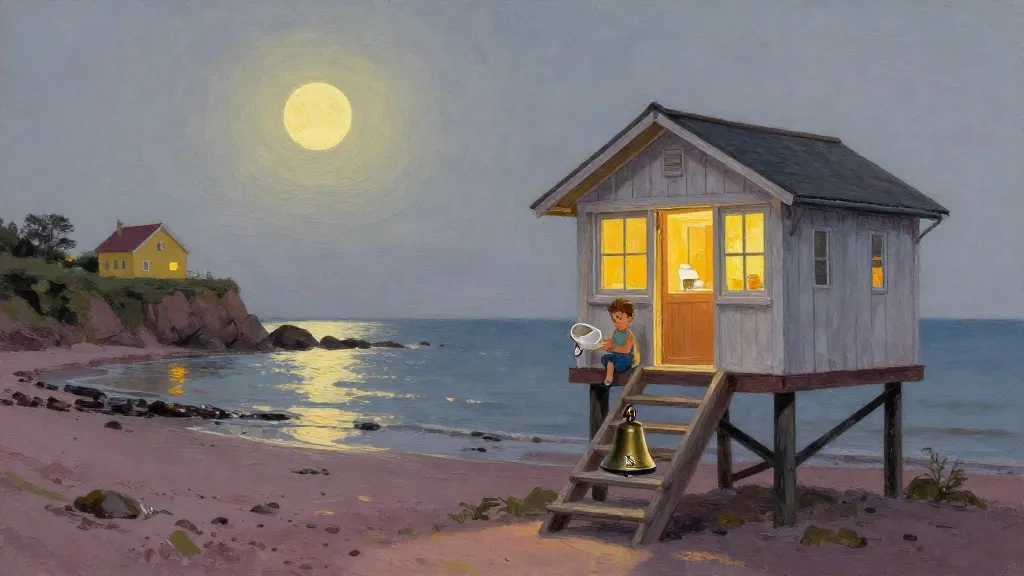
Mara kept the book beneath her desk beside an empty teacup that had arrived with the first tide she remembered. The cup was white china, delicate at the rim, bottomless. Every time she poured tea into it, the tea vanished. Beside it sat a cracked bell from the town’s vanished fire tower, mute except after midnight.
What the Child Would Not Forget
On the ninth day of November, a girl named Oren came in with a list written on a receipt.
“People borrow impossible things,” she said. “I borrow the people.”
She pointed beneath the library, toward the row of cottages climbing the cliff. Smoke-grey air pressed against the windows. Beyond it, Mara saw the yellow house at ninety-seven tides, shuttered since the night the sea took its inhabitants without leaving a single footprint.
“There is a resident there,” Oren said. “You can’t see him because everyone agreed not to.”
Mara looked at the girl. The empty teacup trembled on the desk.
“What does he look like?”
“Like being left behind.”
That evening, Oren returned the impossible book. A new page had appeared. Mara read the first line in handwriting she recognized as her own: Every home begins by deciding who does not belong.
She sought the yellow house before dawn. The street was slick with black seaweed. Doors opened as she passed, revealing rooms occupied by unfinished sentences, lost dogs, a woman made of fog, and a man sitting alone at a table, sewing a torn shadow onto his coat.
At ninety-seven tides, the door was warm.
When Mara knocked, the cracked bell inside the house rang once. The man beneath it looked up. He had Mara’s face, older by a hundred years.
A Census of the Unaccounted
“You cannot take me back,” he said. “That is the whole trouble.”
Mara held out the book. Its pages filled with names, most crossed out. The surviving names belonged to people the town had edited from its records: a bell-maker who had become weather, seven children born with feathers, a dog fluent in prophecy, and the house itself.
“I have been looking for a home,” she said. “One that accepts impossible residents.”
The old man laughed softly. Behind him, the shadows moved independently, taking seats around the table.
“Most people call that a city,” he said. “A city is only a large argument about who gets to stay.”
At sunrise, Oren arrived carrying the empty teacup. The library’s cup had vanished from Mara’s desk, and now the girl held it carefully in both hands.
“It brought something back,” Oren said.
Mara looked into the cup. At its bottom lay a tiny room, complete with a desk, two chairs, and a window facing the sea. The room overlooked the library’s lending desk. Inside stood a librarian made entirely of smoke.
She understood. The cup did not swallow tea. It carried rooms between the forgotten and the found. Someone had lent her this possibility years ago, before she had learned to keep impossible books in the wrong place.
The Door Left Open
Mara placed the cup between the old man and the fire. The room in its bottom brightened. The smoke librarian looked up and raised one hand.
“You have been trying to find a home,” the smoke librarian said, “because you believe home is where we are finally recognized.”
“Isn’t it?”
“It is where recognition is not required.”
Mara opened the book. For the first time, no new words appeared. Instead, every crossed-out name lifted from the page and settled around the room. The weather took a chair. The dog became a rug. The seven feathered children filled the windows with the sound of wings.
Oren wrote a new list. The old man mended the bell. Mara carried the book into the house and placed it on the table.
At the next low tide, the sea returned one forgotten object: a small brass key. It was warm from the inside.
No one claimed it. No one decided what it opened. This, Mara understood, was not failure. It was how the door remained open.





