 Netwrck
Weird Fiction.
The Book of Previous Borrowers
By day, Orra’s library occupied the saffron wall above Mirren Stair, between a pawnbroker selling repaired umbrellas and a customs office painted deep plum. At night, when the river turned at midnight, its reading room wandered to whichever bank agreed to forget the other.
On the desk waited an empty teacup, a cracked bell, and a book bound in grey calfskin. The book had no title. Whoever opened it found their own name written on the borrower’s page.
Orra had lent it to a beekeeper, a ferryman, a woman carrying seven locked birdscages, and a man who claimed he returned it the same night. Each promised to bring it back before the river changed direction. None did.
Her desire was plain enough to confess to the cracked bell: she wanted a home where impossible residents were allowed to remain. Her rooms contained too many borrowed coats, a staircase that occasionally descended into the sea, and a neighbor who had been a weather vane for ninety years. The town tolerated these arrangements because tolerance was cheaper than registration.
What the Child Would Not Forget
On the evening the river turned, a girl named Pell arrived while rain flattened the saffron banners against their poles. She was perhaps nine, wrapped in smoke-grey wool, with river silt polished beneath her nails.
“I saw your house,” she said.
“I live in the library.”
“Not the library. The other one.”
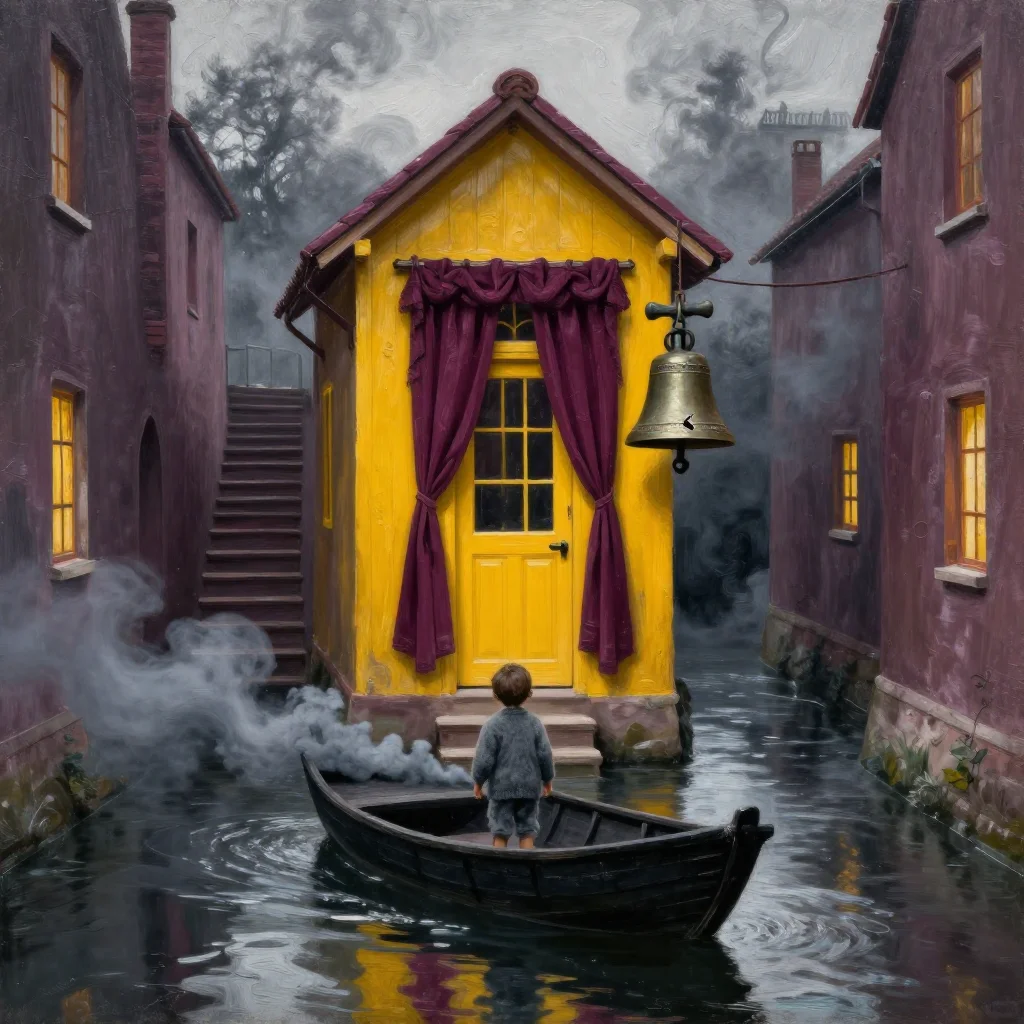
She pointed through the western window. Across the black water stood a narrow house with Orra’s yellow door, plum curtains, and smoke pouring from its chimney. Orra had seen that house only in winter, reflected in the river before midnight. Now it stood on dry land.
Pell opened the grey book. Her name appeared beneath six others, each name crossed out with a red thread.
“They agreed not to see it,” the child said. “The people inside. After the turn, the town decided the house wasn’t there. But it was.”
Orra rang the cracked bell. Its note failed, becoming the dry clink of a teaspoon in the empty teacup. On the far bank, every window of the yellow house darkened.
Then someone inside struck the glass from within.
The Agreement at the Waterline
They crossed in a boat tethered to a streetlamp. The current ran uphill beneath them, carrying leaves toward the sea. Orra rowed while Pell held the grey book shut against her chest.
“If I look directly,” the child said, “it disappears. When everyone looks away, the stairs appear.”
The town’s magistrate, customs clerk, and bell keeper waited at the landing. Each carried a copy of the same municipal ledger. Across its first page was written: THERE IS NO YELLOW HOUSE ON THE EASTERN BANK.
“Read it with us,” the magistrate said, “and your crossing is lawful.”
Orra understood then. The house had not vanished because the river abandoned it. It had vanished because everyone agreed. Agreement was the brick that excluded it from the map.
“And the people inside?” Orra asked.
The clerk lowered his eyes. “The law admits no such occupants.”
“The law was written by people who did not want them.”
“That is how law acquires a proper constituency.”
Behind them, the river reversed. Its brown crest struck the hull and spun the boat toward the distant yellow house. The customs clerk dropped the ledger. In the instant no one watched, a pale stair appeared from the water, climbing to Orra’s door.
A Census of the Unregistered
Orra rang the cracked bell again. This time, below the broken note, the bell sounded intact.
Doors opened throughout the house. A woman descended carrying a motionless thundercloud. Behind her came six transparent guests, a doorway, a tooth, and a child made entirely of river reflections. They waited on the landing, shivering in smoke-grey air.
Pell counted them. The count was one hundred ninety-two.
“Is that enough?” she asked.
“Enough for what?”
“To make them real.”
Orra turned the grey book over. A new page had appeared, headed REGISTERED RESIDENTS, PERMANENTLY IMPOSSIBLE. She wrote the yellow house’s address in the first square.
Then she gave the book to Pell.
“A library belongs to whoever can read it,” Orra said. “You can see what this town has agreed away. Find the others who can.”
The magistrate objected. Orra tore the false sentence from his ledger and laid the strip over the pages of THE HOUSE ACROSS THE TURNING RIVER.
At midnight, the river turned. The water pulled west, but the house remained.
Its door stayed unlocked. The empty teacup filled with saffron tea. The bell, newly mended, rang once from inside—and across the river, every hidden window answered.





