 Netwrck
Romance.
The hour without footsteps
Mara Vale had been told never to search for shadows. They were citizens, the city said: every citizen had one, and every shadow answered to a name. She had lived by that rule until the letter arrived, written in her mother’s uneven hand.
Keep the brass key. Cross Alder Forest before the city remembers you were there.
Her mother had vanished three winters ago, halfway through a journey no map admitted to. Mara had found the letter tucked inside an old ranger’s satchel, beneath a smooth little moon of pale stone. The key was warm against her palm. The stone was cold enough to ache.
At the forest gate, the city’s shadows stretched toward her like reaching hands. Mara raised the stone. They withdrew.
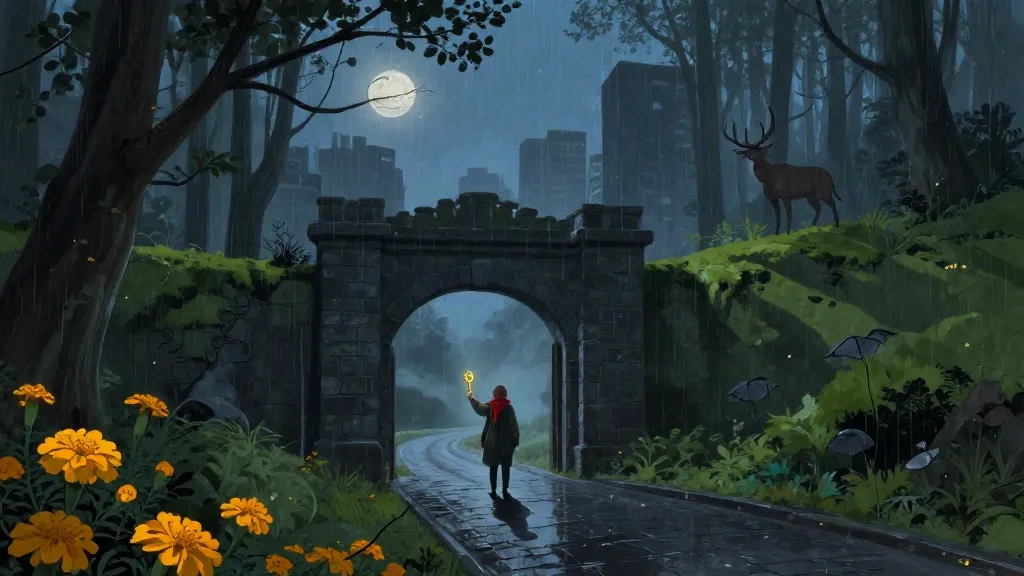
Alder Forest had been evacuated from time. Not destroyed, not abandoned: removed, carefully, along with the roads that led there. Inside its boundary, oaks stood in wet stone silence. Birdsong stopped whenever Mara took a step. The farther she walked, the more the forest seemed to be waiting for her.
Precise creatures
The curfew arrived before dusk.
It came as a low chime beneath the ground and a ring of pale footprints around the ranger’s cabin. The prints were not human. Each ended in five narrow points, like the edges of a star.
“You are early,” said the creature from the roof.
It stood in the shape of a deer, except its antlers were straight as rulers and its eyes contained no pupils. Its fur was the green of moss after rain.
“The forest is empty,” Mara said.
“The forest is precise.” The creature stepped down without making a sound. “At the ninth hour, no living thing may cross the western stream. At the tenth, no memory may cross back.”
“That sounds like a rule.”
“It is a protection.”
It showed her a small brass plate in its mouth. The number eight was stamped into it. Mara looked at the sky. The light had begun to lean toward evening.
“My mother crossed the stream.”
“Your mother was not precise.”
“She disappeared.”
“Disappearance,” said the creature, “is not always an accident.”
Then it opened the cabin door and pointed inside. On the table lay a bowl of rain, a map drawn in black thread, and a pair of gloves lined with moss green.
“The path continues at dawn,” the creature said. “If you value your life.”
The road that bent
Mara slept for six minutes.
In them, her mother crossed the western stream carrying a small moon beneath one arm. She did not look back. At the far bank, the forest opened onto a city where the shadows walked ahead of their owners, holding hands.
Before dawn, Mara crossed the stream.
The water was only ankle-deep, but it carried the weight of years. Her mother’s name rose in her throat. The brass key warmed against her palm, and the little moon pulsed once.
Beyond the water stood a road paved in wet stone. Marigold flowers burned in narrow cracks along its edge, bright as warning flares. The road curved, doubled back, and curved again. Her mother’s footprints continued across it, perfectly preserved.
Mara followed.
At the final bend she found the ranger waiting.
He was alive. Older than she remembered, with silver at his temples and her mother’s red scarf knotted around his neck. Mara’s first thought was that he had let her mother vanish. Her second was that he had followed her all the way.
“You took your time,” he said.
“You took hers.”
He looked away.
“The road does not permit rescue. It permits accompaniment.”
“That sounds like something you rehearsed.”
“It sounds like the truth, which is usually rehearsed by the living.”
He held out his hand. On his palm rested another little moon, identical to Mara’s.
What the key opened
“The key opens a door,” he said. “Not here.”
He pointed toward the marigold flowers. Beneath them, Mara saw a narrow iron archway hidden in the roots of an oak. The brass key fit the lock, though she had never seen the lock before.
“My mother is behind this?”
“Your mother is beside it.”
Mara looked at the ranger.
“We crossed together,” he said. “The city took her shadow. I kept hers.”
He drew the red scarf free. Inside it lay a scrap of darkness shaped like a woman, trembling at the edges.
The forest went silent.
Then, beyond the roots, a shadow rose to meet them.
Mara held the little moon in one hand and the key in the other. The archway opened onto warm light, wet stone underfoot, and a road leading home.
“Choose,” the creature said from the darkness.
Mara took the ranger’s hand. He took her mother’s shadow in his.
The key turned. The door closed behind them.
In the city, at dawn, two citizens stepped into the same shadow. The old ranger began to laugh. The woman began to cry. And Mara, ranger of a forest that had forgotten time, finally finished the journey.





