 Netwrck
Magical Realism.
The Weather Ledger
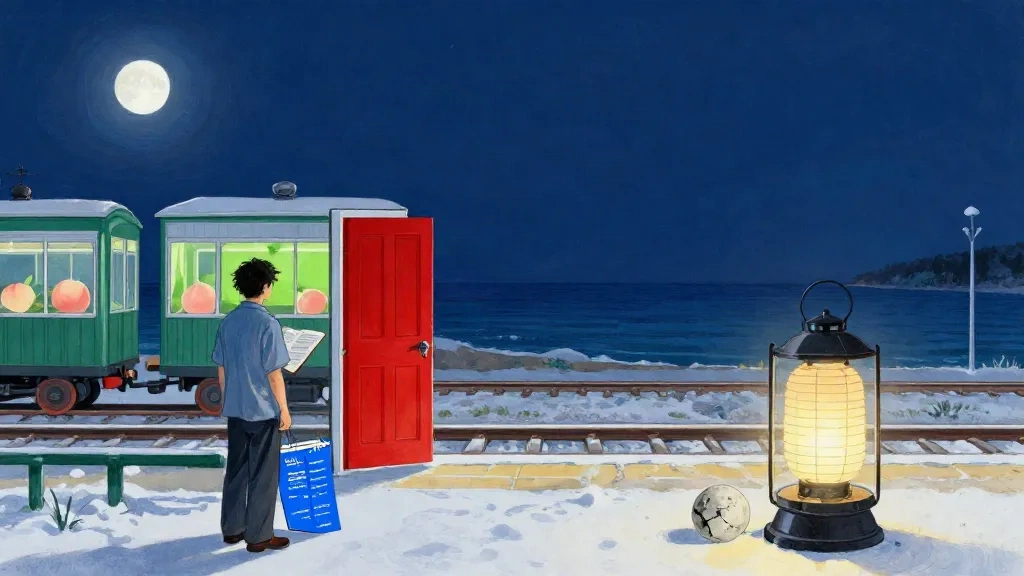
On the coldest night at Vey Station, the platforms shone with a winter that had never quite arrived. Frost silvered the iron rails, though the departure board promised April, mango season, and a thunderstorm in November. Passengers waited beside numbered carriages, each holding another season behind its glass door.
Among them worked Elian Voss, keeper of the Vey lighthouse and unofficial cataloguer of impossible weather. Though the lighthouse stood three valleys away, its beam crossed the station at midnight, measuring winds that blew from places without maps. Elian recorded each one in a narrow blue ledger: rain falling upward from the Harrow Sea; snow carrying the scent of cut grass; hail that struck like applause.
At his hip hung a small moon in a glass cage. It gave off pearl light and waxed and waned with the passing of seasons. In his coat pocket he carried a paper lantern, folded flat, its red character still visible through the creases. He used both to find what the station tried to hide.
A Rule Against the Possible
The stationmaster arrived with frost in his eyebrows and a municipal ordinance pressed beneath one arm. The code prohibited every impossible thing within the borough, including unauthorized weather, unlicensed moons, and doors opening onto seasons not yet approved by the council.
“Technically,” said the stationmaster, “the impossible is illegal.”
Elian looked past him. On Platform Six, a woman named Iria was folding her coat for a carriage marked JULY. She had crossed the station from the red door at the far end of the winter line, speaking of a city where her son had vanished years ago. She remembered the color of his kite, the song he hummed while bathing, and the exact moment he stepped through a summer door.
But each person she asked had begun to forget the city. Its name had slipped from newspapers, maps, and family stories. Iria carried the last living memory of it, and at midnight the whole place would be officially nothing.
The stationmaster lowered his ordinance. “No record of the city exists. No map. No birth certificate for the boy. If you save her from forgetting, you will prove an unregistered world. That is a punishable act.”
Elian closed the weather ledger. “And if the world forgets her?”
“Then there will be nothing to punish.”
The Door That Opened Backward
They crossed the winter platform as the moon dimmed. A single red door stood between the last carriage and the snowfall, its paint bright as a wound. Elian unfolded the paper lantern. The character remember glowed on its paper ribs, and the red door answered with a lock.
Inside was summer. Cicadas sang beneath a copper sky. A narrow street climbed between whitewashed houses toward the coast, and every window was open. A boy sat on the steps of a blue house, tying a red kite to a nail.
Iria called his name.
He looked up. For one moment, recognition crossed his face. Then a wind moved through the street, carrying the smell of salt and distance. He bent to his kite and forgot her.
Elian stepped forward. “The city has no legal existence.”
“Then write one,” Iria said.
He opened the ledger. Beneath the entry for hail, he drew a line and began to name the city. At once, the station shook. Snow surged through the red doorway. The small moon cracked across its middle, flooding the platform with pearl light.
On Platform Six, passengers turned toward the sound, then away. The ordinance trembled in the stationmaster’s hands. One by one, lamps along the winter line began to darken as forgotten places hurried out of season.
The Name That Held
Elian wrote until ink cut his fingers. The city’s name rose from the page in white fire and settled over the rooftops. The boy looked up again. This time he remembered the woman at the door, then the house behind him, then the ocean.
“Mara?” he said.
“Yes,” Iria whispered.
The red door slammed. The station became silent. On Platform Six, the carriage marked JULY shone with sun instead of snow. A clerk in a black coat stepped forward, clutching a fresh ordinance stamped VOID.
The stationmaster read it once, then tore it in half. “Impossible,” he said.
“Yes,” Elian replied. “But not technical.”
At dawn, Iria and the boy boarded the summer carriage. Elian entered the crossing in his ledger: red door, summer beyond winter, one family remembered. The small moon remained cracked, but the paper lantern held its flame.
Spring found the station before winter could reclaim it. The platforms smelled of wet earth and distant oranges, and beneath the departure board, someone had chalked a new rule:
Before a place is forgotten, it must be found.





