 Netwrck
Weird Fiction.
The Bicycle Door
Every morning, the monastery of clockmakers unfolded its rooms in the wrong order. The bakery appeared behind the chapel. The well rose in the attic. By noon, the cloister had become a narrow blue corridor smelling of hot brass and rain.
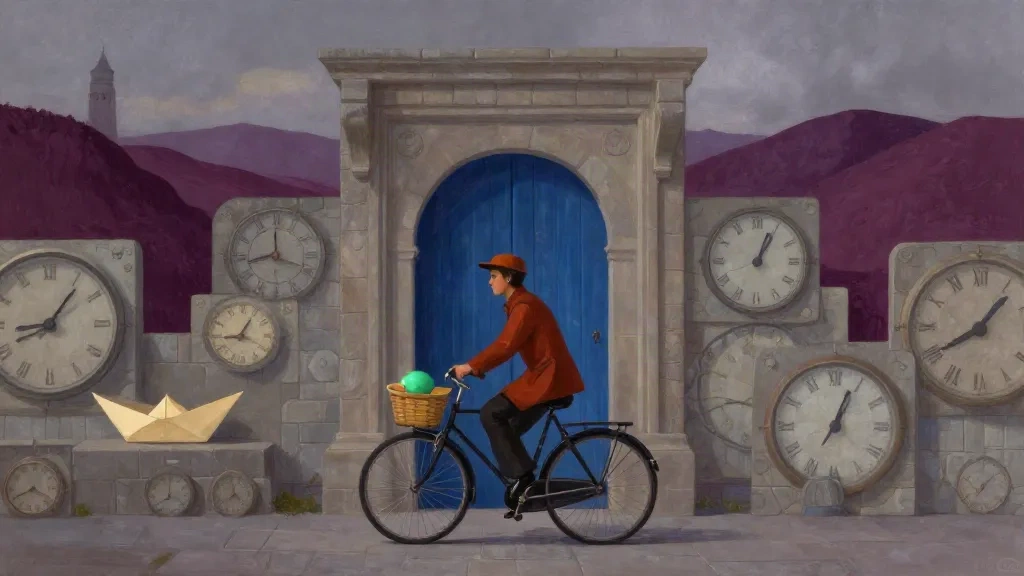
Ilan arrived with a bicycle painted the color of dried saffron. Its wheels had no tires, only smooth black rims that clicked over stone. At his waist hung a green stone, polished by his thumb, and from the rear basket leaned a paper boat with its bow folded toward the future.
He was a courier. That was the only profession the country still respected, though no one agreed what couriers delivered. The roads changed names overnight. Villages sent letters to towns that had vanished. Time arrived late, early, or not at all.
At the monastery gate, a door stood shut inside the wall. Ilan lifted his bicycle. The door opened.
Beyond it waited a bell tower filled with sleeping clocks. Their faces showed different hours: some displayed tomorrow, some showed the year the first rain had failed, and one had no hands at all.
Letters With No Sender
Ilan spread a route ledger across the workbench. Its final entry read: To the future. Awaiting explanation.
He had ridden for eleven days, crossing provinces by slipping through kitchen cupboards and bedroom walls. At every stop, the same question had followed him: why had the future stopped sending letters?
The abbess met him beneath the tower. She was old enough to remember when noon was measured by shadows and young enough to have forgotten which shadow belonged to which tree.
“The letters are not lost,” she said. “They are being withheld.”
She placed a treaty on the table. Its parchment was thin as smoke, covered in signatures pressed in faded purple. The oldest clause bound every clockmaker to keep one hour unfastened. The newest bound the land to listen whenever that hour arrived.
“Legal permission,” the abbess said, tapping the final line. “The land may hear what time is trying to hide.”
Ilan touched the page. A deep hum entered the bicycle frame.
The Land Listens
At midnight, every clock in the monastery began to run backward. The abbess led Ilan outside. Smoke-grey air pressed against the saffron walls, and the plum-colored hills rolled toward the monastery without moving.
They placed the green stone in the road. Ilan set the paper boat beside it and poured clock oil into the folded hull. The boat floated upright.
Then the land listened.
Voices rose from beneath them. Orders from armies, declarations of marriage, the first sentences of books that had not yet been written. Between them came a thin, persistent ticking.
“The future is afraid,” said the abbess.
“Afraid of what?”
“Being heard.”
Ilan understood. Tomorrow had not stopped writing because it had run out of stories. It had stopped because every letter traveled through the same narrow channel, and someone had sealed the channel with a promise made centuries ago.
The treaty had not merely allowed the land to listen. It had taught the land to keep every secret entrusted to it.
Tomorrow’s Unsent Address
Ilan took the paper boat into his hands. The ticking grew louder. Above the monastery, a blank moon appeared in the plum sky, its surface pocked with tiny sealed doors.
“Can a letter be delivered to a silence?” he asked.
The abbess smiled without warmth. “Only if the courier carries an address.”
He unfolded the boat. Inside its paper hull was a blank sheet, warm as a hand. He wrote nothing. The green stone cracked, releasing a green spark that landed on the page and burned a small address into it.
The future had sent no letters because it had nowhere left to return to.
Ilan placed the blank page into the boat and released it into the listening air. The boat rose through the monastery roof, through the blank moon, and vanished.
Every clock stopped. For one unrepeatable instant, the country possessed no time at all.
Then, from somewhere beyond the horizon, came the sound of a bicycle bell. Once. Twice. Three times.
The abbess looked at Ilan. “You have answered it.”
“No,” he said, watching the saffron wall acquire a narrow blue door. “I have only opened the return path.”
He mounted his bicycle and rode toward the sound, carrying the green stone’s last fragment and a paper boat emptied of its secret.
The Door in the Morning
At dawn, the monastery had lost its clocks. The rooms stood in their proper order, and the country’s first shadow pointed east.
Ilan’s bicycle rolled through a closed door at the edge of the world. Beyond it, a road descended through plum hills beneath smoke-grey air. Along the road stood thousands of unopened gates.
At the nearest gate, a letter waited.
Its seal bore the saffron sun. Its paper smelled of rain and clean metal. Ilan took it without reading the address. He placed it inside the bicycle basket, beside the paper boat, and began the long ride toward whoever had finally found the courage to write tomorrow.





