 Netwrck
Magical Realism.
The Unreliable Country
At the edge of Bellwether, the monastery of clockmakers stood behind walls that leaned gently toward the west, as if even stone had lost confidence in morning. Beyond them lay a country without reliable time. Dawn might arrive before the previous night, harvest might happen in January, and letters sent on Monday sometimes reached their writers after their own funerals.
The monks kept clocks nevertheless. They swept dust from copper gears, polished pearl-white enamel faces, and wound mechanisms with brass keys. Every noon they sounded a cracked bell to announce the hour. Its note was not entirely clear. Some heard a summons; others heard an apology.
Into this uncertain country came Mara Venn, municipal gardener of neglected courtyards. She carried no title, only a leather bag of seeds wrapped in letters. Each seed contained a story: a sailor waiting for winter, a baker remembering rain, a girl who traded her shadow for a blue horse. Mara planted them where nobody looked.
Her newest story had belonged to the Duvell family. It concerned a child who sheltered beneath the monastery staircase during an earthquake. The child was not famous, wealthy, or heroic. But the child had given away every crust in a pocket and sung until the stones stopped moving.
“It is not much of a story,” Mara told the almoner when she requested it.
“It is enough for a courtyard,” he replied.
She chose the abandoned cloister west of the monastery, where fig roots had lifted the flagstones and rain stood in silver bowls. There she planted the Duvell story beneath a dead peach tree. The next morning, a narrow brick appeared where no brick had been, and three old people were sleeping beneath its tile roof.
“A shelter,” Mara whispered.
The almoner looked frightened. “A shelter for whom?”
“For strangers,” Mara said.
The Machine of Useful Doubt
Her work required belief, though only practical belief. A path needed feet. A roof needed rain. A story needed someone to enter it before it could shelter them. But the courtyard refuge remained empty.
Travelers saw the brick wall and stepped around it. The almoner showed them the door, and they smiled politely, then found urgent business elsewhere. Even the monks crossed the cloister quickly.
In the clock cellar, Mara found a machine built for no purpose she could understand. Its brass casing was warm. A single glass window displayed a small room: one table, two chairs, and a lamp burning without fuel. Beneath it, engraved words read:
THIS MACHINE OPENS ONLY WHILE NOBODY BELIEVES IT CAN.
“Then nobody should be present,” said Brother Ansel, who had followed her below.
“Then who turns the handle?”
He pointed to Mara’s key ring. “Someone who is willing to fail.”
She found the brass key that opened the abandoned courtyard’s gate, though she had not known such a gate existed. It was cold, notched at the bow, and warm along its teeth.
At sunset, Mara inserted it. A gear turned under her palm. The machine produced a cough of dust and a harsh metallic knock. Above, a bell began to ring.
The Night the Door Refused
Every monk in the monastery believed the machine. The first believed it would fail. The second believed it would explode. The third believed it was stealing the hours from their clocks. Their certainty traveled through the monastery like sparks in dry grass.
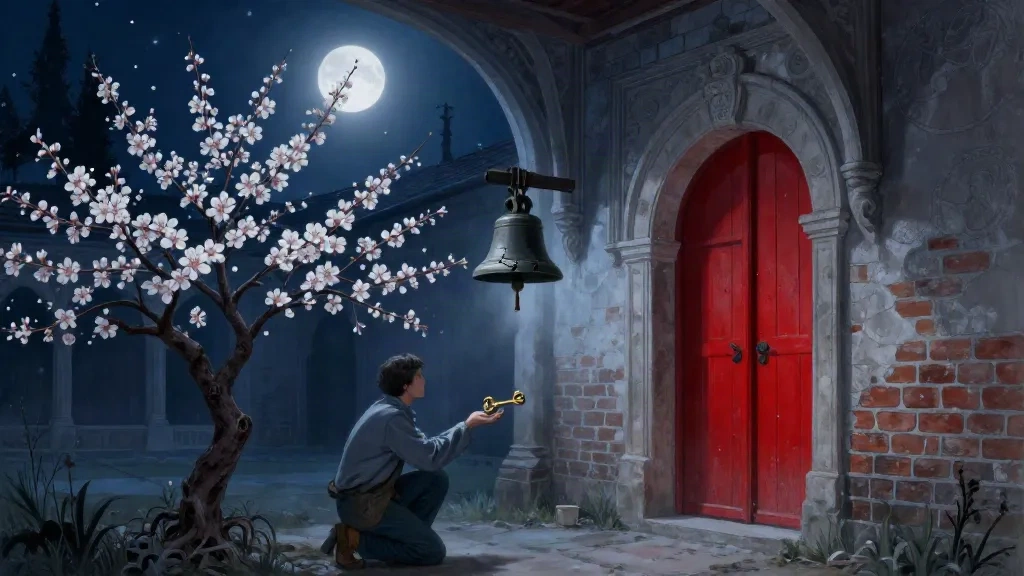
The cracked bell swung wildly. Its clear fragment and blunt fragment struck the night in turn, making one impossible hour after another. In the cloister, the peach tree shook. The hidden door appeared halfway through the brick wall, a red door with no handle.
Brother Ansel hurried toward it.
“I believe it can open,” he called. “That is enough to spoil it.”
The door lengthened into a crack. The shelter behind it vanished.
Mara understood. The machine could not be trusted by anyone. It could only be used by someone who continued despite expecting failure. She turned the key again.
“You have been outside all day,” Ansel said. “You cannot make yourself disbelieve.”
“Then I will wait until I can.”
They sat beneath the dead tree. A fox inspected the red crack. Dripped water became a black glass bead, reflected once, and vanished. Mara recited the Duvell story without changing it. The earthquake, the staircase, the empty pockets, the song that held the stones still. She did not say the child was brave. She did not say the story deserved a roof.
At some hour that no clock recorded, Ansel said, “I still believe the machine will fail.”
“Good,” said Mara. “Keep believing that.”
A Shelter for Strangers
Before dawn, a woman carrying an empty sack asked for water. Behind her came a boy with a broken sandal, then an old man who claimed to have forgotten where he lived. None recognized the courtyard. None trusted it. They followed the sound of the cracked bell because it sounded, Mara understood, less like a summons than a direction.
Brother Ansel turned the brass key. The machine opened its glass window. Inside, the lamp illuminated three places at the table.
The red door swung inward. Rain entered. The peach tree bloomed white in a single breath.
Mara stood aside and let the strangers enter. The Duvell child had once given bread to frightened people. Now the story returned that gift, without condition, without promise that they would become a family.
At noon, the bell cracked completely. Nobody heard it. In the monastery, every clock stopped at a different minute.
Mara kept no key thereafter. But each winter, when travelers argued about what day it was, the red door appeared in another neglected courtyard. It opened only after someone admitted they did not know where they belonged.
That was not belief. It was only a place to begin.





